
SIGNATURE CLINICAL CASE · GLOBAL PROTECTIVE STATE
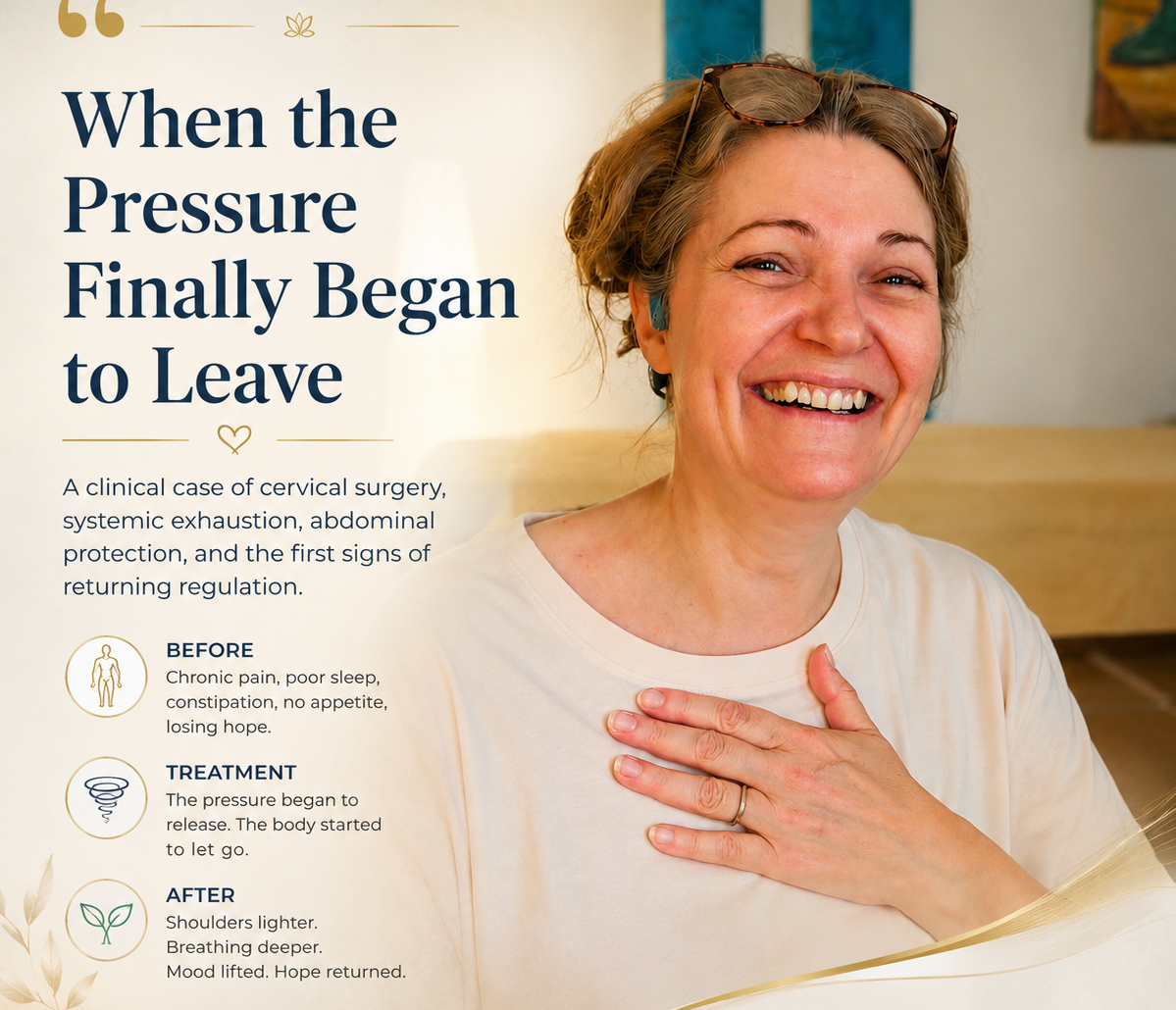
When the Pressure Finally Began to Leave
A clinical case of cervical surgery, systemic exhaustion, abdominal protection, and the first signs of returning regulation.
The pressure began to release.
The body started to let go.
CLINICAL OPENING
It was not only her neck
Two years after cervical surgery, she was once again being advised to consider another operation.
Pain travelled through the right side of her body — from the neck into the forearm, from the low back into the abdomen and leg.
Her sleep had deteriorated. Constipation had become chronic. She rarely felt hungry and often ate only once a day. For six months, she described feeling hopeless about life.
At first glance, the neck seemed to be the problem. But the body was telling a much larger story.
INITIAL SYSTEM STATE
A body carrying pressure in every direction
Physical presentation
She presented with a history of cervical surgery, persistent neck tension, right forearm symptoms, right sacral pain, abdominal tension, and right-sided leg discomfort.
Systemic presentation
Poor sleep, constipation, reduced appetite, intermittent swelling, emotional exhaustion, and loss of hope suggested that the body was no longer simply compensating — it was protecting.
PATTERN ATLAS
The clinical map behind the symptoms
Global Protective State
The entire system appeared organized around protection rather than free adaptation.
System Exhaustion
Poor sleep, reduced appetite, emotional fatigue, and diminished resilience suggested depleted regulatory capacity.
Upper Exit Block
Cervical surgery history, shoulder pressure, and right forearm symptoms reflected persistent restriction around the upper regulatory corridor.
Abdominal Pressure
The abdomen appeared guarded and compressed, limiting breathing transmission and pressure regulation.
Pelvic Protection
Right sacral tension and lower-limb symptoms suggested a deeper protective strategy involving the pelvic system.
Right Compensation Loop
Symptoms travelled through a continuous right-sided chain connecting pelvis, abdomen, thorax, neck, and arm.
BEFORE & AFTER CLINICAL ATLAS
What became visible before and after treatment
Before
- Forward head posture
- Elevated shoulder tension
- Thoracic restriction
- Abdominal guarding
- Protective stance
- Visible fatigue
- Reduced facial brightness
After
- Softer facial expression
- More spontaneous smiling
- Reduced shoulder load
- Breathing visibly deeper
- More relaxed presence
- Emotional state improved
- Hope returned
Not the pain. The pressure.
ENTRY STRATEGY
The goal was not to chase the neck
Rather than focusing on the cervical region as an isolated structure, the treatment strategy was oriented toward reducing global system pressure.
The clinical priority was to restore regulation before pursuing symptom elimination.
Reduce upper-body pressure and shoulder load.
Support breathing descent and thoraco-abdominal release.
Observe systemic regulation markers before judging local pain response.
CLINICAL TURNING POINT
“The pressure came down.”
“The pressure in my body came down. The shoulders felt lighter. My breathing descended. My mood immediately felt better.”
This became the turning point of the session. The first visible change was not measured through local pain reduction, but through the body’s return to regulation.
WHAT BECAME VISIBLE
The first signs of returning regulation
Shoulders
The shoulder load softened and felt lighter.
Breathing
Breathing descended and became deeper.
Expression
The face became brighter and more open.
Mood
The emotional state shifted immediately.
Hope
A sense of possibility returned.
CLINICAL REFLECTION
Sometimes hope is a physiological event
For six months, the patient had felt increasingly disconnected from recovery. Yet within a single session, before major symptom changes occurred, the body demonstrated something important: regulation was still available.
When pressure decreases, breathing returns. When breathing returns, the body begins to reorganize.
Sometimes the first sign of recovery is not less pain. It is the return of possibility.
KEY LEARNING POINTS
What this case teaches
Persistent pain after surgery
Pain after surgery may reflect ongoing protection rather than unresolved structure alone.
Local symptoms may reveal global patterns
The neck, forearm, abdomen, sacrum, and emotional state were not separate problems, but connected expressions of system pressure.
Regulation may appear before pain relief
Breathing, shoulder release, facial expression, and mood can shift before pain fully changes.
Hope can be observed clinically
A softer face, deeper breath, and spontaneous smile may reveal that the system is no longer trapped in the same protective state.
CONNECTED CLINICAL MAP
From global protection to local symptoms
Global Protective State
The body remains organized around vigilance, protection, and survival.
System Exhaustion
Sleep, appetite, mood, and resilience begin to decline.
Upper Exit Block
The cervical-thoracic outlet carries pressure into the neck and arm.
Abdominal Pressure
The center becomes guarded, restricting breathing and internal flow.
Pelvic Protection
The sacral and pelvic system holds lower-body tension.
Right Compensation Loop
The symptoms travel through a right-sided chain from pelvis to arm.
RELATED CONDITIONS
Where this case may connect
RELATED CASES
Other cases where the system begins to release
When the Body No Longer Felt Divided
A case of trigger finger, upper-limb tension, abdominal pressure, and deeper system regulation.
When the Abdomen Finally Let Go
A case showing how abdominal guarding, pelvic load, breathing, and walking may shift together.
When Breathing Becomes Quiet
A clinical moment where the body shifted from external tension to internal quiet.
CONTINUE LEARNING
Learn to read the body as a system
Fasciapuncture® does not begin by chasing symptoms. It begins by reading how the body organizes pressure, protection, breathing, and regulation.
Global Protective State
Understand how long-term protection can shape pain, posture, digestion, sleep, and emotional state.
Clinical Map
Explore the relationship between conditions, patterns, and clinical cases.
Fasciapuncture® Training
Learn the clinical reasoning framework behind fascia-based acupuncture.