FASCIAPUNCTURE® SIGNATURE CLINICAL CASE
When the Body Found Both Feet Again
A patient returned with a right leg that drifted outward, an abdomen that felt impossible to control, and a gait that had become profoundly unstable. Within one session, breathing slowed, support reorganized, and walking became visibly steadier.
My two feet are pushing together.
CLINICAL OPENING
“My right leg no longer wants to work.”
I had first seen this patient in 2024 for vertigo. After three sessions, the vertigo had improved, and the patient later returned with a very different complaint.
The right leg no longer seemed to participate normally in walking. As the patient stepped forward, the leg drifted outward without conscious intention, and the gait appeared markedly unstable.
The patient also described a strong loss of control through the centre of the body:
“My abdomen sticks out like a balloon. I have no way to control it.”
The presentation did not look like an isolated leg problem. The abdomen, pelvis, spinal axis, breathing pattern, and lower-limb support appeared to be participating in the same global organization.
INITIAL SYSTEM STATE
The leg was moving, but the body was no longer trusting it as support.
Main complaint
The right leg drifted outward during walking, creating a profound feeling of instability and reduced control.
Abdominal expression
The abdomen projected forward and felt unavailable to voluntary control, as though the centre of the body could no longer organize support.
Postural expression
Walking appeared disconnected between the trunk, pelvis, and lower limbs. The right side did not integrate smoothly into forward movement.
Facial expression
At the beginning of the session, the face appeared flat and distant. The eyes showed little engagement, as though the person was present but not fully connected to the body.
CLINICAL READING
The body had not simply lost control of one leg. It had lost coordination between its centre and its supports.
The outward movement of the right leg could not be understood only by observing the leg itself.
The abdominal projection suggested that the centre was no longer participating efficiently in pressure regulation, breathing, pelvic organization, and weight transfer.
Cervical and posterior-chain tension also appeared relevant. When the head, spine, abdomen, pelvis, and feet do not coordinate, the body may attempt to remain upright through compensation rather than through balanced support.
Clinical principle
The visible symptom was in the right leg, but the functional disturbance appeared to involve the entire vertical axis.
PATTERN ATLAS
A disconnected centre, an unstable pelvis, and unequal lower-body support.
Core Block
The abdomen appeared unable to participate naturally in breathing, pressure regulation, and postural support. The patient experienced the centre as projected forward and beyond voluntary control.
Pelvic Lock
The pelvis did not appear to transfer weight evenly between the trunk and the legs, contributing to asymmetrical support during walking.
Cross Compensation Loop
The outward movement of the right leg appeared connected to compensatory organization through the opposite side of the pelvis and the spinal axis.
Posterior Compression
Cervical and posterior-chain tension may have limited the body’s ability to transmit movement smoothly from the head and spine toward the pelvis and feet.
ENTRY STRATEGY
The session began at the centre, not at the leg.
Abdominal acupuncture was used first, with the needles retained for approximately twenty minutes. The aim was to offer the body a quieter regulatory entry point before addressing the visible gait disturbance.
As the abdomen began to soften, the patient reported a comfortable sensation of movement spreading through the whole body.
Breathing gradually slowed. Exhalation became more audible and complete, followed by several spontaneous sighs.
The cervical region and posterior spinal chain were then treated to reduce the restrictions organizing the body from above and behind.
The left side of the pelvic and iliac region was gently addressed as part of the cross-body compensation influencing the unstable right leg.
This second phase also lasted approximately twenty minutes. The patient was then invited to stand and walk again.
REGULATORY RESPONSE
The first change appeared in the breath. The second appeared in the eyes.
Breathing slowed
The initially guarded breathing pattern became calmer, with longer exhalations and spontaneous sighing.
The body felt connected
During abdominal needle retention, the patient described a comfortable sense of movement spreading throughout the body.
The face became present
The expression changed from flat and distant to more animated and responsive. The eyes became brighter and more engaged.
A smile appeared
As the body became calmer and walking felt safer, the patient began to smile spontaneously.
BEFORE & AFTER CLINICAL ATLAS
The change was visible in walking, breathing, and presence.
Before
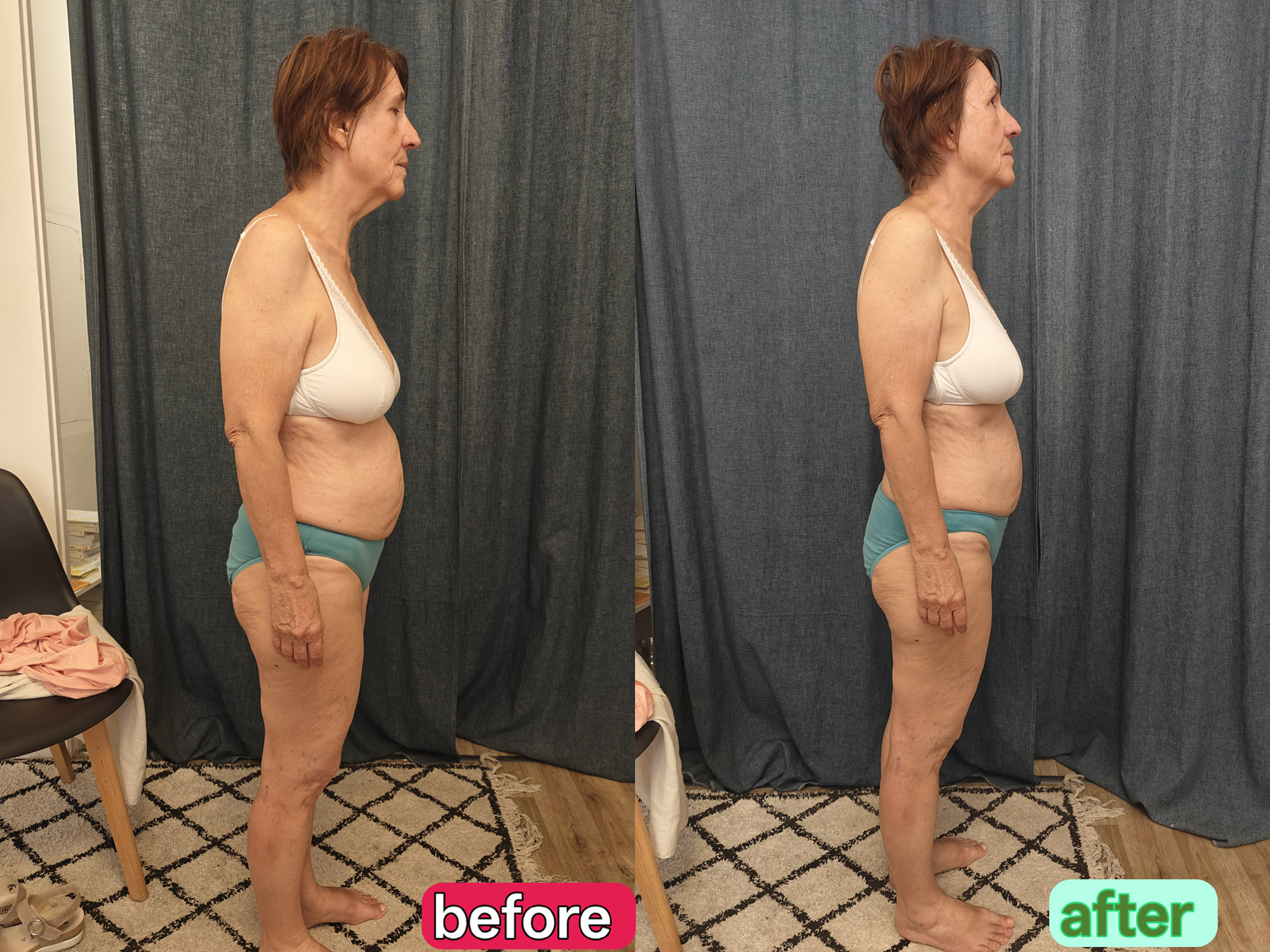
The right leg drifted outward, walking was profoundly unstable, the abdomen projected forward, breathing remained restricted, and the facial expression appeared distant.
After the session
Walking appeared markedly steadier. The right leg no longer moved outward in the same visible way, and weight transfer through both feet appeared more coordinated.
What changed first?
The body did not immediately demonstrate change by talking about the leg. It first demonstrated change through slower breathing, fuller exhalation, spontaneous sighing, and renewed facial expression.
CLINICAL TURNING POINT
“My two feet are pushing together.”
When the patient stood up and walked again, the gait was visibly more stable.
The right leg no longer drifted outward with the same involuntary movement, and the patient appeared able to transfer weight through both sides more evenly.
Rather than describing the change anatomically, the patient expressed it through a simple bodily sensation:
“My two feet are pushing together.”
The statement captured the central change of the session. The body had regained the experience of having two available supports.
WHAT BECAME VISIBLE
Stability returned together with presence.
The right leg stayed closer to the axis
The previous outward drift was no longer clearly visible during the immediate post-session walk.
Weight transfer became more even
Both feet appeared to participate more coherently in standing and walking.
The eyes became engaged
The patient’s gaze shifted from distant and expressionless to alert, responsive, and present.
Social connection returned
The patient smiled and began speaking about bringing the spouse for a future appointment.
CLINICAL REFLECTION
The body did not simply regain a leg. It regained a relationship between centre and support.
It would be too narrow to interpret this session only as a local change in the right leg.
The clinical sequence suggested a broader reorganization. The abdomen softened first. Breathing slowed. Exhalation became easier. Cervical and posterior restrictions were addressed. Pelvic support was then approached through the opposite side.
Only after these changes did the patient stand and demonstrate a more stable gait.
The return of facial expression was equally important. A body that feels profoundly unstable may devote much of its available attention to protection and control. As support became more available, the person also appeared to become more present.
Fasciapuncture® reflection
Sometimes the leg is not asking to be corrected. It is waiting for the centre, pelvis, spine, and nervous system to include it again.
KEY LEARNING POINTS
What this case teaches.
Do not begin where the symptom is loudest.
A visible leg disturbance may be organized through the abdomen, spinal axis, pelvis, breathing, and opposite-side support.
Breathing is part of the assessment.
Slower respiration, longer exhalation, and spontaneous sighing may indicate that the system is becoming less guarded.
Observe the face as well as the gait.
Changes in gaze, expression, responsiveness, and spontaneous smiling can accompany meaningful changes in bodily regulation.
Support is a whole-body experience.
Two functioning legs do not automatically create the felt experience of having two reliable supports. That experience depends on global coordination.
CONNECTED CLINICAL MAP
Related patterns in the Fasciapuncture® Clinical Map.
Core Block
The abdominal centre loses its ability to coordinate pressure, breathing, posture, and movement.
Pelvic Lock
The pelvis becomes less available for balanced weight transfer between the trunk and lower limbs.
Cross Compensation Loop
One side of the body compensates for instability or restriction occurring through the opposite side.
Posterior Compression
Cervical, thoracic, lumbar, and posterior fascial tension restrict vertical transmission.
RELATED CONDITIONS
Presentations that may involve a larger postural and regulatory pattern.
RELATED CASES
Other cases of support, movement, and system reorganization.
CLINICAL NOTE
An immediate observation, not a universal prediction.
This page describes the clinical observations made during one individual session. It does not establish a diagnosis, prove structural correction, or predict that another person with similar symptoms will respond in the same way.
New or progressive weakness, loss of balance, altered walking, or loss of control in one limb should also receive appropriate medical assessment.
CONTINUE LEARNING
From isolated symptoms to whole-body clinical reasoning.
Module 1 · Foundations
Learn how Fasciapuncture® reads protection, pressure, support, and regulatory organization.
Module 2 · Clinical Assessment
Observe breathing, gait, abdominal organization, pelvic support, spinal tension, and facial expression.
Explore the Clinical Map
Follow the relationships between patterns, body regions, compensations, and real clinical cases.