
When observation is not enough.
You have learned how to see the body. Now you begin to understand why it behaves this way.
Pain is not the problem. It is the expression of a system that can no longer adapt.
Level 3 is part of the full Fasciapuncture® training pathway
This level deepens the mechanistic understanding of pain, fascial dysfunction, sensory amplification, inflammation, and systemic regulation.
Why mechanisms change everything
A practitioner may observe pain, restriction, density, or asymmetry. But without understanding the mechanism behind these findings, clinical interpretation remains incomplete.
Level 3 introduces the shift from seeing dysfunction to understanding how dysfunction is formed, stabilized, and expressed through the body.
From symptoms
to system behavior
From findings
to mechanisms
From pain
to dysfunction logic
Pain tells you something is wrong.
Mechanism tells you why it stays.
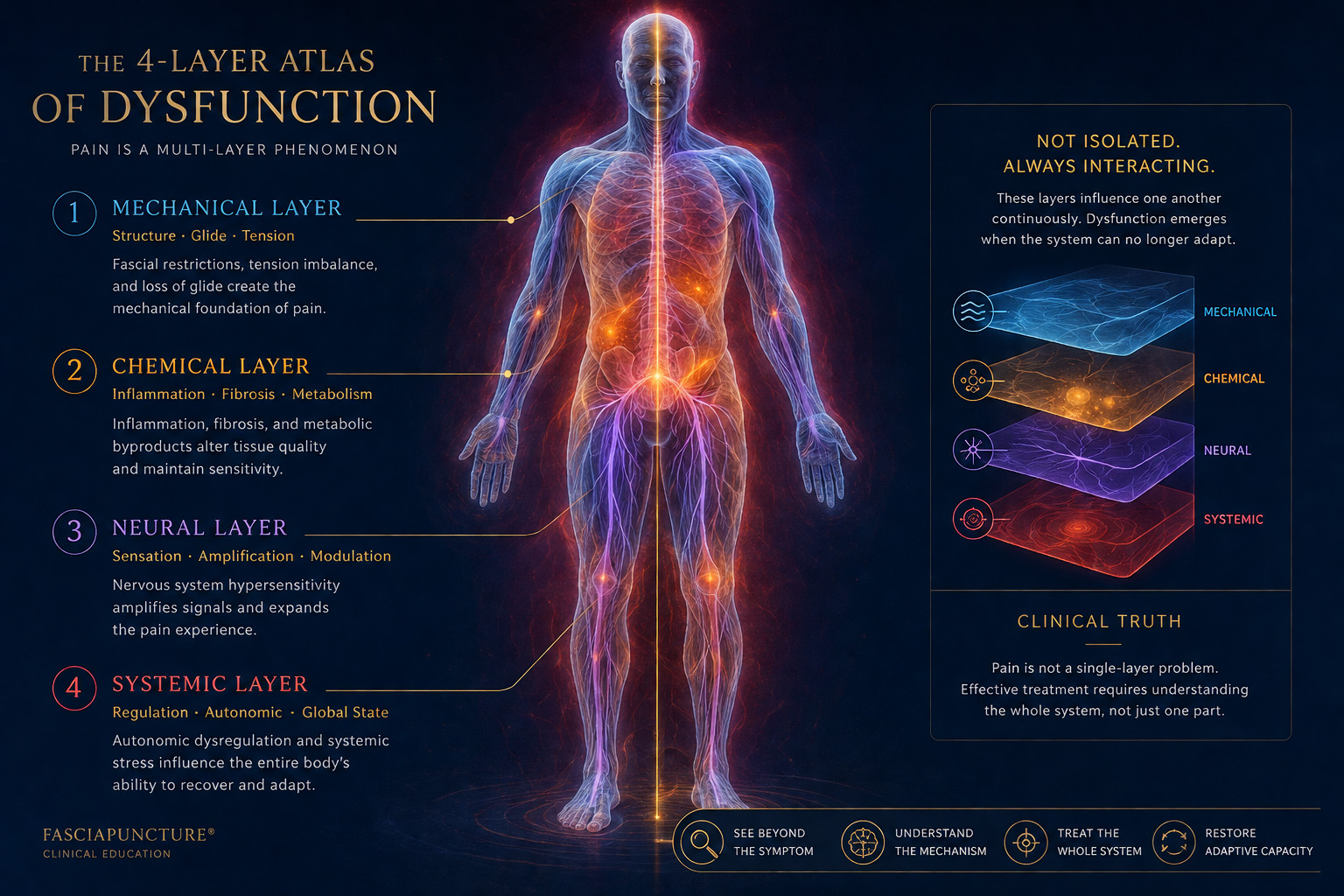
The 4 Layers of Dysfunction
Pain is rarely a single-layer problem. It emerges when mechanical, chemical, neural, and systemic layers interact.
Mechanical Layer
Glide restriction, tension imbalance, tissue density, and loss of movement freedom.
Chemical Layer
Inflammation, fibrosis, metabolic waste, and tissue adaptation after repeated overload.
Neural Layer
Sensory amplification, altered perception, nociceptive sensitivity, and pain expansion.
Systemic Layer
Autonomic involvement, fatigue, sleep disturbance, visceral expression, and global compensation.
How Level 3 is structured
Ten clinical sections forming one progressive mechanism-based pathway.
Adaptation Becomes Dysfunction
Understanding how protective responses become fixed patterns.
Layered Mechanisms
Reading mechanical, chemical, neural, and systemic contributions.
Chronic Pain Logic
Understanding why pain spreads, persists, and returns.
Mechanism to Pattern
Preparing the transition toward pattern recognition and entry point logic.
Lessons included in Level 3
3.1 Adaptation → Dysfunction
Why the body gets stuck after repeated compensation and protective tension.
3.2 The 4-Layer Model
Mechanical, chemical, neural, and systemic layers of fascial dysfunction.
3.3 Glide Restriction
Why fascial layers stop moving and how densification alters tissue behavior.
3.4 Inflammation Revisited
Understanding inflammation as a signal of entrapment and adaptation.
3.5 Sensory Amplification
Why pain expands beyond the original site and becomes difficult to localize.
3.6 Autonomic Involvement
How fascia interacts with sleep, fatigue, digestion, and regulation.
3.7 Why Symptoms Become Chronic
Chronic pain as stabilized dysfunction rather than prolonged injury.
3.8 Local vs Systemic Expression
Why local pain may reflect distant fascial organization and compensation.
3.9 When Treatment Fails
Understanding why treatment may work temporarily but symptoms return.
3.10 Mechanism → Pattern
How mechanisms become visible as linear, crossed, spiral, or mixed patterns.
You are no longer asking:
Where does it hurt?
You are beginning to ask:
Why does it stay?
This is the level where fascia is no longer read only as tissue, but as a living system of adaptation, protection, and regulation.
After Level 3, you will be able to
What comes next
Once the mechanism becomes clear, the next question is no longer only:
What is happening?
It becomes:
How is it organized?
In the next level, you move from mechanism to pattern — the moment where understanding becomes clinical direction.
Unlock Level 3 — Mechanisms of Dysfunction
This level is where clinical observation becomes mechanistic understanding.
Because once you understand why the system is stuck, clinical reasoning becomes possible.