
SIGNATURE CLINICAL CASE
When the Breast Was Not the Problem
A case of post-surgical breast hardening, heel pain, and sustained fascial regulation.
Female, born in 1964
Heel pain and knee discomfort
Left-sided protective fascial tension
Breast tissue softened during global regulation
CLINICAL OPENING
The patient did not come for the breast
This patient initially consulted for heel pain, which had gradually become associated with discomfort in the knee. The breast condition was mentioned only during the clinical discussion.
Yet during a session focused on global fascial regulation, the post-surgical breast hardening changed rapidly and unexpectedly.
INITIAL SYSTEM STATE
A local hardening within a wider protective pattern
Breast history
The patient had undergone breast cancer surgery followed by radiotherapy approximately one year earlier.
Since that time, the left breast had remained swollen, very firm, sometimes painful, and described by the patient as feeling “hard like a brick.”
Previous attempts
Fluid aspiration had previously been performed, but the swelling quickly returned. For almost one year, she had received weekly manual therapy focused on breast massage, without significant improvement.
PATTERN ATLAS
The breast was read through the system
Global Protective State
The body appeared organized around long-term protection after surgery, radiotherapy, and persistent tissue congestion.
Upper Exit Block
Cervical and subclavian tension may influence drainage, pressure release, and upper-body regulation.
Scapular Lock
The medial scapular border and posterior shoulder region showed notable restriction on the surgical side.
Posterior Compression
Heel pain and posterior chain tension suggested that the lower limb was part of the same global compensation pattern.
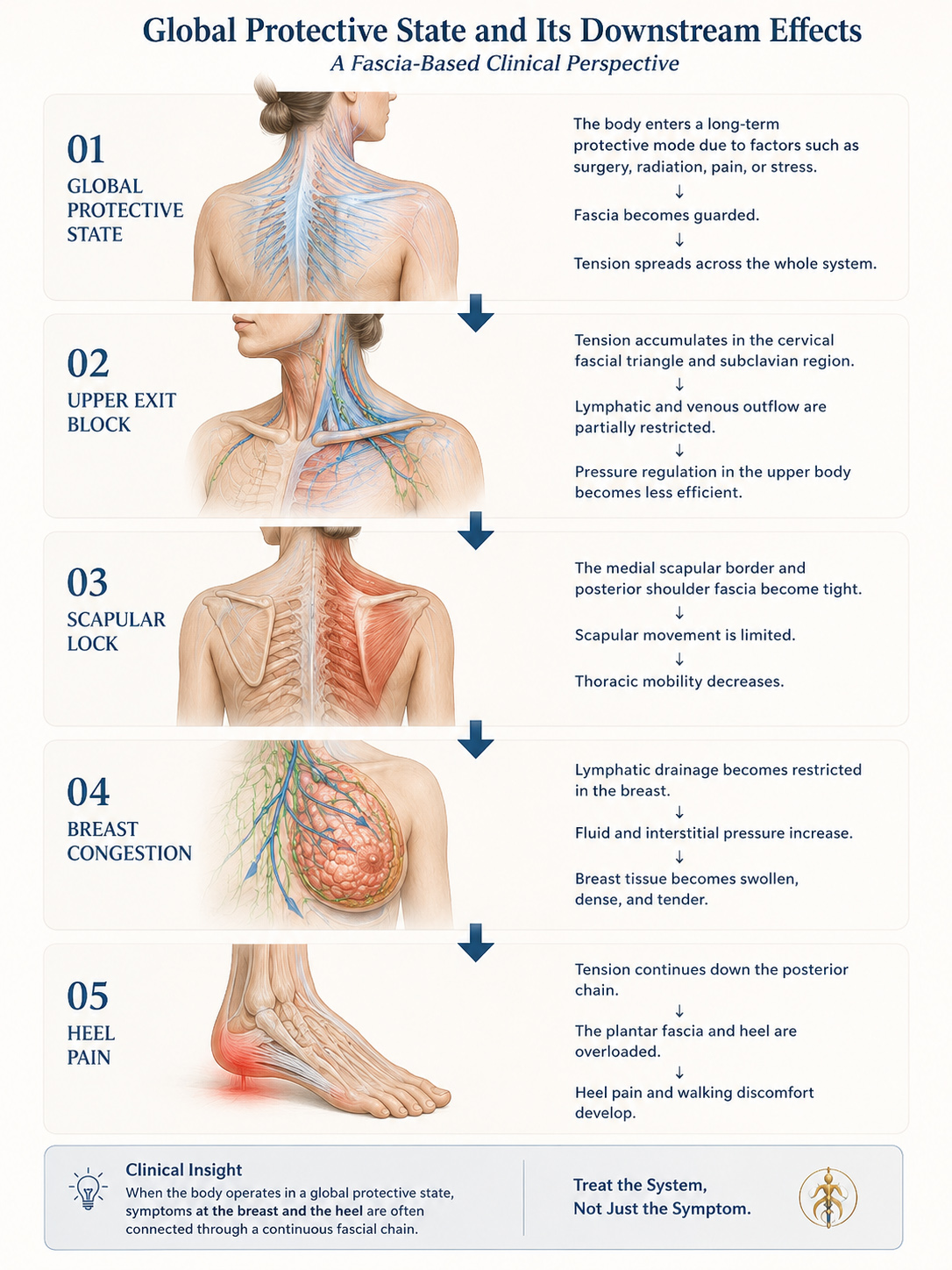
The question is not only whether a person can stop smoking. The deeper question is whether the system can regulate without compensation.
BEFORE & AFTER CLINICAL ATLAS
What changed first was not only pain
Before
• Left breast swollen and very firm
• Tissue described as “hard like a brick”
• Cervical and scapular tension on the left side
• Heel pain affecting walking comfort
• Protective pressure pattern across the upper body and posterior chain
After
• Upper breast tissue softened within minutes
• Lower hard areas also began to soften
• Patient reported approximately 80% reduction in hardness
• One month later, the breast remained soft
• Heel pain had almost disappeared
ENTRY STRATEGY
The breast itself was not the treatment target
Release of lumbosacral fascia and psoas tension
Fascial release along the medial scapular border
Regulation of the cervical fascial triangle
Short abdominal acupuncture session for systemic regulation
CLINICAL TURNING POINT
The unexpected softening
After about ten minutes, palpation revealed that the upper part of the breast had begun to soften noticeably.
A few minutes later, after the patient had stood up and dressed again, the breast was palpated once more. The tissue had become significantly softer, including areas that had previously remained very firm.
Before leaving the clinic, the patient reported that approximately 80% of the hardness had disappeared.
WHAT BECAME VISIBLE
The change was still present one month later
Sustained breast softening
At the second visit, approximately one month later, the breast remained soft.
Heel pain almost gone
The original reason for consultation — heel pain — had almost disappeared.
Systemic relevance
The sustained change suggested that the first session had affected more than a temporary local tissue response.
CLINICAL REFLECTION
A breast change revealed through a heel-pain consultation
This case is clinically important because the patient did not initially seek treatment for the breast condition. The improvement occurred as an unexpected secondary outcome during a broader fascial regulation session.
It suggests that some post-surgical tissue hardening may involve more than local fibrosis alone. Fascial tension, lymphatic congestion, interstitial pressure, cervical-subclavian restriction, scapular tension, and global protective organization may all influence tissue consistency.
The one-month follow-up is especially meaningful: the breast remained soft, and the heel pain had almost disappeared.
KEY LEARNING POINTS
What this case teaches
The symptom was not the full map
Heel pain, breast hardening, cervical tension, and scapular restriction were not treated as separate problems, but as parts of a wider system state.
Local tissue may change through distant regulation
The breast tissue softened without direct treatment to the breast itself, suggesting the importance of proximal drainage and pressure-regulation zones.
Follow-up gives the case its strength
Immediate improvement is interesting. Sustained change one month later gives the observation deeper clinical value.
Systemic reasoning protects the clinical vision
This case supports a core Fasciapuncture® principle: the body may change locally when the global protective pattern begins to release.
CONNECTED CLINICAL MAP
How this case connects to the Fasciapuncture® Atlas
Global Protective State
Long-term organization around protection, pressure, and adaptation.
PatternUpper Exit Block
Cervical-subclavian restriction influencing upper-body drainage and regulation.
PatternScapular Lock
Posterior shoulder and scapular tension affecting thoracic and cervical transmission.
PatternPosterior Compression
Heel pain and posterior chain load as part of a larger compensatory system.
RELATED CONDITIONS
Explore related clinical entries
RELATED CASES
Other cases where the system changed first
When the Abdomen Finally Let Go
A case showing abdominal protection, breathing, pelvic load, and gait regulation.
Clinical CaseThe Foot Was Not the Problem
A foot-pain case revealing deeper chain compensation and systemic pressure patterns.
Clinical CaseWhen Breathing Becomes Quiet
A case where regulation appeared through breath, face, and nervous system softening.
CONTINUE LEARNING
Learn how to read the system behind the symptom
Explore the Pattern × Pillar System
See how symptoms, patterns, and clinical cases connect inside Fasciapuncture®.
Pattern AtlasStudy the Fasciapuncture® Pattern Atlas
Understand the recurring body patterns behind pain, tension, and regulation.
TrainingFasciapuncture® Training
Learn the clinical reasoning framework behind fascia-based acupuncture practice.