
Fasciapuncture® Clinical Case
Trigeminal Neuralgia: Long-standing Facial Pain Relieved Through Fascial Regulation
1 Patient Profile
-
Age: 75
-
Sex: Male
-
Main Complaint: Severe facial pain consistent with trigeminal neuralgia
-
Duration: More than 10 years
-
Trigger / Onset: Pain episodes triggered by chewing, speaking, or touching the face
-
Previous Treatments: Regular use of analgesic medications providing only temporary relief
Summary
The patient sought Fasciapuncture® after persistent trigeminal neuralgia that had affected daily life for more than a decade.
2 Clinical Observation
Clinical examination revealed several patterns of fascial tension and neural irritation:
-
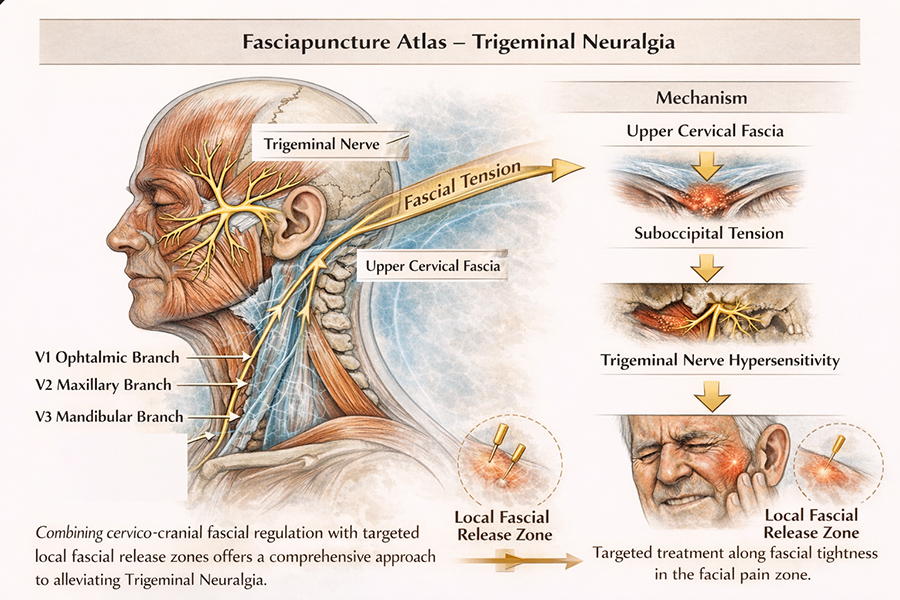
increased fascial tension in the upper cervical region
-
restriction around the suboccipital fascia
-
tension patterns along the lateral cervical fascia and mandibular region
-
hypersensitivity in the facial neural distribution zone
These findings suggested that the facial pain might be associated with deeper cervico-cranial fascial tension patterns.
3 Fascia-Based Interpretation
From a fascia-oriented perspective, trigeminal neuralgia may not only be a local nerve disorder.
In this case, the clinical pattern suggested:
-
cervico-cranial fascial tension
-
irritation of neuro-fascial pathways linking the upper cervical region to the trigeminal system
-
persistent neural hypersensitivity maintained by fascial restriction
Summary
The symptom appeared in the face, but the tension pattern originated primarily in the cervico-cranial fascial system.
4 Treatment Strategy
Treatment focused on restoring balance in the relevant fascial regions rather than targeting the painful point directly.
The therapeutic strategy included:
-
releasing tension within the upper cervical fascia
-
reducing restrictions around the suboccipital region
-
regulating the neuro-fascial environment associated with the trigeminal pathways
-
restoring global fascial balance in the cervico-cranial region
5 Clinical Response
The response to treatment was progressive and encouraging.
-
After the first sessions, the intensity of pain began to decrease.
-
By the fifth session, the facial pain had nearly disappeared.
-
The patient was able to eat and speak without triggering severe attacks.
Approximately one year later, a mild recurrence occurred.
However:
-
the pain was significantly less intense than before
-
three additional sessions were performed to stabilize the system
Following these treatments, the trigeminal neuralgia did not recur.
6 Physiological Interpretation
The clinical response suggested that regulating fascial tension around the cervico-cranial region may reduce neural hypersensitivity.
Summary
Treat the origin of fascial tension, and distal neural symptoms may resolve progressively.
7 Clinical Insight
Clinical Reflection
Persistent facial neuralgia may sometimes reflect cervico-cranial fascial tension patterns rather than purely local nerve pathology.
Understanding this relationship may open new therapeutic perspectives for patients living with long-standing trigeminal pain.