
FASCIAPUNCTURE® CLINICAL CASE
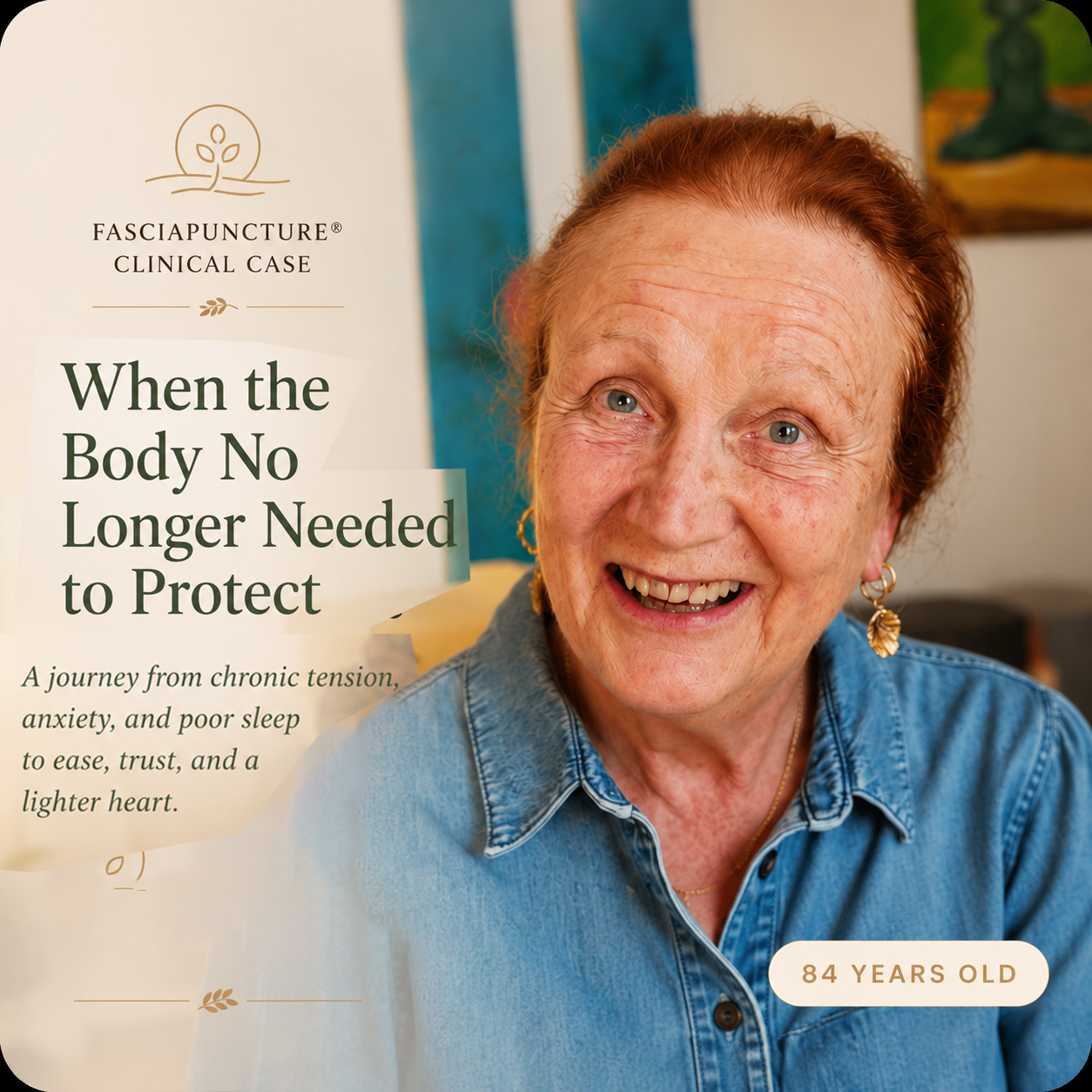
When the Body No Longer Needed to Protect
A clinical case of anxiety, poor sleep, post-surgical cervical tension, and the gradual return of safety in a 78-year-old woman.
Depuis que je vous connais, mon cœur est plus tranquille. “Since I found you, my heart has become calm.”
CLINICAL OPENING
A doctor who had spent her life caring for others
This 78-year-old woman first came for anxiety and sleep disturbance. She had a history of cervical fusion from C3 to T1. Although the severe pain before surgery had improved, her neck remained tense, guarded, and uncomfortable.
When she arrived, her body seemed organized around protection: the chest was drawn inward, the cervical region was rigid, and her gaze appeared distant, as if the nervous system had never fully returned to safety.
She herself had worked as a doctor for most of her life. She understood hospitals, diagnosis, surgery, and medical care. Yet what changed through this work was not only pain. Her sleep deepened, her mood softened, and she became less caught by worry.
INITIAL SYSTEM STATE
The body was still living in protection
Main complaints
Anxiety, poor sleep, cervical tension, and difficulty letting go emotionally.
Surgical history
Cervical fusion from C3 to T1, with persistent post-surgical neck guarding.
Visible state
Collapsed chest, forward cervical tension, distant gaze, and protective posture.
System reading
The body appeared unable to fully exit a long-term protective mode.
PATTERN ATLAS
Global Protective State became visible through the neck
Global Protective State
A long-term state in which the body remains organized around vigilance, tension, and protection even after the original threat has passed.
Upper Exit Block
Restriction around the cervical-thoracic exit limited breathing, emotional release, and upper-body ease.
Cervical Axis Tension
Post-surgical cervical guarding created a persistent protective axis through the neck and upper thoracic region.
Anterior Chain Lock
The inward chest posture suggested that the front body was still holding defensive tension.
BEFORE & AFTER CLINICAL ATLAS
What changed first was not only the neck
Before
The body appeared tense, guarded, and inwardly contracted. The cervical region remained painful and stiff. Sleep was disturbed, and the mind remained caught in worry.
After regular care
Neck discomfort changed significantly. Sleep became deeper. The mood became lighter. Most importantly, she found it easier to let go of troubling thoughts.
ENTRY STRATEGY
Working through safety, not force
Support the neck without directly fighting the surgical history.
Help the cervical-thoracic region regain transmission and ease.
Use the body’s own regulatory response as the main clinical guide.
The goal was not only pain relief, but the return of trust.
CLINICAL TURNING POINT
The heart became calm
After thirteen sessions since September 2025, the patient described a profound change. Her neck no longer dominated her daily life. Her sleep improved. Her mood became more open.
But the most meaningful shift was expressed in her own words: since receiving regular care, her heart had become calm.
“Depuis que je vous connais, mon cœur est plus tranquille.”
WHAT BECAME VISIBLE
The signs of protection began to soften
Breathing
Breath became easier and less held in the upper chest.
Expression
The face became brighter, more present, and more joyful.
Sleep
Sleep became more restorative and emotionally regulating.
Mind
Worry became easier to release. She no longer stayed caught in everything.
CLINICAL REFLECTION
It was not only pain that changed
This case shows how a post-surgical cervical region may remain part of a larger protective pattern. The neck was not treated as an isolated mechanical problem. It was read as one visible expression of a nervous system still organized around protection.
As the cervical-thoracic region softened, sleep improved. As sleep improved, emotional vigilance decreased. As vigilance softened, life became easier to carry.
The most important outcome was not simply that the neck felt better. It was that the body no longer seemed to need the same level of protection.
ONE YEAR FOLLOW-UP
One year later, she no longer came because she was in pain.
Over the following year, she continued returning approximately once a month—not because her symptoms had relapsed, but because she valued the profound sense of regulation and ease she experienced during each session.
At one follow-up visit, she smiled and said:
I haven't taken any pain medication for almost a year.
Then she added something even more meaningful.
I know I can always come and see you. That gives me great reassurance.
As a retired physician, she understood medicine very well. She had spent decades caring for others. What she described was not dependence on treatment. It was the confidence of knowing that a place of safety remained available whenever she needed it.
She was now planning holidays with friends, looking forward to travelling again, and speaking about the future with optimism.
For this reason, she chose to continue monthly sessions—not to fight illness, but to support a state of regulation that had become part of her life.
Sometimes the most meaningful clinical outcome is not simply that pain disappears. It is that life no longer revolves around pain.
KEY LEARNING POINTS
What this case teaches
Symptoms may belong to one story
Anxiety, sleep disturbance, cervical pain, and emotional overthinking may reflect one protective organization.
Post-surgical tissue can remain guarded
Even after structural correction, the fascial and nervous systems may continue to protect the region.
Clinical change is visible
A softer face, brighter eyes, easier breathing, and emotional lightness are meaningful signs of regulation.
Trust is a clinical outcome
When the body feels safe, the person can sleep, soften, and let go.
CONNECTED CLINICAL MAP
Where this case belongs in the Fasciapuncture® map
RELATED CONDITIONS
Explore related clinical entries
RELATED CASES
Other cases of protection and regulation
When Breathing Becomes Quiet
A case of upper-body tension, sleep, anxiety, and regulation.
When Peace Returned
A long-term story of grief, kidney surgery, poor sleep, and the gradual return of trust, rest, and emotional ease.
When the Abdomen Finally Let Go
A case of abdominal guarding, breathing, and pelvic transmission.
From Survival to Breathing Again
A case of exhaustion, emotional pressure, and systemic softening.
CONTINUE LEARNING
From protection to regulation
This case belongs to the deeper clinical study of how fascia, posture, breath, and the nervous system organize around safety.
Explore Fasciapuncture® Training →