
SIGNATURE CLINICAL CASE
When the Body Adapts Too Much
A longitudinal Fasciapuncture® case involving inflammatory pain, post-surgical adaptation, systemic exhaustion, and a body that had spent years trying to cope.
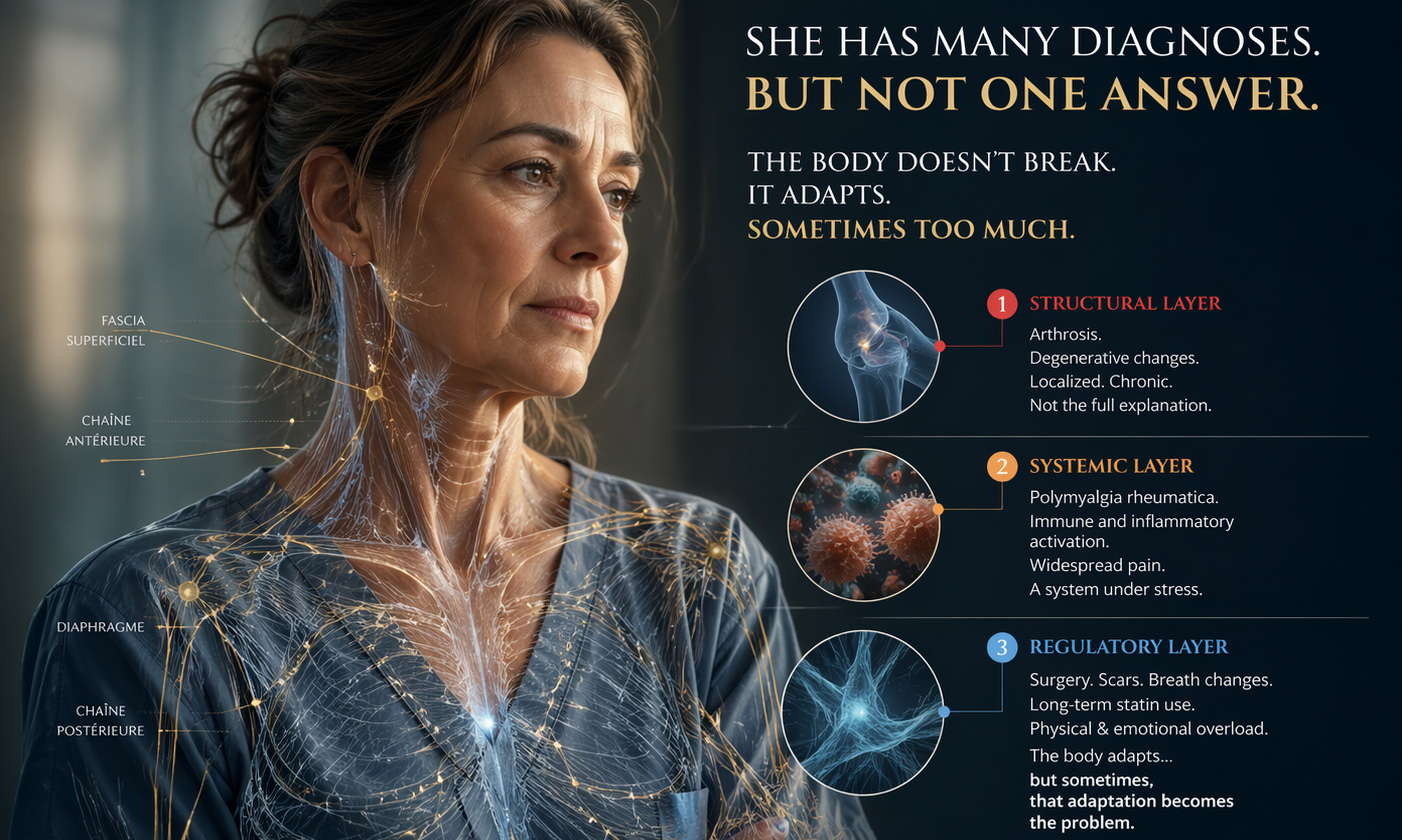
A Fasciapuncture® longitudinal case involving widespread inflammatory pain, post-surgical adaptation, fatigue, and chronic overload. This case explores how a body can remain trapped in protection long after the original stress has passed.
CLINICAL OPENING
She had many diagnoses. But not one answer.
A 56-year-old woman working as a caregiver presented with widespread pain, joint stiffness, fatigue, and a growing inability to recover.
Over the years, she accumulated multiple medical labels: arthrosis, polymyalgia rheumatica, post-cancer recovery, inflammatory pain, and possible medication-related muscular effects.
Each diagnosis described part of the picture. None explained why the entire system appeared unable to return to balance.
INITIAL SYSTEM STATE
What the body showed before treatment
Medical Background
- Breast cancer surgery in 2022
- Diagnosis of polymyalgia rheumatica
- Arthrosis and degenerative joint changes
- Long-term statin use, recently stopped
Current Presentation
- Widespread inflammatory pain
- Joint stiffness
- Fatigue and reduced recovery
- Physical and emotional overload
- Reduced system resilience
PATTERN ATLAS
The diagnoses were different. The adaptation was the same.
Global Protective State
The body remained organized around protection long after the original threats had passed.
Chronic Inflammatory Overload
Pain became a constant background signal of a system struggling to recover.
System Exhaustion
Adaptation continued, but recovery no longer matched demand.
Diaphragm Restriction
Respiratory regulation and recovery capacity appeared reduced.
BEFORE & AFTER CLINICAL ATLAS
The body did not break. It adapted — sometimes too much.

ENTRY STRATEGY
Supporting regulation before chasing symptoms
Observe the Whole System
Pain distribution, fatigue, breathing, posture, and recovery capacity were read together rather than as separate complaints.
Reduce Protective Load
The clinical priority was to reduce the body’s need to remain in a defensive state.
Support Breathing and Regulation
Thoracic inlet, cervical regulation area, and abdominal center were considered as key access zones.
Document Longitudinal Change
This is a longitudinal case. Further clinical changes can be documented progressively across follow-up sessions.
CLINICAL TURNING POINT
The issue was not one disease
This case was not approached from a single-diagnosis perspective. The clinical reading focused on how structural, systemic, and regulatory layers were interacting.
Arthrosis described one layer. Polymyalgia rheumatica described another. Post-surgical history described another. But the body’s overall presentation suggested a deeper adaptive pattern.
WHAT BECAME VISIBLE
What should be observed over time
Breathing
Does respiratory movement become easier and less guarded?
Pain Distribution
Does pain remain fixed, or does the pattern begin to reorganize?
Fatigue
Does recovery capacity improve after the system receives support?
Sleep
Does the nervous system begin to enter deeper restoration?
Emotional Load
Does the body appear less organized around vigilance and effort?
CLINICAL REFLECTION
The body does not fail randomly
Pain, in this context, is not only a symptom. It may be the expression of a system struggling to regulate after years of structural, inflammatory, surgical, and emotional load.
The clinical goal is not simply to reduce symptoms, but to restore the conditions for regulation to return.
It adapts.
But sometimes,
it adapts too much.
KEY LEARNING POINTS
What this case teaches
Diagnosis is not always the whole answer
Multiple diagnoses may describe parts of the body without explaining the whole system state.
Adaptation can become the problem
The body’s protective strategies may continue even after the original stressors have passed.
Inflammation is also a system signal
Widespread inflammatory pain may reflect overload in regulation, recovery, and autonomic balance.
Longitudinal observation matters
This type of case should be followed over time through breathing, sleep, fatigue, pain distribution, and functional change.
CONNECTED CLINICAL MAP
Patterns connected to this case
Global Protective State
The body remains organized around vigilance, adaptation, and protection.
Chronic Inflammatory Overload
Inflammatory pain, system load, and reduced recovery capacity.
System Exhaustion
Fatigue, poor recovery, and a body that cannot fully reset.
Diaphragm Restriction
Breathing restriction, pressure regulation, and autonomic load.
RELATED CONDITIONS
Conditions connected to this case
RELATED CASES
Other cases where adaptation became visible
When the Skin Stopped Carrying the Pressure
A case where long-term pressure appeared through inflammatory skin expression.
When the Body Remembers How to Rest
A case of exhaustion, poor sleep, and returning regulation.
When Stress Becomes Pain
A clinical thinking article on stress, autonomic activation, and fascial pain.
CONTINUE LEARNING
From diagnosis to system reading
Module 1 — Foundations of Fasciapuncture®
Understand why symptoms may reflect deeper regulatory patterns.
Module 2 — Clinical Perception & Diagnosis
Learn to read posture, breathing, pressure, and system availability.
Pattern Atlas — Global Protective State
Explore how the body remains organized around protection and adaptation.