
CLINICAL THINKING
When Stress Becomes Pain
A fascia-based clinical interpretation of systemic dysregulation.
Pain does not always begin where it is felt. Sometimes the body speaks through discomfort when the regulatory system has remained under pressure for too long.
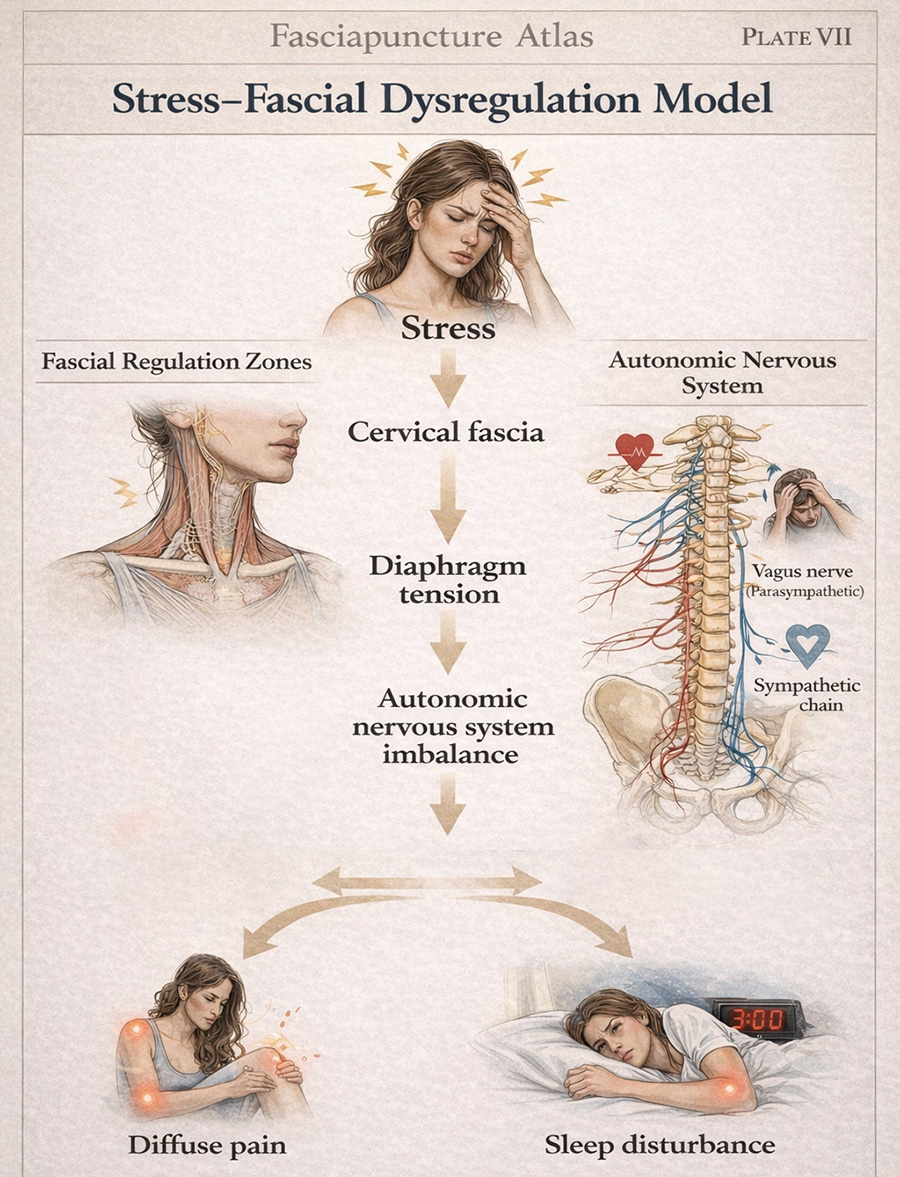
Stress may first appear emotional. The body may experience it as regulation.
INTRODUCTION
When the body cannot settle
In clinical practice, it is common to encounter patients who describe a puzzling combination of symptoms: anxiety, fragmented sleep, diffuse physical pain, and a sense that the body remains tense even when no clear structural cause is found.
From a fascia-oriented perspective, these symptoms may not be isolated problems. They may reflect a deeper state of systemic regulation, where emotional stress, autonomic activation, breathing restriction, and fascial tension begin to influence one another.
CLINICAL SEQUENCE
How stress may become physical pain
CLINICAL OBSERVATION
A regulatory pattern, not a local complaint
A 35-year-old woman consulted for recurrent episodes of diffuse joint discomfort. The symptoms appeared intermittently and were clearly associated with periods of emotional stress.
Primary complaints included:
- Anxiety and mental tension
- Frequent awakening between 1 and 3 a.m.
- Episodes of generalized joint pain during stressful situations
- No clear structural pathology explaining the symptoms
The clinical picture suggested that the symptoms were not primarily orthopedic in origin, but part of a broader regulatory burden expressed through the fascial and autonomic systems.
CLINICAL INTERPRETATION
Two ways of reading the same symptoms
Symptoms are separated
Pain is read through the joints.
Sleep is read through the nervous system.
Anxiety is read through emotional stress.
The system is connected
Stress activates the autonomic system.
Autonomic activation increases fascial tone.
Persistent tension alters breathing, sleep, and pain perception.
SLEEP & AUTONOMIC ACTIVITY
Night waking as a regulatory signal
Night-time awakening between one and three in the morning is frequently associated with heightened autonomic arousal. Rather than entering a stable restorative phase of sleep, the nervous system remains partially activated.
In many individuals, fascial tension around the thoracic region and diaphragm may influence respiratory rhythm and autonomic modulation. These subtle mechanical changes may contribute to the sleep disturbances observed in stress-related conditions.
RELATED PATTERNS
Where this article connects to the Clinical Map
Global Protective State
The body remains organized around vigilance and protection.
SYSTEMIC REGULATIONAutonomic Dysregulation
Sleep, breathing, tension, and internal rhythm lose coherence.
BREATHING AXISDiaphragm Restriction
The breathing center becomes part of the tension pattern.
HEAD & NECK REGULATIONUpper Exit Block
Pressure may collect around the neck, jaw, skull base, and upper body.
CONCLUSION
Pain may be where the body speaks
Stress-related pain is not imaginary. It may be the visible expression of a body that has lost its capacity to return to physiological quiet.
Recognizing the relationship between emotional stress, autonomic activity, fascial tension, breathing, and sleep may provide a more coherent clinical framework for complex presentations.
Continue exploring the Clinical Map
Follow the connection from symptom to pattern, and from pattern to clinical reasoning.