
Patient Profile
-
Age: 34
-
Sex: Female
-
Main complaint: Bilateral hand numbness, worse at night
-
Duration: ~4 years
-
Onset: Symptoms began after a COVID vaccination
-
Previous treatments: Two steroid injections in the wrists, with only short-term improvement
The patient sought Fasciapuncture® after years of disrupted sleep and persistent nighttime numbness greatly affecting her quality of life.
Initial Clinical Insight
The Problem Was Not in the Wrist
During the first clinical examination, the wrist itself showed no major mechanical restriction.
Instead, palpation revealed:
-
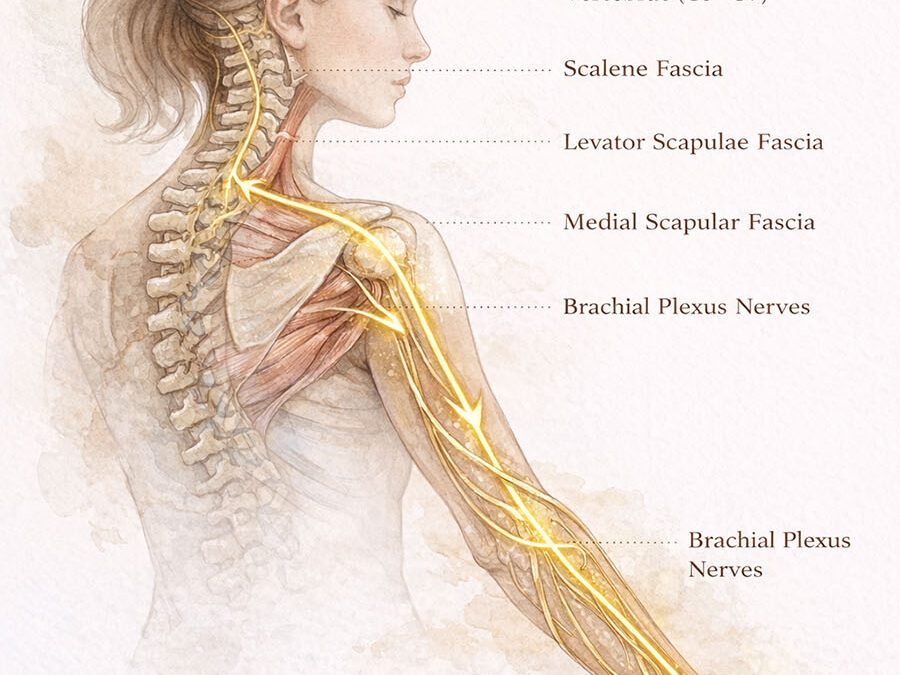
Marked tension in the lower cervical fascia (C5–C7)
-
Hypertonicity of the scalene muscles
-
Strong fascial tension in the levator scapulae
-
A continuous fascial pulling pattern along the medial scapular plane
This pattern indicated a Cervico-Scapular Myofascial Entrapment Syndrome, rather than a primary wrist disorder.
The hand numbness appeared to result from neural irritation caused by fascial tension in the cervical region.
Typical manifestations included:
-
Hand numbness
-
Nighttime worsening
-
Temporary relief after shaking or repositioning the hands
First Fasciapuncture Session
Rapid Change
Treatment focused on releasing the proximal fascial restrictions, including:
-
Deep cervical fascia
-
Scalene fascial tension
-
Scapular fascial anchoring zones
No direct intervention was applied at the wrist.
The patient reported:
Five consecutive nights without numbness.
After four years of symptoms, this represented a significant clinical turning point.
Why Wrist Injections Failed
Steroid injections targeted the site of symptoms, not the origin of tension.
Temporary improvement occurred because inflammation was reduced, but the underlying fascial vector remained unchanged.
The cervical and scapular fascia continued to:
-
Pull along neural pathways
-
Reduce nerve sliding space
-
Maintain chronic irritation
Second Session
The Wrist Responds Indirectly
During the second visit, the patient noted:
-
Continued reduction in numbness
-
Lighter shoulder sensation
-
Warmer hands
Unexpectedly, wrist mobility improved significantly, even though the wrist had not been directly treated.
Fascial Chain Explanation
This response illustrates a key principle:
Fascia-Chain Physiology
When proximal fascial tension decreases:
-
Neural sliding improves
-
Blood flow increases
-
Distal tissues recover rapidly
In this case, the wrist acted as the end point of a cervico-scapular fascial chain.
Treating the origin produced rapid distal improvement.
Clinical Reflection
This case highlights an important clinical lesson:
Symptoms do not always indicate the true origin of dysfunction.
In many chronic conditions, distal pain or numbness reflects proximal fascial tension patterns.
Understanding fascial vectors allows clinicians to intervene at the structural origin rather than the symptomatic endpoint.