
PATTERN DEMONSTRATION CASE
When Sciatic Pain Was Not Only the Disc
A fascia-based clinical case showing how chronic sciatic pain may persist when the system remains organized around protection, posterior compression, and movement restriction.
Chronic sciatic pain
Four years of persistent pain
Posterior compression and pelvic compensation
Movement changed before pain became the only measure
CLINICAL OPENING
Four years of pain, one session, and movement began to change
The patient presented with chronic sciatic pain that had persisted since 2021. Sitting was painful. Standing was painful. Morning stiffness was present, and daily movement had gradually become limited by discomfort and protection.
Imaging had shown degenerative disc changes at L4–L5, and previous injection treatment had been performed. Yet the symptoms persisted.
In Fasciapuncture®, the question was not only whether a disc problem existed. The deeper clinical question was whether the body was still able to adapt, transmit load, and regulate movement.
INITIAL SYSTEM STATE
A structural diagnosis did not fully explain the functional state
Clinical presentation
The patient reported strong sciatic pain in the lower back and lower limb, with pain present during both sitting and standing.
Morning pain and stiffness suggested that the system was not recovering easily after rest.
Functional restriction
The condition had become part of daily life. Movement was guarded, posture was protective, and the body appeared to organize itself around avoiding pain.
A mild distal symptom was also present, including discomfort toward the small toe.
PATTERN ATLAS
The sciatic symptom was read through a wider fascial pattern
Posterior Compression
The posterior chain appeared overloaded, with lumbosacral tension and sciatic irritation expressed through the back, hip, leg, and foot pathway.
Pelvic Lock
Pelvic load transfer appeared restricted, affecting standing, walking, rotation, and the ability of the lower limb to move freely.
Compensation Loop
Long-term pain created adaptive movement strategies, where one region protected another and the system gradually lost fluidity.
Global Protective State
After four years of pain, the body no longer responded as a simple local injury. It behaved like a system organized around protection.
BEFORE & AFTER CLINICAL ATLAS
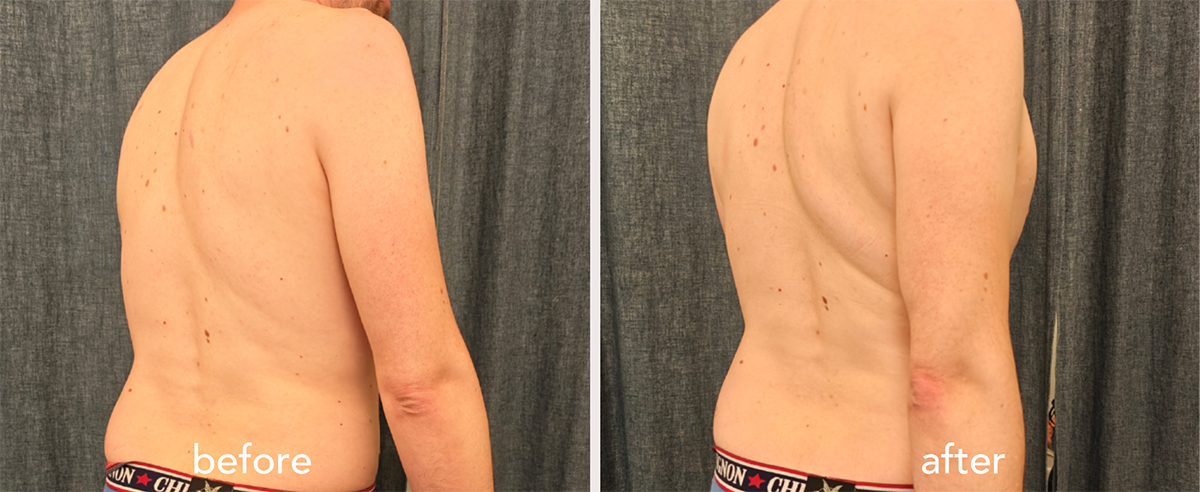
Movement and posture became visible evidence
Before
• Protective trunk posture
• Lumbosacral tension
• Posterior chain restriction
• Pain with sitting and standing
• Reduced confidence in movement
After
• Improved movement amplitude
• Easier standing and transition
• Less visible guarding
• More fluid functional response
• Patient felt more confident moving
ENTRY STRATEGY
The treatment did not focus on the disc itself
Regulation of the lumbosacral fascial system
Release of posterior chain tension and protective load distribution
Assessment of pelvic balance and asymmetrical compensation
Support of global movement regulation rather than local pain suppression
CLINICAL TURNING POINT
The first meaningful change was movement
Immediately after the session, movement amplitude increased. The patient could move more easily, with less visible guarding and more confidence.
This was clinically important because in chronic sciatic pain, pain intensity is not the only measure of change. Often, the first sign of regulation is that the body begins to trust movement again.
WHAT BECAME VISIBLE
The system showed a shift in protection
Movement amplitude increased
The patient could move with greater range and less protective restriction.
Functional ease improved
Standing, transitioning, and postural organization became easier after treatment.
Confidence returned
The patient felt more confident, suggesting that the nervous system was no longer organizing movement only around threat.
CLINICAL REFLECTION
Chronic sciatic pain may be more than a local nerve problem
In this case, the structural diagnosis did not fully explain the functional picture. The disc finding was real, but the persistence of symptoms suggested a wider system adaptation.
Fasciapuncture® reads chronic sciatic pain through load transmission, posterior chain restriction, pelvic balance, protective posture, and the body’s capacity to regulate movement.
The clinical value of the session was not only pain reduction. It was the visible return of movement availability.
KEY LEARNING POINTS
What this case teaches
Imaging does not define function
A disc diagnosis may describe structure, but it does not always explain why the body remains unable to move comfortably.
Sciatic pain may reflect system adaptation
Long-term pain often involves protective strategies, load redistribution, and fascial tension patterns beyond the symptomatic pathway.
Movement is clinical information
When movement improves, the system is showing that protection has decreased and regulation has become more available.
The goal is not only pain suppression
Fasciapuncture® seeks to restore adaptability, transmission, and functional confidence within the whole system.
CONNECTED CLINICAL MAP
How this case connects to the Fasciapuncture® Atlas
Posterior Compression
When the back of the body holds pressure, sciatic symptoms may emerge along the posterior chain.
PatternPelvic Lock
Pelvic restriction can disturb load transfer between the spine, hip, leg, and foot.
PatternCompensation Loop
Long-term pain may create a loop where protection maintains the very pattern that keeps symptoms active.
PatternGlobal Protective State
Chronic pain can become a whole-system protective organization rather than a single local disorder.
RELATED CONDITIONS
Explore related clinical entries
RELATED CASES
Other cases where movement revealed the system
The Foot Was Not the Problem
A foot-pain case showing how lower-limb symptoms may reflect deeper chain compensation.
Signature CaseWhen the Abdomen Finally Let Go
A case of abdominal protection, breathing restriction, pelvic load, and walking change.
Signature CaseWhen the Breast Was Not the Problem
A case where heel pain and post-surgical breast hardening revealed a broader protective pattern.
CONTINUE LEARNING
Learn how to read chronic pain beyond structure
Explore the Pattern × Pillar System
See how symptoms, patterns, and cases connect inside the Fasciapuncture® clinical reasoning map.
Pattern AtlasStudy the Fasciapuncture® Pattern Atlas
Understand the recurring body patterns behind pain, tension, compensation, and regulation.
TrainingFasciapuncture® Training
Learn the clinical reasoning framework behind fascia-based acupuncture practice.