FASCIAPUNCTURE® SIGNATURE CLINICAL CASE
When the Body Learned to Bend Again
Four years after lumbo-sacral surgery, the body was still moving as if it needed to protect itself. This case shows how restoring movement confidence changed pain across the lower back, shoulder, arm, and knee.
CLINICAL OPENING
Four years after surgery, the body still did not feel free
The patient was a 57-year-old man who had undergone lumbo-sacral surgery four years earlier. Despite the surgery, he continued to experience pain on both sides of the lower back. He also reported discomfort in the left shoulder and arm, as well as pain in the left knee.
During the initial assessment, both side-bending and trunk rotation were severely restricted. His movements were cautious, guarded, and mechanical.
“I feel like a robot. I don’t dare to move my body freely.”
This sentence became the key to the case. The main issue was not only where the pain remained. It was how the whole body had learned to move under protection.
INITIAL SYSTEM STATE
A body organized around protection
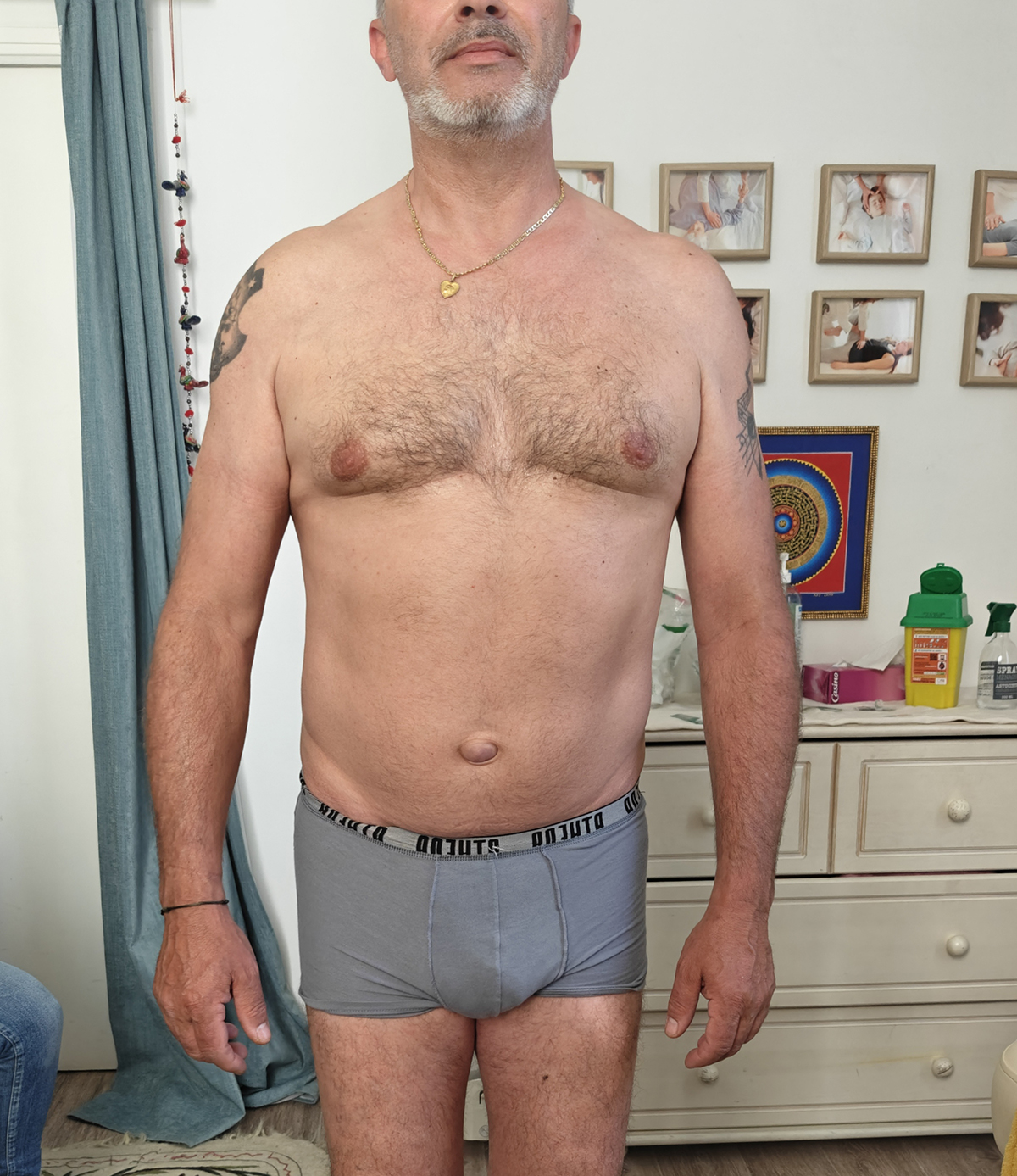
Front View
The front view showed a visible protective organization through the abdomen, shoulder girdle, pelvis, and umbilical axis. The body appeared to hold tension through the center rather than move freely through it.
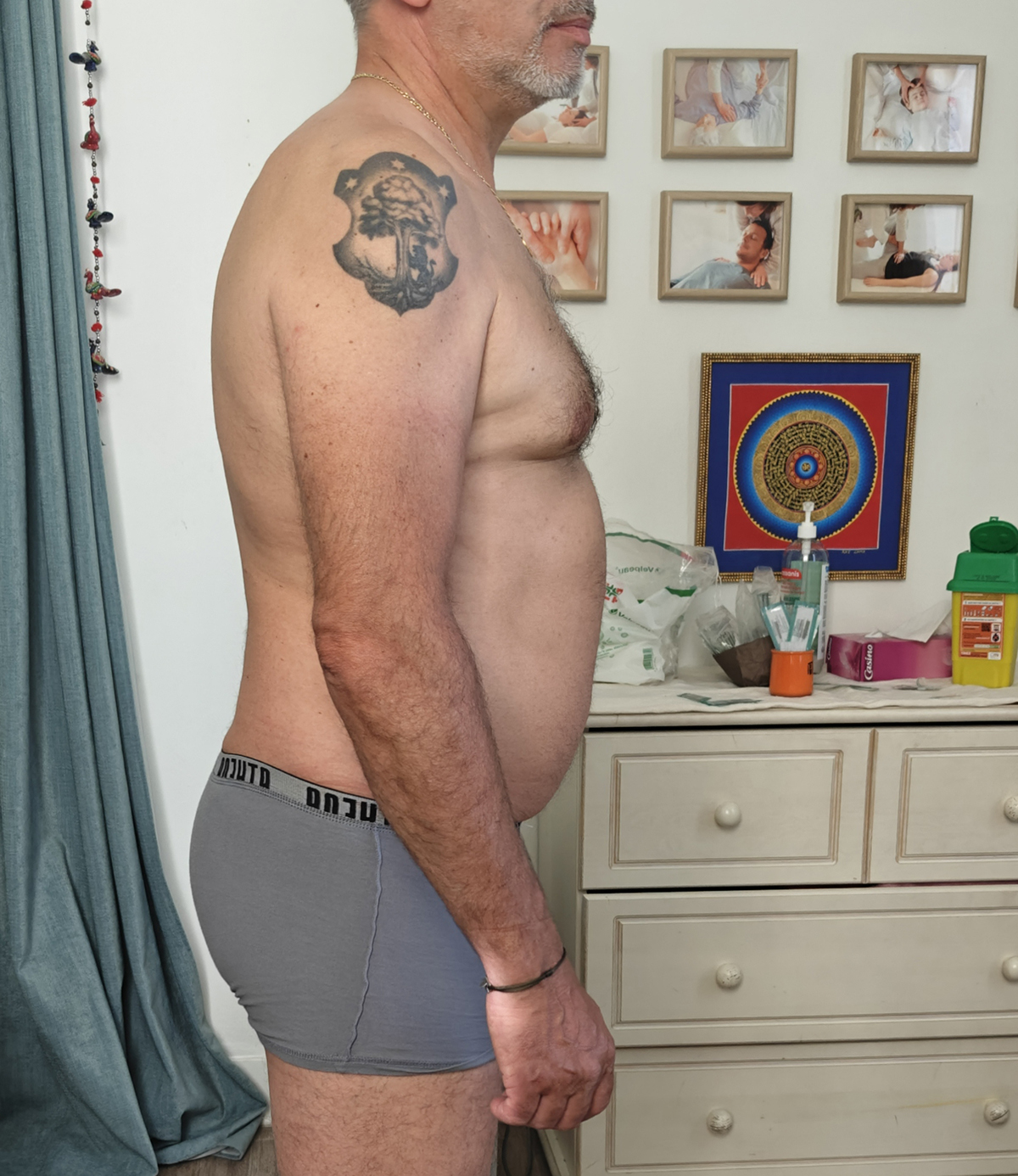
Side View
From the side, the abdominal area appeared to participate strongly in postural holding. The trunk seemed guarded, with reduced ease through the lumbar and pelvic axis.
Clinical Observations
- Severe restriction in side-bending and trunk rotation
- Left shoulder elevation and upper-body compensation
- Umbilical deviation toward the right
- Abdominal bracing and anterior chain protection
- Lumbo-sacral surgical scar restriction
- Global fear of movement and “robot-like” movement strategy
Clinical Meaning
The body was not only painful. It was braced. The post-surgical area, abdomen, shoulder, pelvis, and lower limb appeared to participate in one protective organization. This was less a local pain presentation than a global movement strategy shaped by protection.
PATTERN ATLAS
The pain was local, but the pattern was global
Anterior Chain Lock
The abdominal and anterior trunk system appeared to participate in protecting the lumbo-sacral region.
ASSOCIATED PATTERNPelvic Lock
Pelvic transmission was reduced, limiting bending, rotation, and movement confidence.
ADAPTATIONCompensation Loop
Shoulder, lower back, and knee symptoms suggested a wider compensatory organization.
SECONDARY PATTERNThoracic Restriction
Reduced trunk rotation suggested that the thoracic system was also participating.
BEFORE & AFTER CLINICAL ATLAS
Side-bending revealed the protective pattern
Before Treatment
- Severe bilateral side-bending restriction
- Minimal lumbar participation
- Whole-body guarding strategy
- Mechanical movement quality
- Fear of free trunk movement
After Treatment
- Visible increase in side-bending range
- Improved lumbar opening
- Reduced protective bracing
- More fluid trunk movement
- Greater confidence in movement
What Changed First?
The first change was not only pain reduction. The first visible change was movement returning. As the body began to move again, pain in the lower back, shoulder, arm, and knee began to decrease together.
ENTRY STRATEGY
Treatment followed the pattern, not the symptom
The treatment did not begin by chasing the lower back pain directly. The clinical strategy followed the visible organization of the body.
Left shoulder regulation to reduce upper compensatory tension.
Mid-abdominal release to reduce anterior bracing and internal pressure.
Lumbo-sacral scar integration to soften the post-surgical protective barrier.
Functional reassessment through side-bending, rotation, and rising movement.
Lumbo-sacral and psoas integration to support deeper movement recovery.
MOVEMENT VIDEO
The change became visible through movement
Before Treatment
Before treatment, movement was cautious and restricted. Side-bending and trunk motion were limited, and the body appeared to move as a single guarded unit.
After Treatment
After treatment, side-bending improved visibly. The patient moved with greater freedom, reduced protective bracing, and increased confidence in movement.
CLINICAL TURNING POINT
He moved, paused, and could not believe the difference
After the first sequence of release, the patient was asked to test his movement again. The side-bending and rotation had already changed significantly. After further lumbo-sacral and psoas integration, the rising movement became easier.
He reported that the internal tension had dropped. His body felt more relaxed and freer to move.
“I can’t believe it.”
Pain decreased by approximately seventy percent during the session. His shoulder and arm movement improved, and when he raised the arm, he noticed that the pain was no longer present in the same way. The left knee pain also reduced.
WHAT BECAME VISIBLE
The system softened before the story was fully explained
Movement
Side-bending and trunk rotation increased visibly. The body no longer moved as one rigid block.
Internal Tension
The patient reported a clear reduction of internal tension, with a sensation of relaxation inside the body.
Shoulder & Arm
Shoulder elevation and arm movement improved. Raising the arm became easier and less painful.
Knee
The left knee discomfort reduced as the global protective pattern changed.
Confidence
The patient became visibly more willing to move, test, bend, and explore his body again.
Emotional Response
Both the patient and his wife witnessed the immediate change. Their surprise became part of the clinical moment.
CLINICAL REFLECTION
Surgery changed the structure. Protection changed the movement.
This case does not suggest that surgery was unnecessary or ineffective. Rather, it shows that structural intervention does not always resolve the protective organization that develops around pain, fear, scars, and compensation.
Four years after surgery, the body was still behaving as if it needed to protect the lumbo-sacral region. The abdomen, shoulder, pelvis, scar tissue, and lower limb were not isolated findings. They were part of one movement strategy.
In Fasciapuncture®, the clinical question is not only: Where is the pain?
The deeper question is: Where has the body stopped moving freely?
KEY LEARNING POINTS
What this case teaches
Pain may remain after structure has changed
Persistent pain after surgery may reflect unresolved protective patterns, not only local tissue damage.
Movement testing reveals the system
Side-bending and rotation showed the global restriction more clearly than pain location alone.
The scar may act as a protective anchor
Post-surgical scars can participate in bracing and movement inhibition within a wider fascial field.
Multiple pains may change together
Lower back, shoulder, arm, and knee symptoms shifted together when the global pattern softened.
CONNECTED CLINICAL MAP
Where this case belongs in the Fasciapuncture® system
Anterior Chain Lock
When the front body becomes a protective brace.
PATTERNPelvic Lock
When pelvic transmission loses mobility and load transfer.
PATTERNCompensation Loop
When one region protects another and the body becomes trapped in repeated adaptation.
PATTERNThoracic Restriction
When trunk mobility and breathing mechanics become limited.
RELATED CONDITIONS
Clinical themes connected to this case
Low Back Pain
When the lumbar region carries more than local pain.
Sciatic Pain
When leg pain reflects deeper pelvic and fascial transmission patterns.
Shoulder Pain
When shoulder symptoms are part of a wider compensatory chain.
Knee Pain
When knee discomfort changes as pelvic and trunk movement improve.
RELATED CASES
More cases where movement revealed the pattern
When the Spine Begins to Rise Again
A case showing how spinal posture changed when the system regained support.
When the Abdomen Finally Let Go
A case where abdominal protection and movement restriction shifted together.
From Survival to Breathing Again
A case showing how global protection softened through systemic regulation.
CONTINUE LEARNING
Learn to read movement before chasing pain
Module 1 · Foundations
Learn the clinical principles behind pain, fascia, protection, and pattern recognition.
TRAININGModule 2 · Clinical Perception
Develop observation skills for posture, movement, palpation, and functional testing.
CLINICAL LIBRARYExplore More Clinical Cases
See how Fasciapuncture® reads patterns across real clinical presentations.