CLINICAL THINKING
When “Correct” Becomes Compensation
And comfort reveals what is true.
Sometimes what we call correctness is only a well-organized compensation. In Fasciapuncture®, comfort is not weakness. It is clinical information.
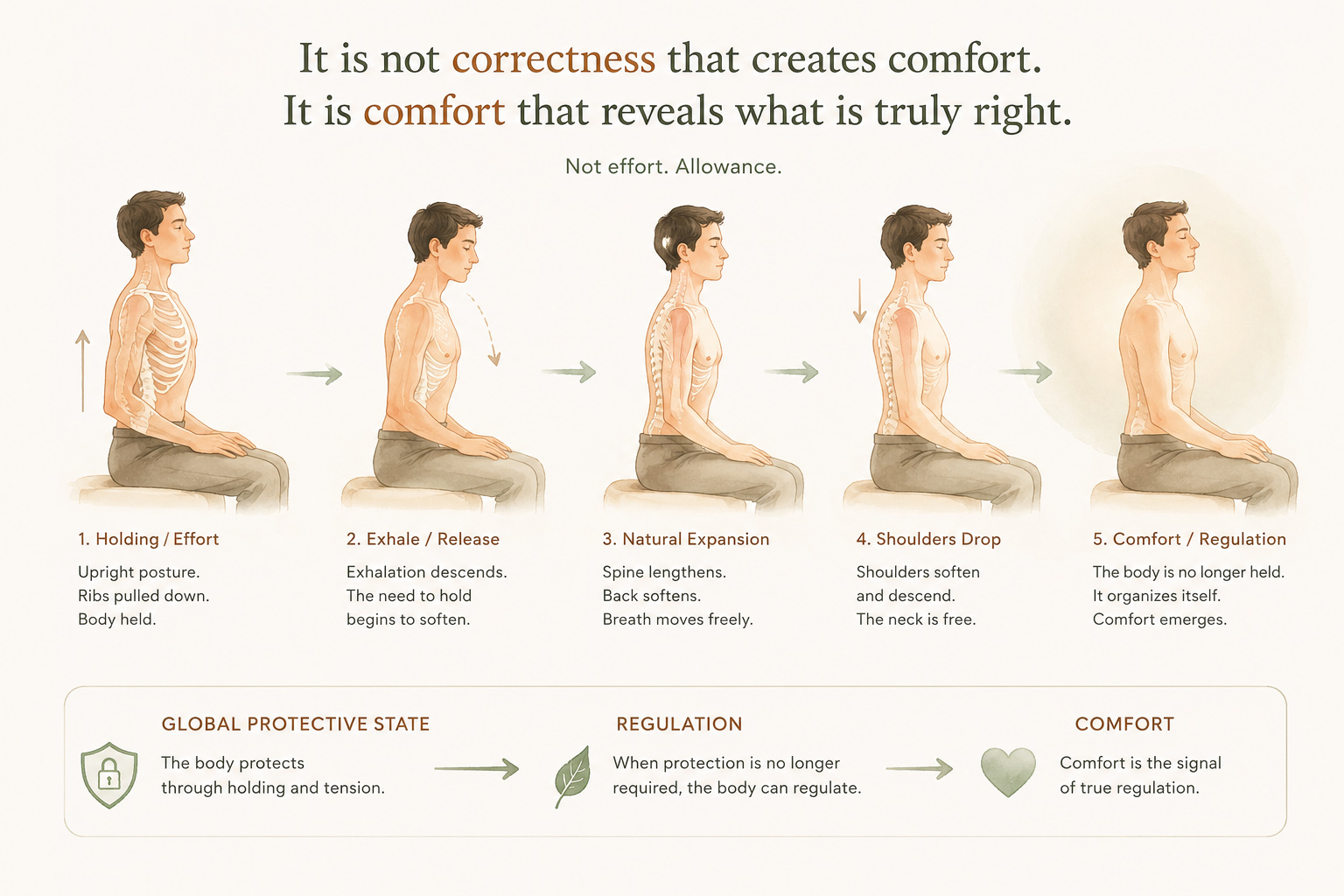
When the body no longer needs to hold a form, regulation can begin to organize itself.
For a long time, I believed I was practicing “correct breathing.”
I consciously guided the rib cage downward during exhalation. I maintained an upright posture. I thought I was supporting my body in the right way.
And yet, something was constantly holding.
For this “correct” breathing to work, my body had to compensate elsewhere. My lower back stiffened. My spine stayed erect through effort rather than ease. I was holding myself together without realizing it.
was, in fact,
a well-organized compensation.
Then, one day, I stopped trying to maintain a form.
I simply allowed the exhalation to descend.
And something unexpected happened: my spine softened, my back naturally curved, my breathing became fluid, and my body felt at ease.
That was the moment of clarity.
It is not correctness that creates comfort. It is comfort that reveals what is truly right.
When the body is genuinely regulated, it no longer needs to be held. It organizes itself.
In Fasciapuncture®, this experience repeats itself constantly. Very often, what we call “good posture,” “proper breathing,” or even “correct technique” is actually a strategy to compensate for a deeper imbalance.
The role of care is not to impose a form, but to create the conditions in which the body can rediscover its own.
Sometimes it looks less “proper.”
But almost always, it can be recognized by one simple signal:
comfort.
Quiet, honest comfort becomes our most reliable clinical guide.
RELATED CLINICAL PATTERNS
This reflection belongs to the wider Clinical Map
Global Protective State
When the body remains organized around vigilance, effort, holding, and adaptation long after the original threat has passed.
BREATHING PATTERNDiaphragm Restriction
When breathing becomes managed, controlled, or mechanically organized rather than naturally expressed.
CENTRAL PRESSURE PATTERNCore Block
When the center of the body loses its ability to transmit pressure, movement, and breathing freely.
REGULATION PATTERNAutonomic Dysregulation
When the nervous system remains organized around effort rather than regulation and recovery.
CLINICAL INSIGHT
The Body Often Prefers Comfort to Correctness
Many compensations appear intelligent. They create stability. They create control. They often appear clinically "correct."
Yet they require continuous effort.
Regulation is different.
Regulation does not need to be maintained. It sustains itself.
Regulation organizes itself.
FASCIAPUNCTURE® PERSPECTIVE
When Comfort Becomes Clinical Information
In Fasciapuncture®, comfort is not interpreted as passivity, weakness, or collapse.
Comfort may represent the moment when unnecessary effort is no longer required.
This is why many patients report similar observations:
- My shoulders dropped.
- My breathing became deeper.
- I stopped holding my abdomen.
- I felt softer.
- I felt more like myself.
These changes are often more clinically meaningful than temporary symptom reduction.
FINAL REFLECTION
Comfort Is Not Weakness
Modern culture often associates effort with virtue.
We admire discipline, control, correction, and optimization.
Yet living systems do not organize themselves through force.
They organize themselves through regulation.
It is comfort that reveals
what is truly right.
CONTINUE EXPLORING
Follow this idea through the Clinical Map
This reflection is part of a larger exploration into protection, regulation, breathing, pressure transmission, and the body's capacity to reorganize itself.