
FASCIAPUNCTURE® SIGNATURE CLINICAL CASE
When a Collapsed Back Returned to Balance
A sudden lumbar collapse during a ski trip. One Fasciapuncture® session restored visible alignment, skiing resumed the next day, and the result remained stable over the following two years.
The most important part of healing is not the change. It is what remains after the change.
CLINICAL OPENING
A sudden collapse during a ski trip
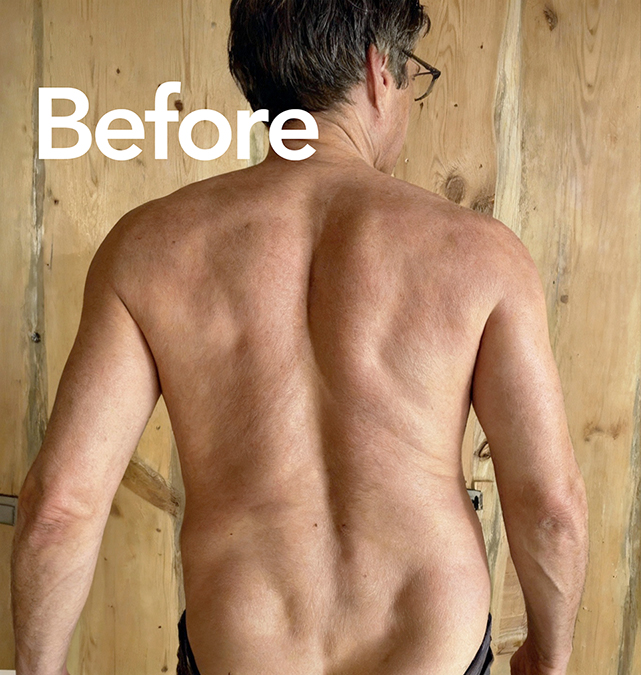
This story happened during a ski trip with my husband. After a long drive and the physical preparation for skiing, he suddenly felt something was wrong in his lower back.
His back tightened quickly. His trunk shifted to one side. He could not stand naturally upright, and every movement felt guarded.
At first glance, it looked like an acute low back problem. But what I saw was not simply “a strained back.” It was a whole fascial chain entering a protective collapse.
INITIAL SYSTEM STATE
The body had shifted into protection
Visible signs
His torso was no longer centered. The pelvis appeared pulled. The lumbar region was compressed and guarded. His body looked as if it was trying to avoid loading one side.
Functional signs
Standing upright became difficult. Walking was uncomfortable. The movement pattern was no longer free, but defensive.
This was not only local lumbar pain. It was a visible loss of axial organization: the spine, pelvis, thoracolumbar fascia, gluteal fascia, and deep lumbar chains were all involved.
BEFORE & AFTER CLINICAL ATLAS
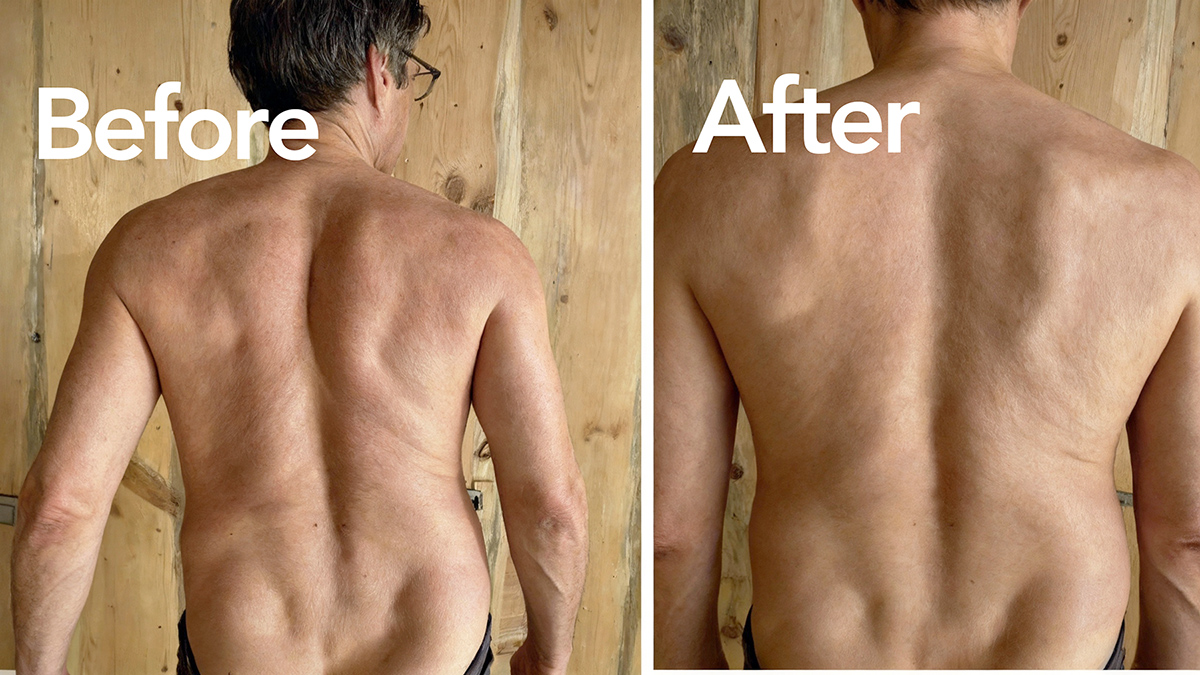
Visible reorganization after one Fasciapuncture® session
Before
The back appeared shifted, compressed, and asymmetrical. The body was holding itself in a protective posture.
After
The trunk returned toward center. The back looked more open, the spine more vertical, and the whole posture more organized.
What changed first?
The first change was not a forced correction. It was a release of the protective holding pattern. Once the key fascial restrictions softened, the body naturally returned toward its own center.
PATTERN ATLAS
The clinical pattern behind the collapse
Posterior Compression
The lumbar and posterior fascial chain tightened as the body tried to stabilize itself under sudden overload.
Pelvic Lock
The pelvis became part of the protective strategy, limiting natural load transfer through the lumbosacral region.
Compensation Loop
The body shifted away from pain, creating a visible trunk deviation and a temporary loss of central alignment.
Neuro-Fascial Irritation
Deep tension irritated the local sensory system, making movement feel unsafe and restricted.
ENTRY STRATEGY
Where the body was holding the collapse
To release the central posterior tension connecting the back, ribs, pelvis, and lumbar region.
To reduce deep lumbar guarding and restore side-to-side balance.
To calm the protective contraction around the spinal axis.
To reconnect pelvic support and lower-limb load transmission.
To help the lumbosacral area regain continuity and stability.
CLINICAL TURNING POINT
Within minutes, the system reorganized
After the session, he stood up with disbelief. The painful guarding had released. The trunk was no longer pulled to one side. His back felt lighter and more stable.
“I feel so light. It’s like something inside just opened.”
The visible transformation was immediate. But the most important part of this case was not only what happened that day. It was what remained afterward.
WHAT BECAME VISIBLE
The change was not only visual — it became functional
Posture
The trunk returned toward center without manipulation.
Movement
Walking became easier and less guarded.
Pain
The acute low back pain reduced rapidly.
Confidence
The fear of movement disappeared quickly.
Activity
He was able to go skiing the next day.
Stability
The problem did not return over the following years.
FOLLOW-UP
The result remained
The next day
He felt stable enough to ski. We went skiing as planned, without the fear and protective movement that had appeared the day before.
Three days later
The low back pain had essentially resolved. His posture and movement had returned to normal daily function.
One year later
There was no recurrence of the same lumbar collapse. No chronic instability developed afterward.
Two years later
The back remained stable. The episode did not become a recurring problem.
CLINICAL REFLECTION
Why this case matters
Many people are impressed by immediate change. But clinically, I am more interested in what remains.
A temporary reduction in pain can happen in many ways. The deeper question is: can the body maintain the change without repeated correction?
In this case, the answer was yes. The posture changed quickly. The function returned rapidly. And the result remained stable over time.
The body was not forced back into place. It remembered how to organize itself again.
KEY LEARNING POINTS
What this case teaches
1. Pain is rarely local
The low back was the visible complaint, but the problem involved a larger fascial chain.
2. Posture can be protective
The trunk deviation was not random. It was the body’s attempt to avoid pain and protect itself.
3. Release is not force
Fasciapuncture® does not push the body into alignment. It removes key restrictions so the system can reorganize.
4. Stability matters more than speed
The dramatic first change was meaningful because it remained stable over the following years.
CONNECTED CLINICAL MAP
How this case connects to the Fasciapuncture® map
Posterior Compression
Back-body fascial compression and protective holding.
Pelvic Lock
Pelvic restriction affecting load transfer and lumbar stability.
Compensation Loop
How the body shifts away from pain and creates secondary imbalance.
Neuro-Fascial Irritation
When fascial tension irritates sensory pathways and movement feels unsafe.
RELATED CASES
Other cases showing structural reorganization
CONTINUE LEARNING