MODERN LIFE & REGULATION
The Modern Body Is Not Weak — It Is Overloaded
A Fasciapuncture® reflection on adaptation, overload, and why modern pain is often the last signal to appear.
The modern body is not failing. It is carrying more mechanical, emotional, inflammatory, and regulatory load than it was designed to hold continuously.
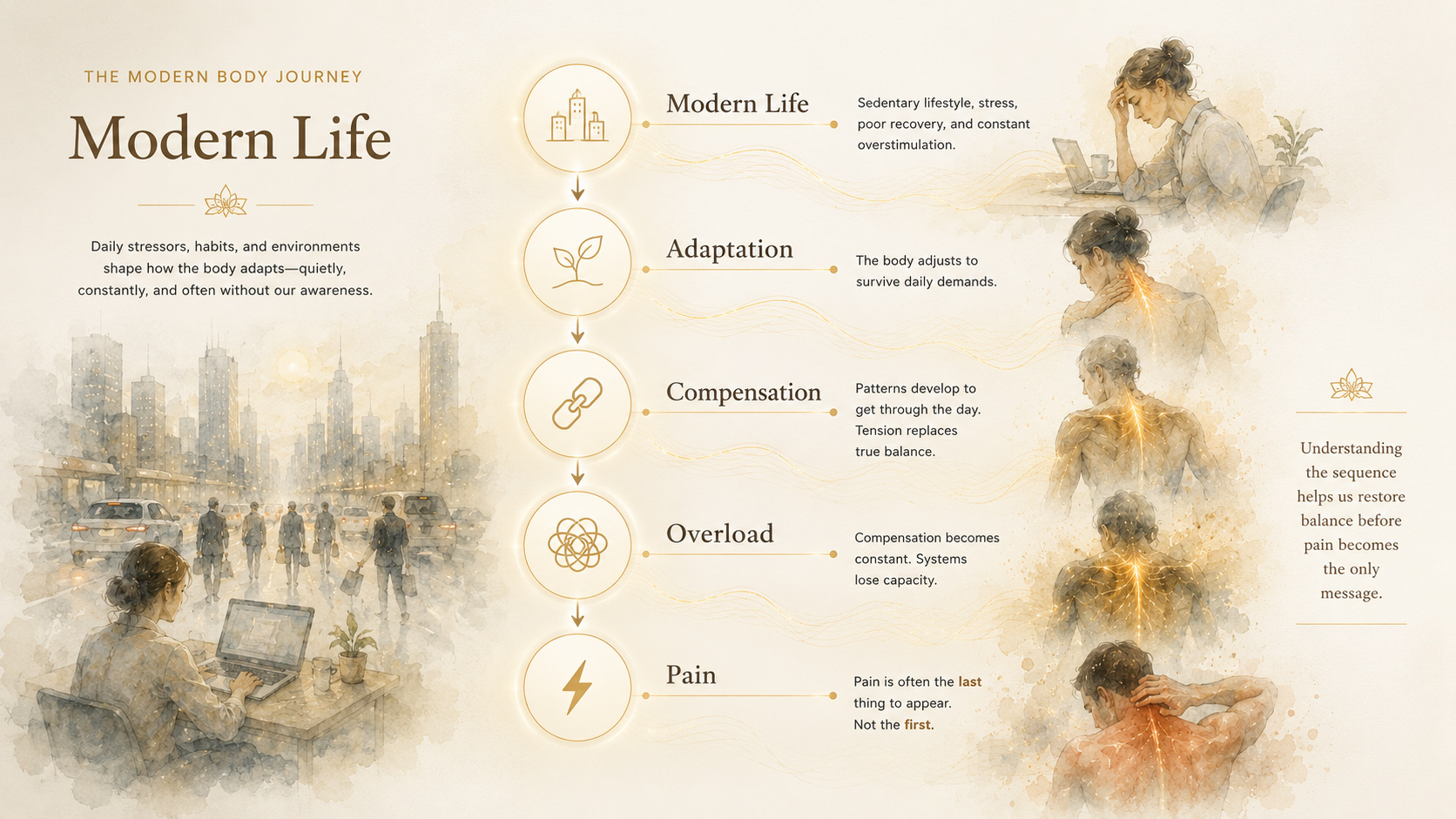
Modern life creates adaptation. Repeated adaptation becomes compensation. Long-term compensation becomes overload.
CLINICAL REFLECTION
Pain Is Often the Last Thing to Appear
Today, many people live more comfortably than ever before — yet their bodies have never been more tense, fatigued, or inflamed.
This contradiction is not accidental.
It is the result of a body repeatedly adapting to pressure without enough recovery, movement, breath, and regulation.
It is often the moment the body can no longer compensate quietly.
CLINICAL MAP
How Modern Load Becomes Pain
MODERN STRESSOR 1
Sedentary Living: The Body Designed for Movement Now Sits Still
The human body is built to walk, reach, bend, rotate, breathe deeply, and explore space.
But today we often sit at work, sit while commuting, sit during meals, sit to relax, and sit while scrolling through screens.
Over time, this creates more than stiffness. Ligaments shorten, fascia loses sliding capacity, circulation slows, and posture collapses inward.
- tight hip flexors
- sacroiliac imbalance
- thickened cervical fascia
- overworked shoulder muscles
- sleeping gluteal muscles
- increased lumbar pressure
- nerve traction along multiple chains
Every “mysterious pain” may have a mechanical story behind it.
MODERN STRESSOR 2
Stress: A Nervous System That Never Switches Off
Modern stress is continuous and subtle: constant notifications, emotional suppression, poor sleep, performance pressure, and the inability to slow down.
The body interprets this as persistent threat. Over time, sympathetic overactivation becomes a permanent fight-or-flight background state.
- shallow breathing
- tension in the neck and diaphragm
- reduced digestive function
- impaired tissue repair
- increased muscle tone
- fascial stiffness
- heightened nerve sensitivity
The fascia becomes the mirror of the nervous system.
MODERN STRESSOR 3
Mechanical Imbalance: Daily Habits That Reshape the Body
Modern posture contradicts human biomechanics. We look down at screens, collapse the chest, overuse the arms, and twist the pelvis without noticing.
- forward head posture
- rounded shoulders
- prolonged driving posture
- one-sided carrying habits
- pelvic rotation from crossing legs
- excessive forearm pronation from typing
- weakened deep stabilizers
- compensatory tension in the neck and lower back
These are not “bad habits.” They are repetitive patterns that distort the fascial system.
MODERN STRESSOR 4
Low-Grade Inflammation: The Invisible Fire
Low-grade inflammation has become a defining feature of the modern body.
It may be fueled by sedentary circulation, chronic stress, processed foods, poor sleep, gut imbalance, air pollution, microplastics, long-term muscular tension, and poor breathing mechanics.
It does not always cause immediate illness. But it can dull vitality and heighten pain sensitivity.
- thickening
- adhesion
- nodules
- morning stiffness
- swelling sensation
- inexplicable muscle fatigue
- slow recovery after exercise
These are early warnings of tissue overload.
FASCIAPUNCTURE® PERSPECTIVE
How Fasciapuncture® Responds to Modern Stressors
Fasciapuncture® is not designed to treat a symptom in isolation. It is designed to restore balance to a system under chronic load.
Through precise, gentle, and targeted approaches, Fasciapuncture® may help the body reorganize mechanical tension, fascial restriction, breathing patterns, and regulatory overload.
- restore sliding between fascial layers
- support microcirculation in overloaded tissues
- reduce sympathetic overactivation
- release deep-seated postural tension
- normalize mechanical chains
- support the body’s natural healing rhythm
- help tissues “breathe” again
This is why patients often say:
“My neck feels light.”
“My legs are warm for the first time in years.”
“I slept better than I have in a decade.”
These changes are not coincidences. They are signs of a system returning to coherence.
CORE IDEA
The Body Is Not Broken
Modern pain is often interpreted as weakness, degeneration, or isolated tissue damage.
But many symptoms are not signs of failure. They are signs that the body has been adapting for too long without enough recovery.
It is overloaded.
RELATED CLINICAL PATTERNS
This reflection belongs to the wider Clinical Map
System Exhaustion
When output continues for too long and recovery can no longer keep pace.
FOUNDATIONAL PATTERNGlobal Protective State
When the body remains organized around protection, vigilance, and effort.
REGULATION PATTERNAutonomic Dysregulation
When stress, sleep, digestion, recovery, and emotional tone become unstable.
INFLAMMATORY PATTERNChronic Inflammatory Overload
When tissues remain under persistent low-grade inflammatory pressure.
FINAL REFLECTION
Healing Is Not Forced Correction
Fasciapuncture® offers a way to listen, release, and rediscover balance — not by forcing the body, but by restoring space, movement, circulation, and calm within the fascia.
When the body regains its natural room to move and breathe, healing is no longer an effort.
CONTINUE EXPLORING
Learn to read overload before it becomes pain
Explore how modern stress, fascial tension, inflammation, recovery loss, and protective patterns connect within the Fasciapuncture® Clinical Map.