FASCIAPUNCTURE® CLINICAL THINKING
Symptoms as Warnings, Not Failures
A clinical reflection on symptoms as signals, not enemies.
Symptoms are often treated as problems to eliminate. But in Fasciapuncture®, they may also be read as the body’s last intelligent communication before compensation can no longer continue.
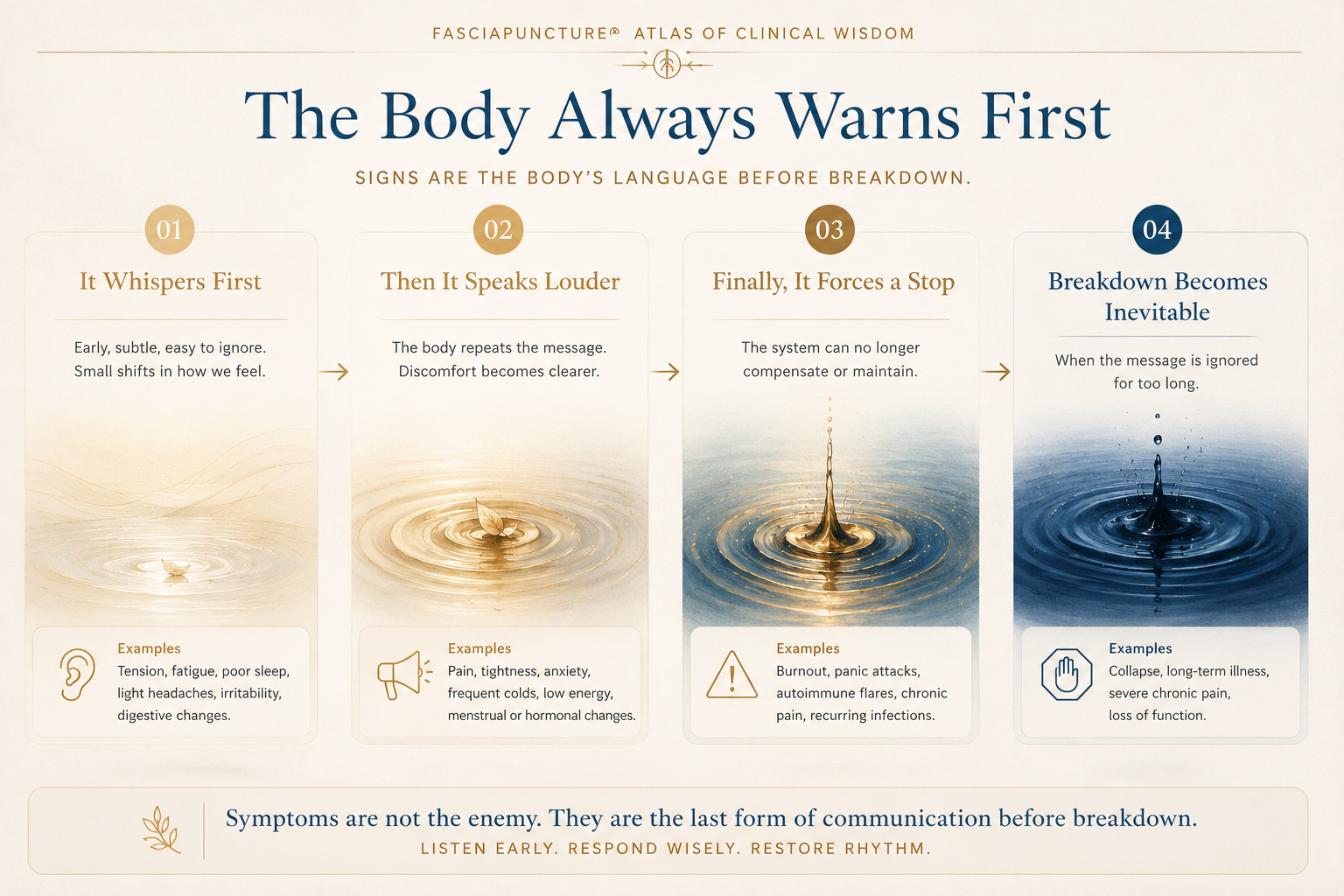
Symptoms are not always the breakdown. They may be the alarm before breakdown.
REFRAMING THE BODY’S LANGUAGE
Symptoms Are Not the Enemy
In modern healthcare culture, symptoms are often treated as problems to eliminate.
- Pain must stop.
- Heat must cool.
- Insomnia must disappear.
- Inflammation must be suppressed.
The faster the symptom disappears, the better the treatment may seem.
But from a clinical perspective, this way of thinking can miss something essential.
It may be the place where regulation is no longer sufficient.
THE ALARM BEFORE BREAKDOWN
Symptoms Are Not the Breakdown
Most systems do not fail suddenly.
They warn first.
The body does the same.
Symptoms are rarely signs of weakness. They are signs of adaptation under strain.
They appear when the body is still trying to regulate, compensate, and survive.
Ignoring them does not restore balance. It only delays the moment when compensation is no longer possible.
The body rarely fails without warning. It whispers first, then speaks louder, and finally forces a stop.
WHY SUPPRESSION FEELS LIKE RELIEF
Relief Is Not Always Regulation
When symptoms are suppressed, there is often immediate comfort.
- Pain decreases.
- Sleep improves temporarily.
- Heat subsides.
- The body feels quieter for a while.
But relief is not always regulation.
In many cases, symptoms return — sometimes stronger, sometimes elsewhere.
Not because treatment failed, but because the message was never integrated.
THE BODY SPEAKS IN SIGNALS
Not Explanations, but Signals
The body does not communicate in words.
It uses signals:
- pain
- temperature changes
- sleep disturbances
- digestive reactions
- inflammatory responses
- fatigue and loss of rhythm
These are not errors in the system. They are the system speaking.
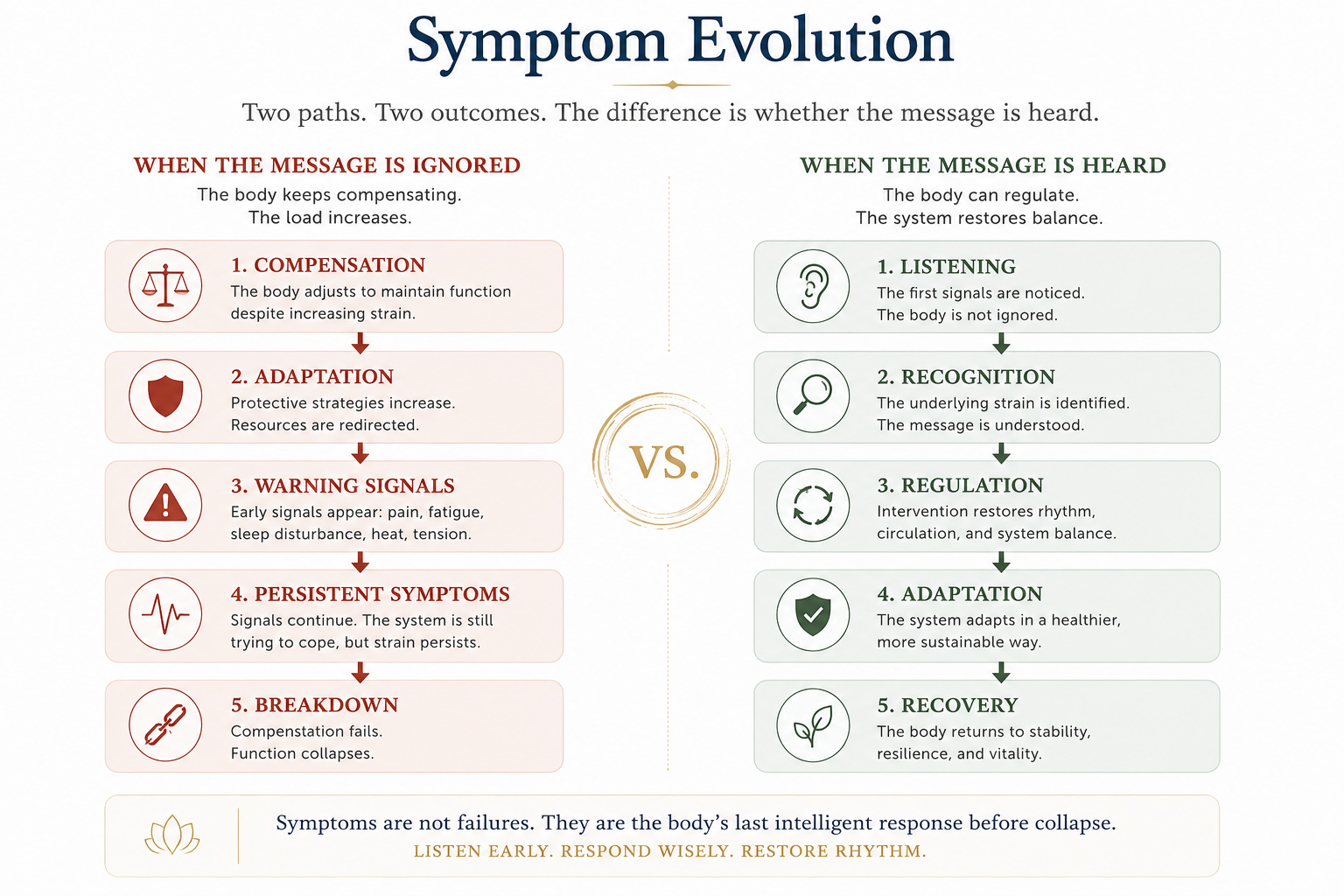
CLINICAL MAP
From Warning to Recovery
The Compensation Path
Compensation
↓
Adaptation Under Strain
↓
Warning Signals
↓
Persistent Symptoms
↓
Breakdown
The Regulation Path
Listening
↓
Recognition
↓
Regulation
↓
Adaptation
↓
Recovery
TRADITIONAL PERSPECTIVE
Symptoms Are Not Isolated Events
In traditional Chinese medicine, symptoms are not isolated events.
They are expressions of imbalance in rhythm, circulation, reserve, and systemic communication.
They indicate where the system is struggling, and how long it has been struggling.
The question is not:
But rather:
WHEN SYMPTOMS ARE TREATED AS ENEMIES
Distance Delays Recovery
When symptoms are seen only as failures, patients often learn to distrust their own bodies.
- They push through pain.
- They normalize exhaustion.
- They silence warning signs.
This does not create resilience.
It creates distance.
And distance delays recovery.
RELATED CLINICAL PATTERNS
This reflection belongs to the wider Clinical Map
Global Protective State
When symptoms reflect a body organized around protection, vigilance, and long-term adaptation.
RECOVERY PATTERNSystem Exhaustion
When fatigue, insomnia, and recurring symptoms reveal that recovery can no longer keep pace.
SYSTEMIC REGULATIONAutonomic Dysregulation
When sleep, digestion, emotional tone, temperature, and recovery signals become unstable.
INFLAMMATORY RESPONSEChronic Inflammatory Overload
When inflammatory symptoms become part of a wider systemic overload pattern.
A CLINICAL REFRAMING
Why Intervention Is Possible
The clinical problem is not that symptoms exist.
The problem is that symptoms are often treated as targets to suppress, leading to escalation rather than resolution.
but through the regulatory level they signal.
By identifying which fascial-neural interfaces are under strain, the practitioner can intervene where regulation has become insufficient — without chasing the symptom itself.
This enables precise, non-aggressive intervention even when symptoms are diffuse, shifting, or unclear.
CLINICAL IMPLICATION
A Symptom Is a Request for Adjustment
Our role is not to glorify symptoms, nor to let people suffer unnecessarily.
It is to help patients understand this:
not a verdict.
When the message is heard early, change can be gentle.
When it is ignored repeatedly, the body eventually chooses for us.
HEALING IS NOT SILENCING
It Is Listening, Then Responding
True recovery begins when symptoms are no longer feared or fought.
They become guides.
Not because they are pleasant, but because they are precise.
The body does not punish. It protects — until it can no longer compensate.
FINAL REFLECTION
Symptoms Are Not Failures
They are the last intelligent response before collapse.
And when we learn to listen sooner, we rarely need to learn the hard way.
They are the body asking to be heard.
FASCIAPUNCTURE® TRAINING
These Principles Become Clinical Skills
- precise identification of neuro-fascial entry zones
- distinction between regulatory, destabilizing, and non-indicated areas
- clinical decision-making based on system state rather than symptoms
CONTINUE EXPLORING
Learn to read symptoms as part of regulation
Fasciapuncture® does not treat symptoms as isolated failures. It reads them as signals within a larger protective, adaptive, and regulatory pattern.