
Signature Clinical Case
When Shoulder Treatment Fails
A clinical case showing how persistent shoulder pain changed when treatment did not begin from the shoulder.
Movement Re-Test
The shoulder changed after the system changed
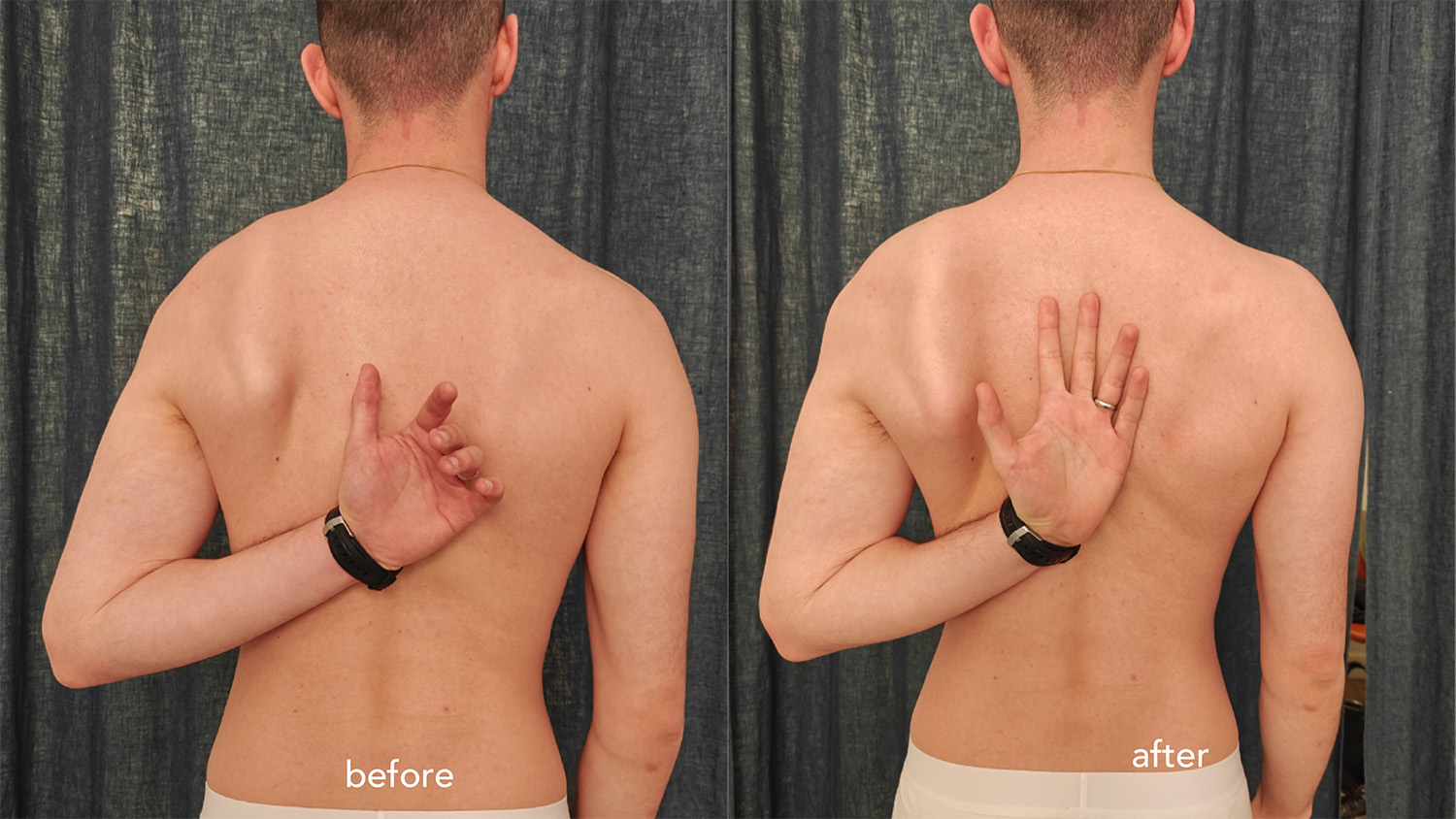
Real clinical case from daily practice. No direct work was performed on the shoulder.
Initial Presentation
A shoulder that did not respond to shoulder treatment
The patient presented with persistent shoulder pain after consulting several practitioners. Previous sessions included physiotherapy and osteopathy, but the pain and movement restriction remained.
The most obvious limitation was internal rotation. Reaching behind the back was difficult, and daily movements remained restricted.
The shoulder was restricted,
but the restriction was not only local.
System State
What the body was showing
Main symptoms
Persistent shoulder pain, limited internal rotation, difficulty reaching behind the back, and restriction during daily movements.
Clinical context
Several weeks of discomfort, previous local treatments without lasting improvement, and functional limitation more obvious than local pain alone.
Clinical Question
Is this really a shoulder problem?
In Fasciapuncture®, the painful area is not automatically treated first. The first question is not only where the pain is located, but whether the system is available for change.
In this case, the shoulder restriction appeared together with scapular instability, reduced glide over the thoracic wall, posterior fascial tension, and a wider system-wide restriction pattern.
Fascia-Based Reasoning
Why the shoulder was not treated first
The shoulder expressed the problem, but did not explain the whole pattern.
Lumbar and lumbosacral tension suggested an axial component influencing the upper body.
Abdominal regulation was used to help the system settle and reorganize.
Cervical release helped restore upper-body availability and shoulder movement.
Treatment Strategy
Restoring system availability before chasing pain
The goal was not to fix the shoulder.
The goal was to restore the system behind it.
Immediate Clinical Shift
One session — without direct shoulder treatment
Pain decreased
The patient reported a clear decrease in pain immediately after the session.
Range improved
Internal rotation became easier, and reaching behind the back improved.
Movement changed
The shoulder followed the system once the wider fascial restriction began to release.
Clinical surprise
The patient was surprised because the shoulder had not been treated directly.
Clinical Reflection
Pain shows expression. It does not always show origin.
This case demonstrates one of the central principles of Fasciapuncture®: pain shows where the system expresses distress, but it does not always show where the problem begins.
In persistent shoulder pain, local treatment may be insufficient when the restriction belongs to a wider fascial and regulatory pattern.
We do not treat where the pain is.
We read where the system is blocked.
Pattern × Pillar Map
Where this case belongs in the Fasciapuncture® clinical map
Training Insight
This is not about technique. It is about clinical perception.
This case illustrates the clinical reasoning pathway used in Fasciapuncture® training: how to look beyond the painful area, recognize system-wide patterns, and choose treatment zones based on functional logic.