
SIGNATURE CLINICAL CASE
When Inflammation Never Truly Rests
A 44-year-old woman with psoriatic arthritis, night pain, digestive tension, anxiety, skin flare-ups, and systemic exhaustion — where the first clinical question was not how to fight inflammation, but how to help the body recover its ability to regulate.
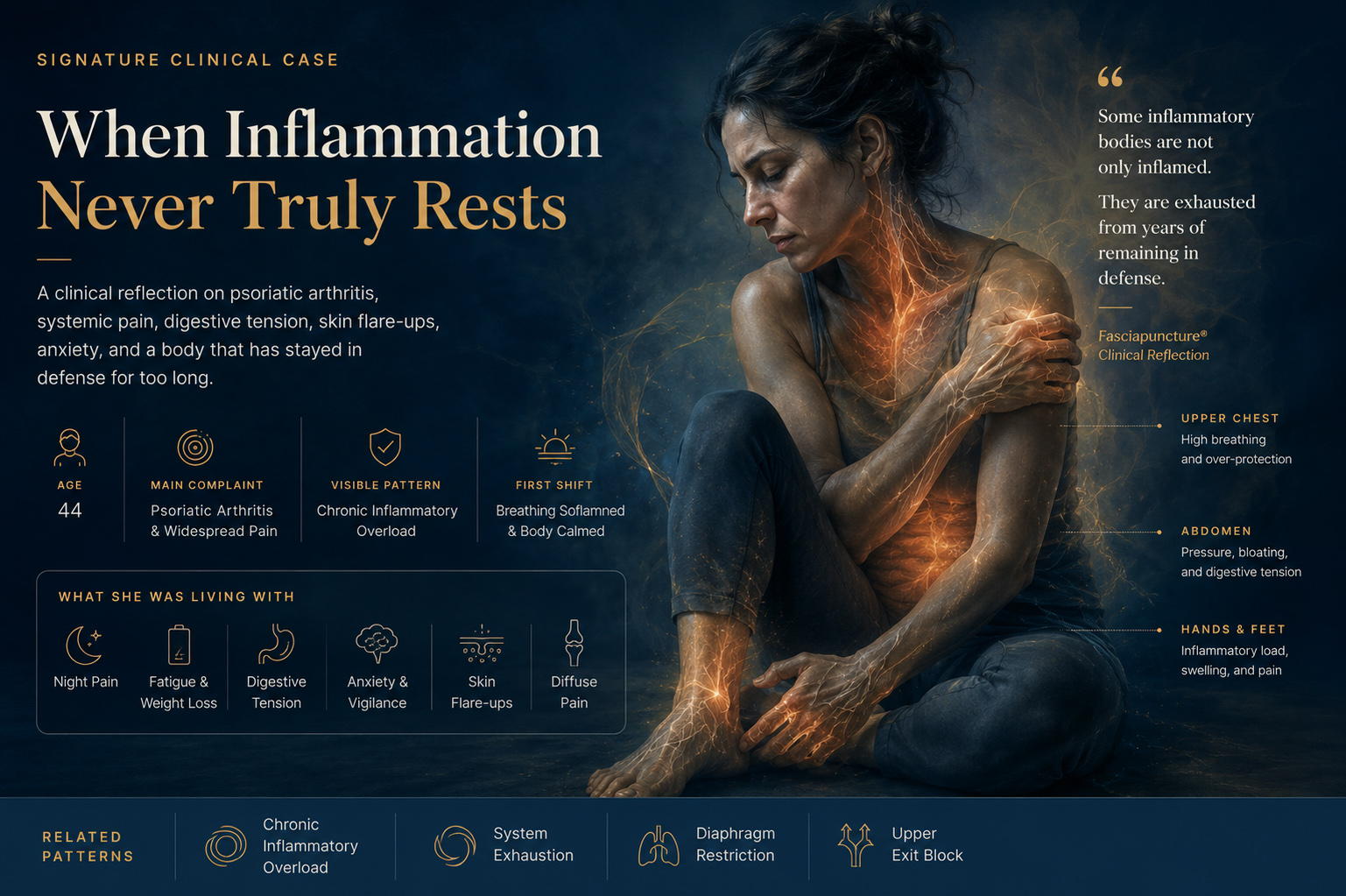
The intention was not to fight inflammation. The intention was to restore regulation.
CLINICAL OPENING
Inflammation was visible. Exhaustion was hidden.
The patient had been living with psoriatic arthritis for several years. She was receiving methotrexate treatment and monthly anti-TNF injections, yet body pain had progressively returned and become more diffuse.
Pain was particularly severe at night. The right ankle, left foot, and left hand were especially painful. She also described chronic anxiety, digestive bloating, reflux, constipation, skin eruptions on the feet, weight loss, and a long history of antidepressant medication.
Beyond inflammation itself, the body appeared globally exhausted, hypervigilant, compressed, and unable to fully enter recovery.
INITIAL SYSTEM STATE
The body remained in prolonged defense
Inflammation & Pain
Psoriatic arthritis with diffuse body pain, night aggravation, right ankle pain, left foot pain, and left hand pain.
Digestive Pressure
Bloating, reflux, constipation, and abdominal guarding suggested that the center of the body was also under pressure.
Emotional Vigilance
Chronic anxiety and long-term antidepressant use reflected a nervous system that had remained under emotional load for years.
System Exhaustion
Weight loss, fatigue, night pain, shallow recovery, and skin flare-ups suggested that the system was running out of restorative capacity.
PATTERN ATLAS
The inflammatory body was also an exhausted body
Chronic Inflammatory Overload
Joint pain, skin flare-ups, night aggravation, and diffuse inflammatory expression suggested chronic overload beyond a single local area.
System Exhaustion
Fatigue, weight loss, poor recovery, and night pain showed a body that could no longer fully restore itself.
Global Protective State
Anxiety, guarding, shallow recovery, and persistent defense suggested a system organized around vigilance and protection.
Diaphragm Restriction
Breathing, abdominal tension, reflux, bloating, and pressure regulation were read as part of the same central pattern.
BEFORE & AFTER CLINICAL ATLAS
The first change was not only pain
Before
- Diffuse pain and night aggravation
- Right ankle, left foot, and left hand pain
- Digestive tension, bloating, reflux, and constipation
- Anxiety and hypervigilance
- Skin flare-ups and global exhaustion
After
- Breathing began to descend
- The body softened
- The face appeared calmer
- Internal agitation reduced
- The system felt less compressed
ENTRY STRATEGY
Regulation before aggression
Do Not Chase the Most Painful Joint
The clinical approach did not begin by focusing immediately on the right ankle, left foot, or left hand.
Read the Systemic Defense State
Night pain, anxiety, digestive tension, skin flare-ups, and exhaustion were read together as one broader inflammatory defense pattern.
Support Breathing Descent
Upper thoracic, cervical, abdominal, and diaphragmatic zones were used to help the system descend out of compression.
Reduce Global Guarding
The intention was not to fight inflammation, but to help the body recover some capacity for regulation and rest.
CLINICAL TURNING POINT
The body calmed before the joints changed
Rather than focusing immediately on the most painful joints, the clinical approach prioritized systemic decompression and autonomic down-regulation.
Breathing began to descend. The body softened. The face appeared calmer. Internal agitation reduced, and the system felt less compressed.
WHAT BECAME VISIBLE
Observable signs of regulation
Breathing
Breathing began to descend instead of remaining held in compression.
Face
The facial expression appeared calmer and less defended.
Internal Agitation
The sense of internal unrest and hypervigilance reduced.
Body Compression
The system felt less globally compressed and guarded.
Recovery Capacity
The body showed the first signs of being able to move toward rest.
CLINICAL REFLECTION
Some inflammatory bodies are exhausted bodies
In Fasciapuncture®, chronic inflammatory conditions are not reduced to isolated joints or isolated symptoms. We also observe breathing, abdominal pressure, fascial guarding, recovery capacity, autonomic tone, and the body’s ability to return to calm.
This case suggests that chronic inflammation may not only be an immune story. It may also reflect tension, exhaustion, compression, and a body that no longer knows how to fully rest.
KEY LEARNING POINTS
What this case teaches
Inflammation has a system state
Joint pain and skin flare-ups may coexist with global compression, anxiety, exhaustion, and poor recovery.
Night pain matters
Pain that worsens at night may reveal that the system cannot enter true restoration and down-regulation.
The abdomen is part of the story
Bloating, reflux, constipation, and guarding may reflect central pressure and diaphragm-abdominal restriction.
First shift may be regulation
Breathing, facial expression, and internal calm may change before joint pain itself becomes the main visible marker.
CONNECTED CLINICAL MAP
Patterns connected to this case
Chronic Inflammatory Overload
Long-term inflammatory expression, pain, skin flare-ups, and systemic pressure.
System Exhaustion
Fatigue, night pain, reduced recovery capacity, and body depletion.
Global Protective State
Vigilance, protection, compression, anxiety, and chronic defense.
Diaphragm Restriction
Breathing limitation, abdominal pressure, reflux, and central tension.
RELATED CONDITIONS
Conditions connected to this case
RELATED CASES
Other cases where inflammation and exhaustion became visible
When the Skin Stopped Carrying the Pressure
A 37-year psoriasis case showing how the skin may carry systemic pressure.
When Sleep Slowly Returns
A case where sleep returned after systemic regulation returned.
When the Body Remembers How to Rest
A case of long-term exhaustion, poor sleep, and returning regulation.
CONTINUE LEARNING
From inflammation to systemic regulation
Pattern Atlas — Chronic Inflammatory Overload
Explore how inflammatory expression may connect with systemic pressure and exhaustion.
Module 1 — Foundations of Fasciapuncture®
Understand why symptoms may reflect deeper regulatory patterns.
Module 2 — Clinical Perception & Diagnosis
Learn to read pressure, breathing, guarding, and system state.