
SIGNATURE CLINICAL CASE
When Jaw Clicking Is Not a Jaw Problem
A 42-year-old woman with jaw tension, audible clicking, cervical pain, medial scapular discomfort, poor sleep, and internal anxiety — where the first clinical question was not “how to treat the jaw,” but how to read the cervical–scapular fascial pattern behind it.
THE CLINICAL TURNING POINT
The Problem Was Not the Jaw
The patient came with jaw clicking and mandibular tightness. Yet clinically, the jaw did not appear to be the primary origin of the problem.
The broader pattern involved cervical tension, scapular restriction, submandibular fascial tightness, poor sleep, anxiety, and a mild forward-head posture.
In Fasciapuncture®, the question is not only where the symptom appears. The deeper question is: what system is transmitting tension toward that symptom?
INITIAL SYSTEM STATE
The System Was Caught Between Jaw, Neck, and Scapula
Jaw
Persistent jaw tightness with audible clicking during opening, accompanied by repeated mouth-stretching movements.
Neck
Right cervical tension with increased loading from a mild forward-head posture pattern.
Scapula
Pain along the medial border of the scapula, with sensitivity near the levator scapulae and upper trapezius fascial insertion.
Regulation
Light sleep, fragmented rest, anxiety, and a sensation of internal pressure suggested autonomic involvement.
PATTERN READING
The Jaw Was Not Failing. It Was Receiving Tension.
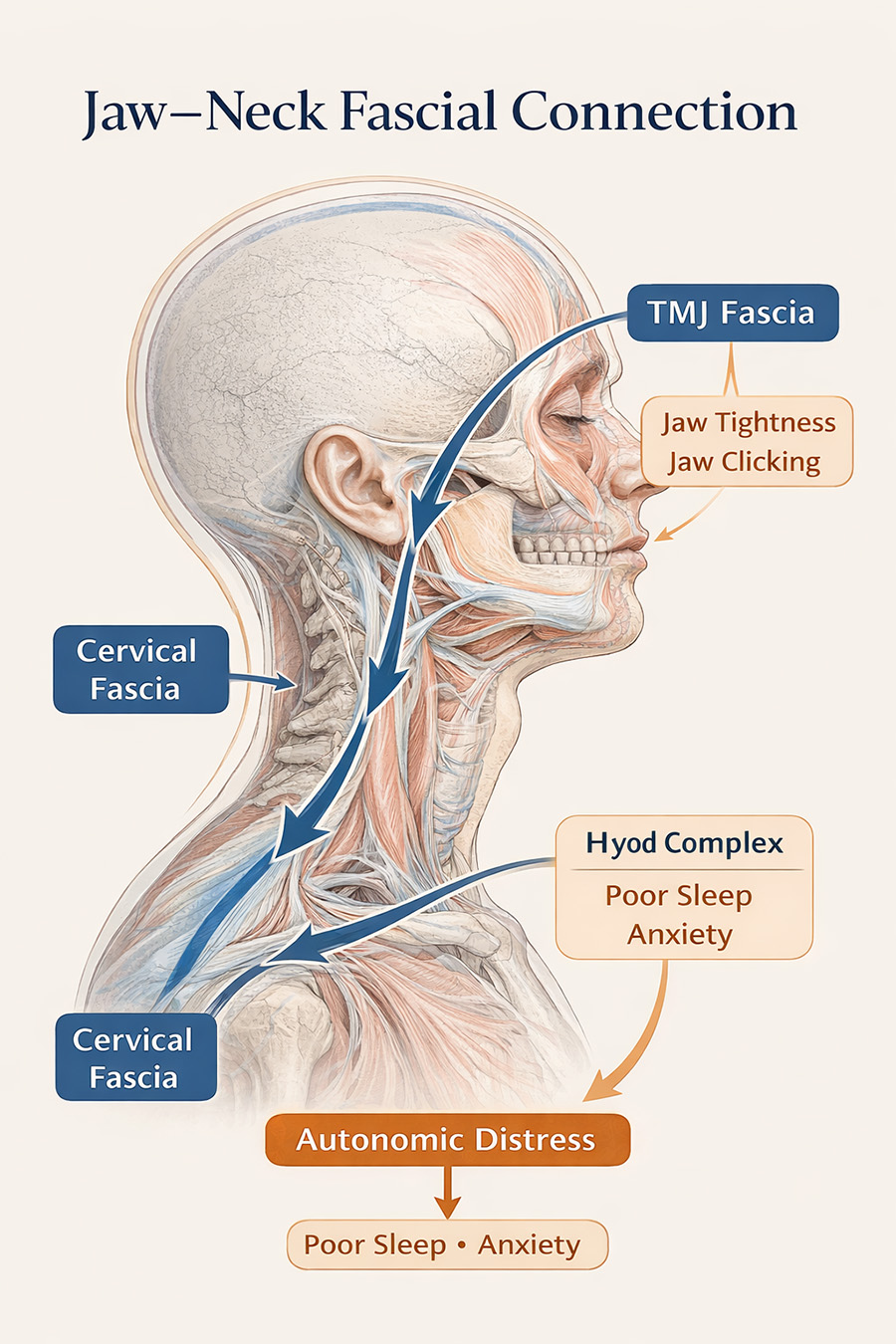
Jaw clicking was interpreted not as an isolated temporomandibular disorder, but as a distal expression of cervico-scapular fascial tension.
The clinical reading suggested a broader pattern involving:
- Cervical–scapular fascial corridor tension
- Levator scapulae and upper trapezius restriction
- Suprahyoid and submandibular fascial tightness
- Forward-head loading
- Autonomic dysregulation with poor sleep and anxiety
When cervical and scapular fascia lose mobility, the hyoid complex and mandibular system may become secondary endpoints of that tension.
TREATMENT STRATEGY
Treatment Did Not Begin by Chasing the Clicking
Read the cervical–scapular fascial corridor
Observe jaw movement and cervical loading
Assess the hyoid and submandibular fascial tension
Release the primary fascial restriction zones
Re-test jaw opening, clicking, facial tone, and internal calm
WHAT BECAME VISIBLE
The Jaw Changed After the Neck Began to Release
CLINICAL REFLECTION
Jaw Clicking Is Sometimes the End of the Story — Not the Beginning
This case shows how a local symptom may be the visible endpoint of a deeper fascial tension pattern.
The symptom was not treated as an isolated jaw problem.
Instead, treatment focused on restoring mobility and regulation within the cervical, scapular, hyoid, and upper thoracic fascial network.
CONNECTED CLINICAL MAP