
FASCIAPUNCTURE® CONDITION MAP
Migraine
A fascia-oriented perspective on migraine, head pressure, light sensitivity, nausea, neck tension, jaw compression, dizziness, and autonomic overload. Fasciapuncture® Perspective on Migraine: Exploring the relationship between fascia, cervical tension, breathing patterns, sensory sensitivity, and body regulation.
CORE READING
Migraine is not only a headache.
Migraine may reflect a deeper interaction between cranial fascia, cervical tension, jaw compression, sensory sensitivity, breathing restriction, and autonomic dysregulation.
FASCIA-BASED REASONING
Migraine may begin before the pain appears.
Many people experience migraine as pain in the head. But clinically, the pattern often begins earlier: neck stiffness, pressure behind the eyes, jaw tension, nausea, fatigue, poor sleep, emotional overload, or a nervous system that cannot fully settle.
In Fasciapuncture®, migraine is not viewed only as a local cranial problem. It may be the visible expression of a wider cranio-cervical and autonomic pattern.
COMMON EXPRESSIONS
How migraine may show itself
Migraine may involve more than head pain alone. Pain, pressure, sensory sensitivity, cervical tension, digestive response, and autonomic changes may appear together as part of a wider body pattern. Fasciapuncture® explores these expressions through fascia, movement, breathing, and body regulation.
One-Sided Head Pain
Migraine pain may appear around one temple, eye, forehead, or one side of the head. Fasciapuncture® explores how these symptoms may connect with cranial fascia, cervical tension, sensory load, and protective body patterns.
Neck and Shoulder Tension
Neck stiffness, upper trapezius tension, jaw tightness, or shoulder guarding may appear before or alongside migraine episodes. Fasciapuncture® observes the relationship between cervical fascia, upper-body posture, breathing patterns, and cranio-cervical organization.
Sensory Sensitivity
Light, sound, smell, screen exposure, or movement may become difficult to tolerate during migraine episodes. Fasciapuncture® explores how sensory sensitivity may interact with cranial tension, autonomic regulation, and the body's protective response.
Digestive and Autonomic Signs
Nausea, fatigue, dizziness, poor sleep, anxiety, or abdominal pressure may appear together with migraine patterns. Fasciapuncture® explores these connections through breathing, abdominal regulation, fascia, and whole-body organization.
CLINICAL VIEW
The Hidden System Behind Migraine
Local approaches may focus on reducing symptoms. Fasciapuncture® explores the wider body organization that may accompany recurring migraine patterns.
In Fasciapuncture®, we observe migraine through a larger map: the skull, temples, jaw, anterior cervical fascia, suboccipital region, clavicular area, thoracic outlet, breathing axis, abdomen, and autonomic state.
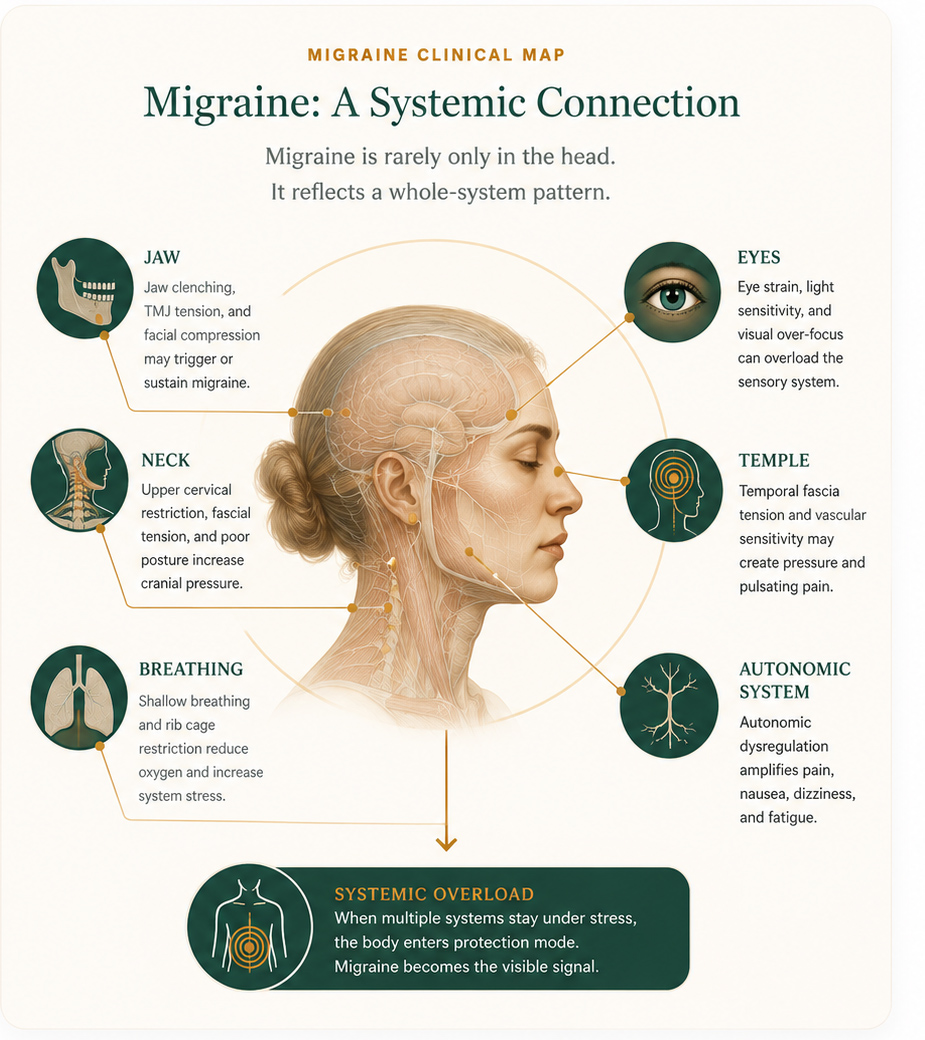
MIGRAINE PATTERN ATLAS
Common patterns behind migraine
We do not only ask where the head hurts. We observe how the body organizes around cranial pressure, cervical restriction, and sensory overload.
Cranial Fascial Tension
Pressure around the scalp, temples, forehead, eyes, and cranial fascia.
Pattern 02Upper Exit Block
Restriction around the neck, jaw, clavicle, upper thorax, and exit zones.
Pattern 03Cervical Axis Tension
Cervical stiffness, altered head posture, and chronic fascial adaptation.
Pattern 04Jaw–Neck Lock
Jaw compression and cervical tension reinforcing each other.
Pattern 05Autonomic Dysregulation
A nervous system that remains activated, sensitive, and reactive.
Pattern 06Global Protective State
Long-term protection where the body stays on guard after the original stress has passed.
CLINICAL INSIGHT
The pain is in the head, but the pattern may involve the whole system.
Migraine may appear when cranial fascia, cervical axis, jaw tension, sensory sensitivity, breathing restriction, digestive response, and autonomic regulation all participate in the same protective pattern.
The question is not only: “Where is the headache?” The deeper clinical question is: “What system is overloaded before the migraine begins?”
RELATED CONDITIONS
Other entry points connected with migraine
CLINICAL CASES
Where migraine patterns become visible
Clinical cases show how migraine may connect with neck tension, throat pressure, reflux, anxiety, sleep disturbance, and systemic regulation.
It Was Never Only the Throat
A 40-year-old woman with migraine, reflux, anxiety, neck tension, and persistent throat obstruction experienced immediate breathing relief when pressure finally began to descend.
When the Concrete Lifted from Her Neck
A chronic headache case showing how neck pressure, tinnitus, abdominal compression, and lower limb swelling may reflect one deeper systemic pressure pattern.
The Neck Was Carrying More Than Posture
A clinical case of head heaviness, poor sleep, breathing restriction, and chronic cervical guarding where visible neck tension reflected a deeper protection pattern.
RELATED TRAINING
Learn the clinical reasoning behind migraine patterns
Foundations of Fasciapuncture®
Understand pain, fascia, adaptation, and regulation-based clinical reasoning.
Explore Module →Clinical Perception & Diagnosis
Learn to observe posture, movement, tension zones, and global fascial patterns.
Explore Module →Cranio-Cervical and Shoulder Syndromes
Explore cervical-origin symptoms, jaw tension, tinnitus, headaches, migraine, and face pain.
Explore Module →Migraine may be the signal — not the source.
If migraine appears with neck tension, jaw tightness, dizziness, nausea, sleep disturbance, light sensitivity, or anxiety, a wider fascia-based assessment may reveal the pattern behind the pain.
Book a Consultation