SIGNATURE CLINICAL CASE
When the Skin Stopped Carrying the Pressure
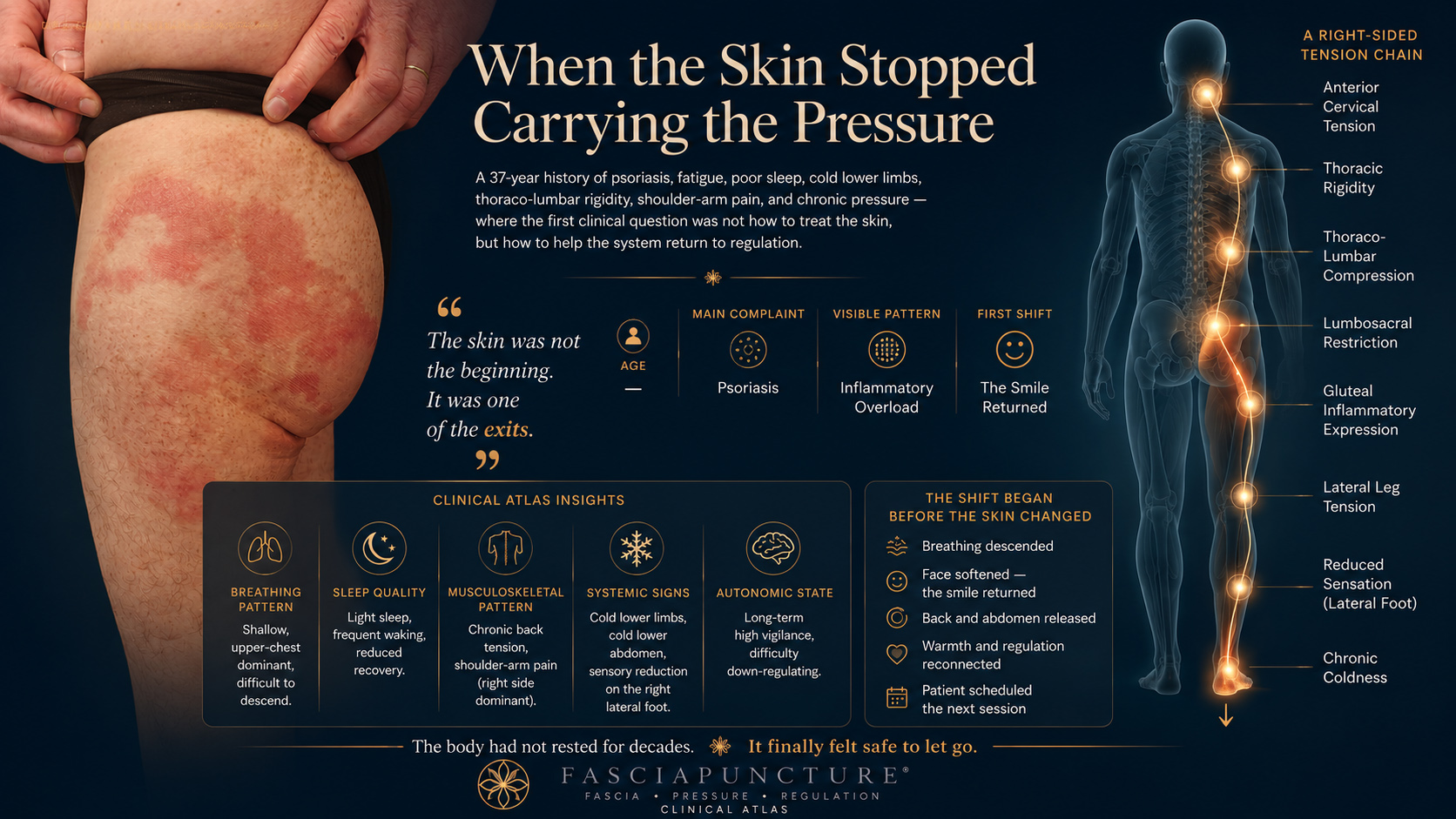
A 37-year history of psoriasis, fatigue, poor sleep, cold lower limbs, thoraco-lumbar rigidity, shoulder-arm pain, and chronic pressure — where the first clinical question was not how to treat the skin, but how to help the system return to regulation.
CLINICAL OPENING
The skin had been speaking for 37 years
The patient had lived with psoriasis for 37 years. He worked as an architect under long-term pressure, with chronic fatigue, poor sleep, cold feet, cold lower abdomen, and a back that remained tense and contracted.
Two years earlier, after only two Fasciapuncture® sessions, the psoriasis that had been present for decades gradually faded, and the skin returned close to a normal appearance.
This time, he returned with a recurrence. The deeper pressure pattern had not truly changed: stress remained high, sleep remained poor, and the body still carried signs of chronic protection.
INITIAL SYSTEM STATE
The system was caught between pressure and exhaustion
Skin
A 37-year inflammatory skin expression, recurring when the deeper stress and sleep pattern remained unchanged.
Sleep & Recovery
Poor recovery and light sleep suggested that the system could not fully down-regulate.
Back & Thoraco-Lumbar Rigidity
Thoraco-lumbar rigidity and chronic contraction showed a body held in long-term defensive tone.
Lower Body Coldness
Cold lower abdomen, cold feet, and lateral foot sensory reduction suggested reduced downstream regulation.
PATTERN ATLAS
The psoriasis was read as a systemic outlet
Chronic Inflammatory Overload
The skin appeared as a visible inflammatory expression of long-term systemic pressure and regulatory burden.
Upper Exit Block
Neck tension, shoulder-arm pain, and pressure in the upper body suggested difficulty releasing through the upper exit pathways.
Core Block
Cold lower abdomen and abdominal restriction suggested that the center of the body was not transmitting pressure freely.
System Exhaustion
Long-term fatigue, poor sleep, coldness, and emotional heaviness showed that the body was no longer recovering efficiently.
ENTRY STRATEGY
Treatment did not begin by chasing the skin
Read the Upper Exit
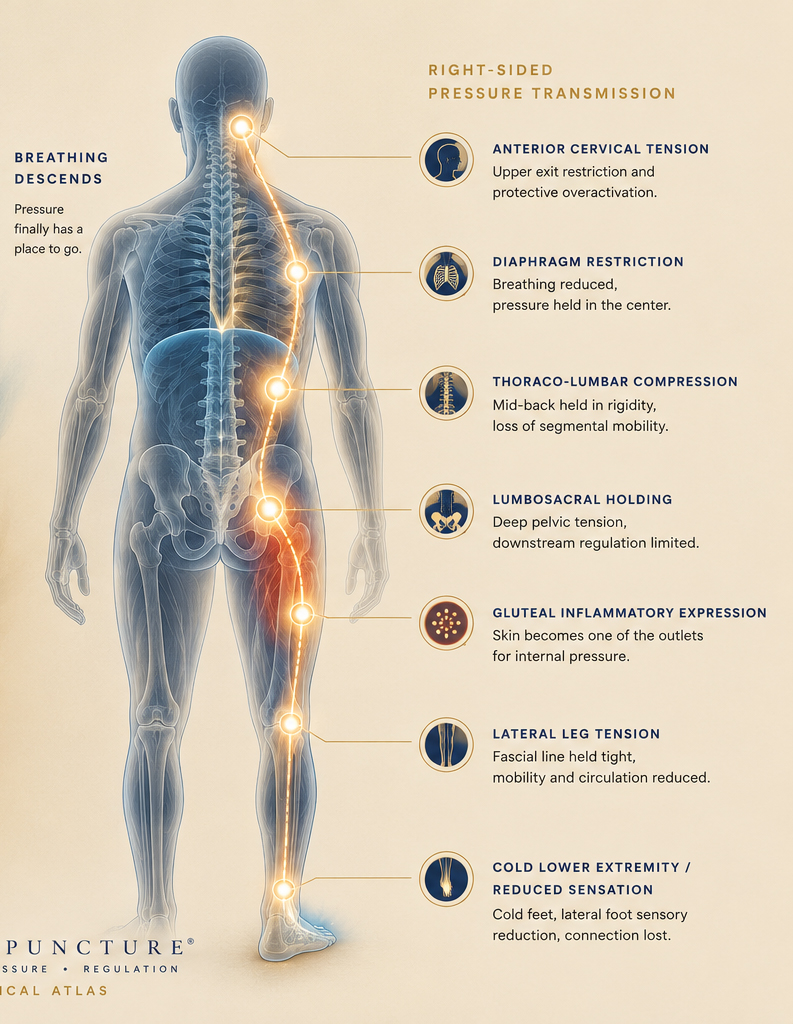
The anterior neck and suboccipital region were observed as key areas of pressure release and autonomic access.
Observe the Breath and Abdomen
The middle abdomen and diaphragmatic response were used to read whether the body could return toward regulation.
Release Thoraco-Lumbar Pressure
The thoraco-lumbar region was addressed as a long-term pressure corridor between upper tension and lower-body coldness.
Open Lumbosacral Regulation
The lumbosacral region was included to help reconnect lower-body warmth, foot sensation, and downstream circulation.
CLINICAL TURNING POINT
The smile returned before the skin changed
After treatment of the anterior neck, middle abdomen, thoraco-lumbar area, lumbosacral region, and suboccipital points, the breathing became deeper.
Then something changed before the skin: his facial expression softened. The previous seriousness and emotional distance gave way to warmth, relief, and a visible smile.
WHAT BECAME VISIBLE
Observable signs of systemic regulation
Breathing
Breathing descended and became deeper.
Face
The facial expression softened and the smile returned.
Back
The thoraco-lumbar region released from defensive contraction.
Warmth
The body began to show signs of returning warmth and circulation.
System State
The patient appeared calmer and scheduled the next session.
CLINICAL REFLECTION
Psoriasis may be the end of the story, not the beginning
This case shows how a visible skin symptom may be the final expression of a deeper system trying to manage pressure, tension, coldness, exhaustion, and internal overload.
The symptom was not approached as an isolated skin problem. Instead, treatment focused on restoring systemic availability.
KEY LEARNING POINTS
What this case teaches
The skin may be an outlet
Chronic skin expression may reflect deeper pressure regulation, not only local dermatological activity.
Sleep reveals system recovery
Poor sleep suggested that the system could not fully return from vigilance into restoration.
Coldness matters
Cold lower abdomen and cold feet showed that systemic regulation was not reaching the lower body efficiently.
The first shift may be emotional
The returning smile was a clinical sign that the protective state had begun to soften.
CONNECTED CLINICAL MAP
Patterns connected to this case
Chronic Inflammatory Overload
Long-term inflammatory expression, pressure burden, and system overload.
Upper Exit Block
Neck, head, shoulder, and upper-body pressure restriction.
Core Block
Abdominal holding, pressure stagnation, and central regulatory blockage.
System Exhaustion
Fatigue, poor sleep, coldness, and reduced recovery capacity.
RELATED CONDITIONS
Conditions connected to this case
RELATED CASES
Other cases where the system became visible
When the Body Remembers How to Rest
A case of long-term exhaustion, poor sleep, and returning regulation.
When Breathing Becomes Quiet
A clinical moment where breathing descends and the system softens.
When the Abdomen Finally Let Go
A case of abdominal holding, breathing restriction, and pelvic protection.
CONTINUE LEARNING
From skin symptoms to systemic regulation
Module 1 — Foundations of Fasciapuncture®
Understand why symptoms may reflect deeper regulatory patterns.
Module 2 — Clinical Perception & Diagnosis
Learn to read pressure, breathing, fatigue, coldness, and systemic signs.
Pattern Atlas — Chronic Inflammatory Overload
Explore how chronic inflammatory expression may connect with systemic pressure.