
Signature Clinical Case
When the Hand Is Not the Problem
A clinical case of nocturnal hand numbness revealing an anterior shoulder, scapular, and cervical fascial pattern.
Movement Re-Test
The wrist was not the answer. The pattern was elsewhere.
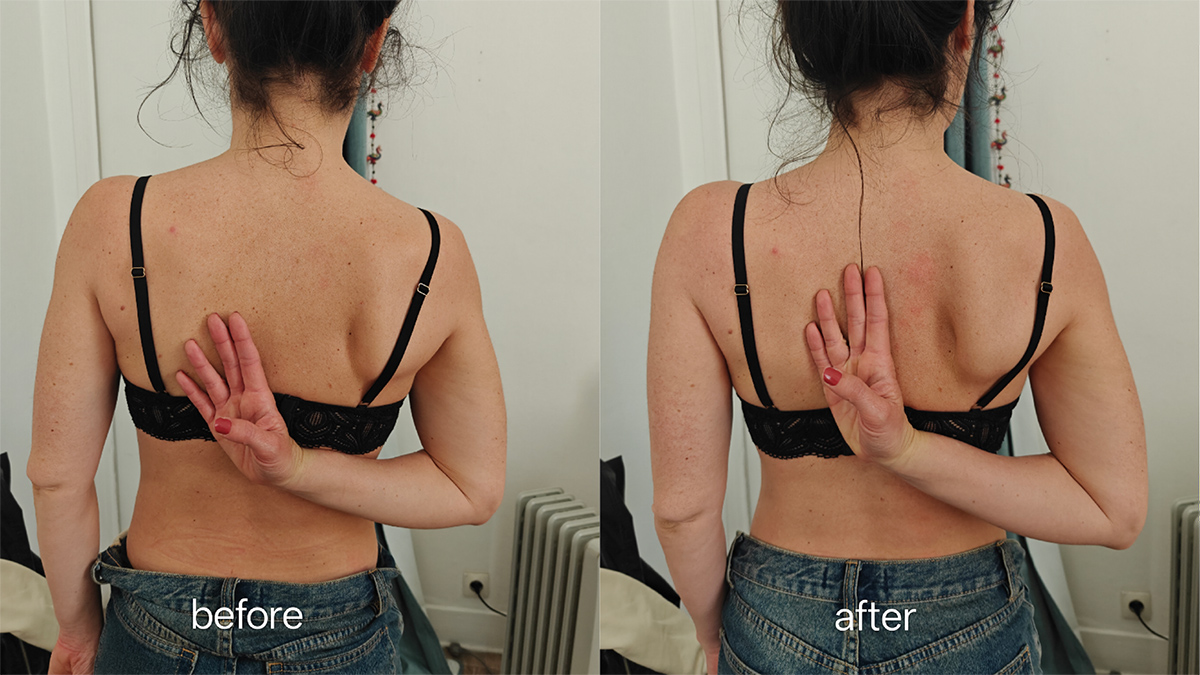
Functional improvement after treatment targeting the anterior shoulder, scapular, and cervical regions.
Initial Presentation
Hand numbness every night, but no lasting wrist solution
A 39-year-old patient presented with nocturnal hand numbness. She woke up every night around 4 a.m. and had to shake her hand or lift the wrist to reduce the sensation.
Despite this repeated pattern, no lasting solution had been found. The symptom appeared in the hand, but the clinical question was whether the hand was truly the origin.
The hand was numb.
But the pattern was not in the hand.
System State
What the body was showing
Clinical presentation
Nocturnal hand numbness, waking around 4 a.m., relief by shaking or elevating the hand, disturbed sleep, and recurring symptoms at rest.
Movement findings
Pain during hand-behind-back movement, restricted shoulder mobility, internal rotation limitation, and reduced scapular glide.
Clinical Question
Is this really a wrist problem?
In many cases, hand numbness leads attention directly toward the wrist, the carpal tunnel, or the hand itself. But in Fasciapuncture®, the symptom location is only the beginning of the investigation.
The key question was not simply “where is the numbness?” but whether the upper limb, shoulder girdle, and cervical region were allowing the system to remain stable at rest.
Clinical Reasoning
The limitation was not local. It was adaptive.
The hand symptom appeared at night, when the system should have been resting.
Movement testing revealed restriction in hand-behind-back motion.
The anterior shoulder region showed tension affecting upper-limb freedom.
Scapular imbalance and cervical involvement suggested a proximal pattern.
Intervention Approach
The treatment did not focus on the hand
The goal was not to fix the symptom.
The goal was to restore system availability.
Outcome
The hand improved when the shoulder–scapular pattern changed
Objective changes
Improved hand-behind-back movement, increased mobility, reduced restriction, and clearer shoulder–scapular movement.
Subjective changes
Movement felt easier, tension decreased, and the patient experienced an immediate sense of relief.
Clinical Insight
The system could now remain stable at rest
After treatment, the patient lay on her back for ten minutes. During this resting period, no numbness appeared.
This was clinically important. The change was not only a movement improvement; it suggested that the upper limb pathway could remain quieter when the body was no longer protecting through the same shoulder–scapular pattern.
Night symptoms often reveal
system instability at rest.
Pattern × Pillar Map
Where this case belongs in the Fasciapuncture® clinical map
Training Insight
This is not about technique. It is about seeing differently.
This case illustrates a key learning pathway in Fasciapuncture® training: how to identify fascial patterns, assess system availability, choose intervention zones, and work beyond local symptoms.