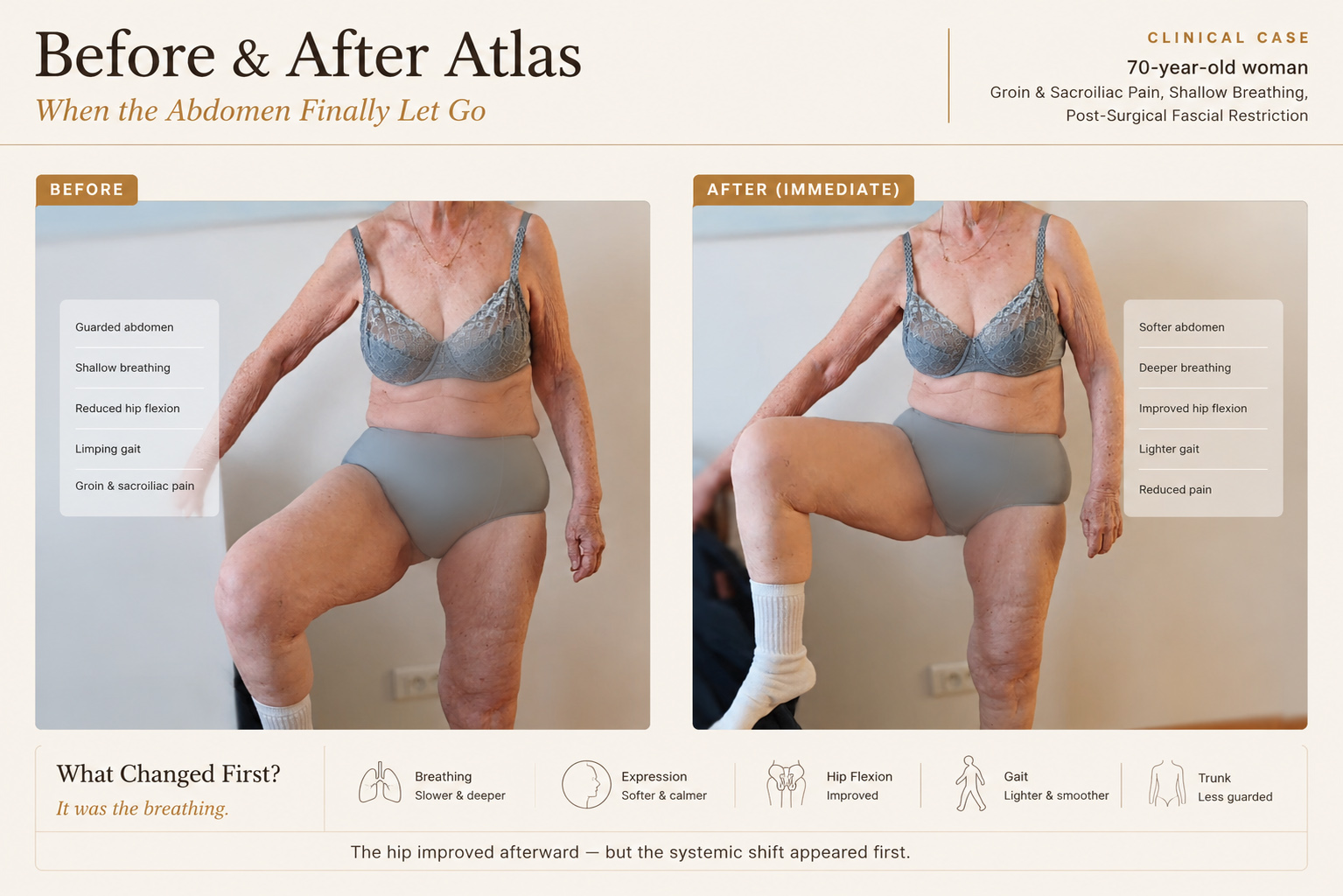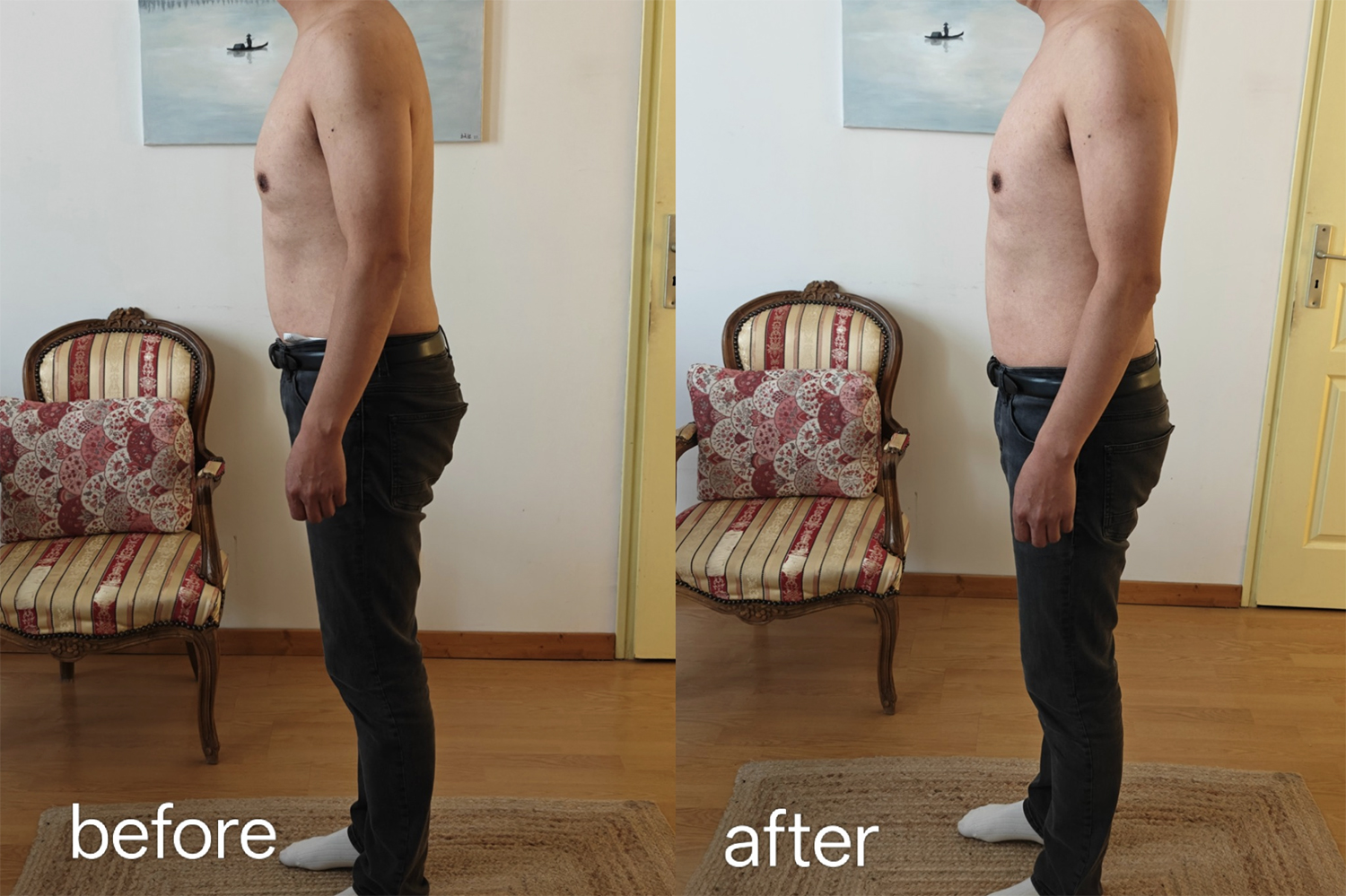
FASCIAPUNCTURE® SIGNATURE CLINICAL CASE
When the Lumbar Pain Was Not the Origin
A post-surgical case where persistent lumbar pain was understood not as an isolated back problem, but as a secondary expression of visceral trauma, abdominal pressure, pelvic protection, and systemic fascial adaptation.
CLINICAL OPENING
The pain was in the back, but the story began deeper.
The patient presented with persistent lumbar pain following a history of severe abdominal trauma and emergency surgery. Although the pain appeared musculoskeletal on the surface, the clinical picture suggested a deeper systemic adaptation involving the abdomen, pelvis, posterior chain, and autonomic protective tone.
In Fasciapuncture®, such cases are not approached only by chasing the painful lumbar area. The question becomes:
What system is still protecting, even after the original trauma has passed?
INITIAL SYSTEM STATE
What was visible before treatment
Patient Profile
- Female patient
- History of severe abdominal trauma
- Emergency surgery following splenic injury during a medical procedure
- Persistent symptoms despite previous interventions
Chief Complaints
- Chronic abdominal distension
- Persistent lumbar pain with acute exacerbation
- Diffuse tension in the posterior chain
- Long-term discomfort affecting daily function
CLINICAL CONTEXT
A body organized around protection
Following the abdominal trauma and surgical intervention, the patient appeared to have developed a long-standing protective pattern. The abdomen remained guarded, the pelvic region seemed unable to fully release, and the lumbar pain became the visible output of a deeper compensatory system.
Clinically, the lumbar area was interpreted as a site of expression rather than the original source. The system had reorganized itself around visceral protection, scar-related fascial densification, altered intra-abdominal pressure, and loss of adaptive capacity.
PATTERN ATLAS
Patterns revealed in this case
This case connects several Fasciapuncture® patterns rather than one isolated pain location.
Abdominal Pressure
The abdomen remained in a guarded pressure state, influencing breathing, lumbar tone, and pelvic availability.
02Pelvic Protection
The pelvis appeared to hold a protective regulatory pattern after trauma and surgical stress.
03Posterior Compression
Lumbar pain reflected increased posterior chain load rather than a purely local lesion.
04Compensation Loop
The body adapted around the abdominal trauma, but the adaptation itself became a persistent source of dysfunction.
CLINICAL READING
The lumbar pain was secondary.
The case was not approached as a local lumbar disorder. Instead, it was understood as a system locked in post-traumatic adaptation.
The painful area was not necessarily the origin. It was the place where the system could no longer compensate.
Key elements included visceral trauma, scar-related fascial densification, autonomic dysregulation, sacral–pelvic restriction, and increased protective tone along the posterior myofascial chain.
ENTRY STRATEGY
Do not chase the pain. Restore the system.
The intervention focused on identifying a fascial entry point capable of influencing systemic regulation, rather than directly treating the most painful lumbar zone.
- Identify the central protective pattern
- Avoid direct treatment of the acute painful lumbar area
- Influence visceral–fascial interface tension
- Reduce sacral and pelvic protective tone
- Restore global regulatory availability
The objective was not to release tissue by force, but to help the system recognize that protection was no longer necessary.
CLINICAL SHIFT
The first change was systemic.
After a single session, the patient reported a significant reduction in lumbar pain, approximately 50%. More importantly, the body entered a deeper state of relaxation. This suggested that the intervention had reached the regulatory layer rather than simply producing a local analgesic effect.
Immediate Response
- Significant reduction in lumbar pain
- Patient reported deep relaxation
- Clear change in body perception
- Reduced protective tone within the system
POST-SESSION EVOLUTION
A new sensation appeared in the upper back.
Within 24 hours, the lumbar pain remained reduced. The patient noticed soreness in the upper back, which was interpreted not as a negative reaction, but as a redistribution of tension within the system.
When a long-standing protective pattern begins to reorganize, the body may reveal areas that had previously been silent or masked by stronger pain signals.
CLINICAL INSIGHT
Pain does not always reflect the primary dysfunction.
This case illustrates one of the central principles of Fasciapuncture®:
When regulation is restored, change can occur rapidly without force. The clinical task is not only to reduce pain, but to understand why the body continues to hold, guard, compress, or protect.
KEY LEARNING POINTS
What this case teaches
01. Scars can become systemic
Post-surgical scars may influence fascial density, pressure regulation, and distant movement patterns.
02. Lumbar pain may be secondary
The painful lumbar zone may express dysfunction from the abdomen, pelvis, or visceral–fascial system.
03. Regulation changes first
Deep relaxation after treatment may indicate that the nervous system has shifted out of protective tone.
04. Small input, global response
Precise low-intensity intervention can initiate broad fascial and autonomic reorganization.
RELATED CONDITIONS
Where this case belongs in the Clinical Map
COURSE INTEGRATION
Continue learning from this case
Foundations of Fasciapuncture®
Understanding regulation before intervention.
Module 2Clinical Assessment
Reading global patterns instead of isolated symptoms.
Module 8Lumbar Fascia
Understanding lumbar pain through fascial and systemic relationships.
Module 9Pelvic & Visceral Integration
Exploring pelvic protection, visceral tension, and regulatory patterns.