CLINICAL THINKING
Smoking as a Compensation Strategy
A Fasciapuncture® perspective on autonomic regulation, breathing, and the body’s search for relief.
Smoking is rarely only a habit. In many people, it becomes a temporary way for the nervous system to regulate pressure, breathing, anxiety, and internal tension.
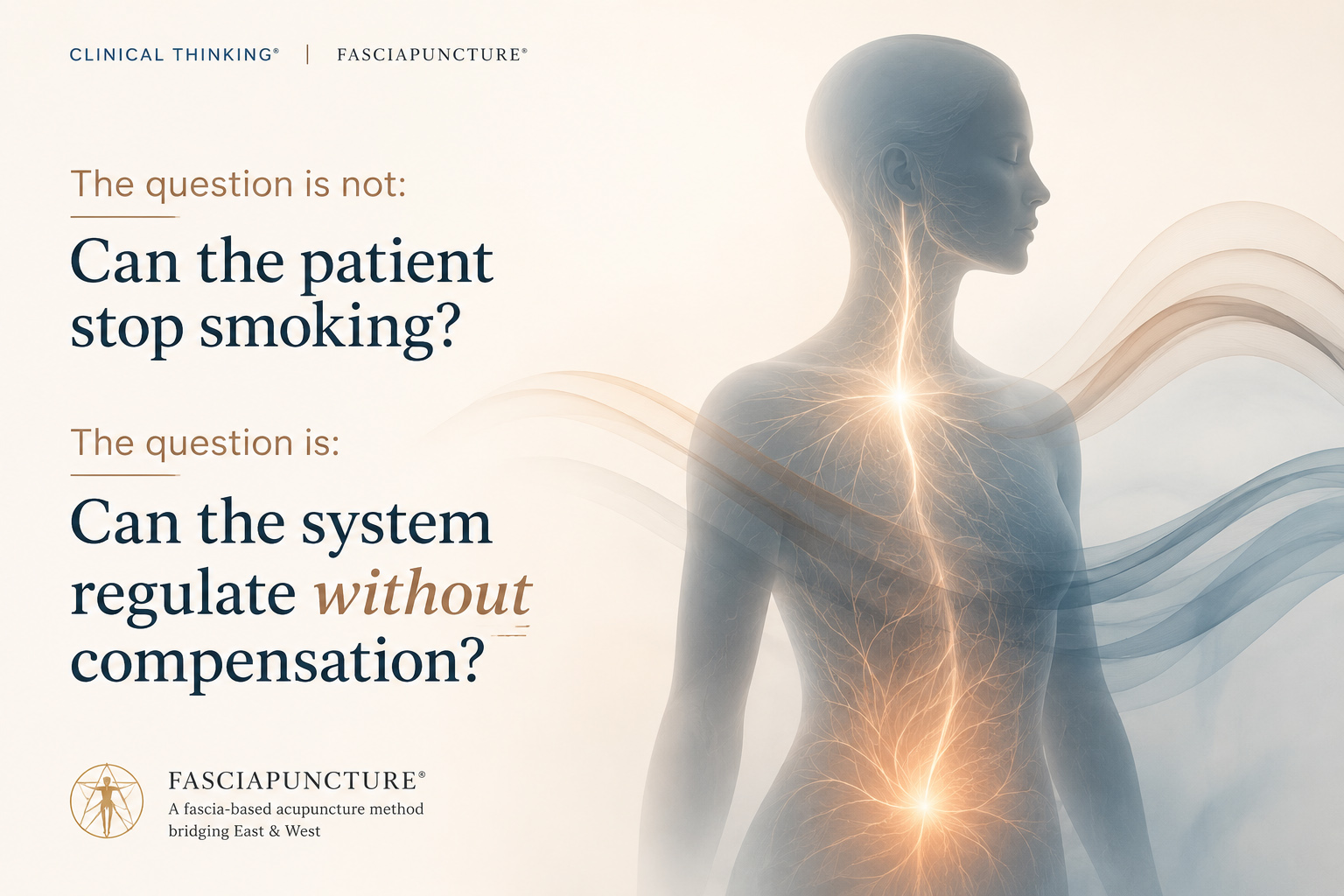
The question is not only whether a person can stop smoking. The deeper question is whether the system can regulate without compensation.
CLINICAL REFLECTION
Smoking is not always the real problem
Most approaches to smoking cessation focus on willpower, discipline, or behavioral control.
But in clinical practice, another reality appears again and again: smoking is rarely the real problem. It is a compensatory response.
For many patients, smoking functions as a temporary regulator of the nervous system. It helps them breathe when breathing feels restricted, calm down when internal pressure rises, and stabilize a system that no longer knows how to self-regulate.
In other words, smoking often acts as an emergency solution — not a bad habit.
CORE CLINICAL IDEA
The behavior may be compensating for a regulation problem
NEURO-FASCIAL PERSPECTIVE
What long-term smokers often reveal in the body
From a fascia-oriented and neuro-regulatory point of view, long-term smokers frequently present with a body that is trying to regulate itself through external input.
Common clinical signs may include:
- shallow or thoracic-dominant breathing
- restricted diaphragmatic motion
- elevated autonomic tone
- abdominal and thoracic fascial tension
- difficulty accessing a true resting state
In this context, smoking becomes a way to force respiration, stimulate vagal input, or momentarily relieve internal pressure.
TWO CLINICAL VIEWS
Habit control or regulation support?
Smoking as a habit to stop
The focus is on discipline.
The goal is to suppress the behavior.
Failure is often interpreted as lack of willpower.
Smoking as compensation
The focus is on restoring regulation.
The goal is to reduce the need for compensation.
Change becomes possible when the system no longer needs the behavior.
A DIFFERENT CLINICAL APPROACH
Can the system regulate without external compensation?
In our practice, we do not start by asking patients to stop smoking.
We begin by asking a different question:
The therapeutic work focuses on restoring diaphragmatic mobility, reducing thoraco-abdominal fascial tension, supporting autonomic down-regulation, and allowing respiration to become deeper and more spontaneous.
As internal pressure decreases and safety returns, the need for compensation often fades — sometimes quietly, without conscious effort.
WHEN CESSATION HAPPENS NATURALLY
When the body no longer needs the behavior
In this framework, smoking cessation is not an objective to impose, but a consequence of restored regulation.
There is no struggle, no confrontation, and no sense of failure. The body simply lets go of what it no longer needs.
RELATED PATTERNS
Where this article connects to the Pattern Atlas
Compensation Loop
The body repeats a behavior or pattern because it temporarily solves a deeper regulatory problem.
SYSTEMIC REGULATIONAutonomic Dysregulation
Smoking may appear when the nervous system struggles to return to a stable resting state.
FOUNDATIONAL PATTERNGlobal Protective State
The body may remain organized around vigilance, pressure, and protection.
BREATHING AXISDiaphragm Restriction
Restricted breathing may drive the search for external respiratory stimulation.
IN SUMMARY
Smoking may be the body’s attempt to regulate
This perspective does not deny the harmful effects of smoking. It simply asks a deeper clinical question before judgment:
When regulation becomes possible again, the compensation may no longer be necessary.
ETHICAL NOTE
Support does not replace cessation care
This article offers a fascia-oriented clinical perspective on regulation and compensation. It does not replace medical advice, smoking cessation programs, or professional support for nicotine dependence.
Continue exploring compensation and regulation
Follow the connection between internal pressure, breathing restriction, autonomic regulation, and the body’s search for relief.