
FOUNDATIONAL CLINICAL ESSAY
From Huangdi Neijing to Fascia-Oriented Clinical Judgment
How classical Chinese medical principles become observable, teachable, and clinically applicable through fascia.
Fasciapuncture® does not reinterpret the Neijing through symbolism. It asks a different question: where does systemic regulation actually occur in living tissue?
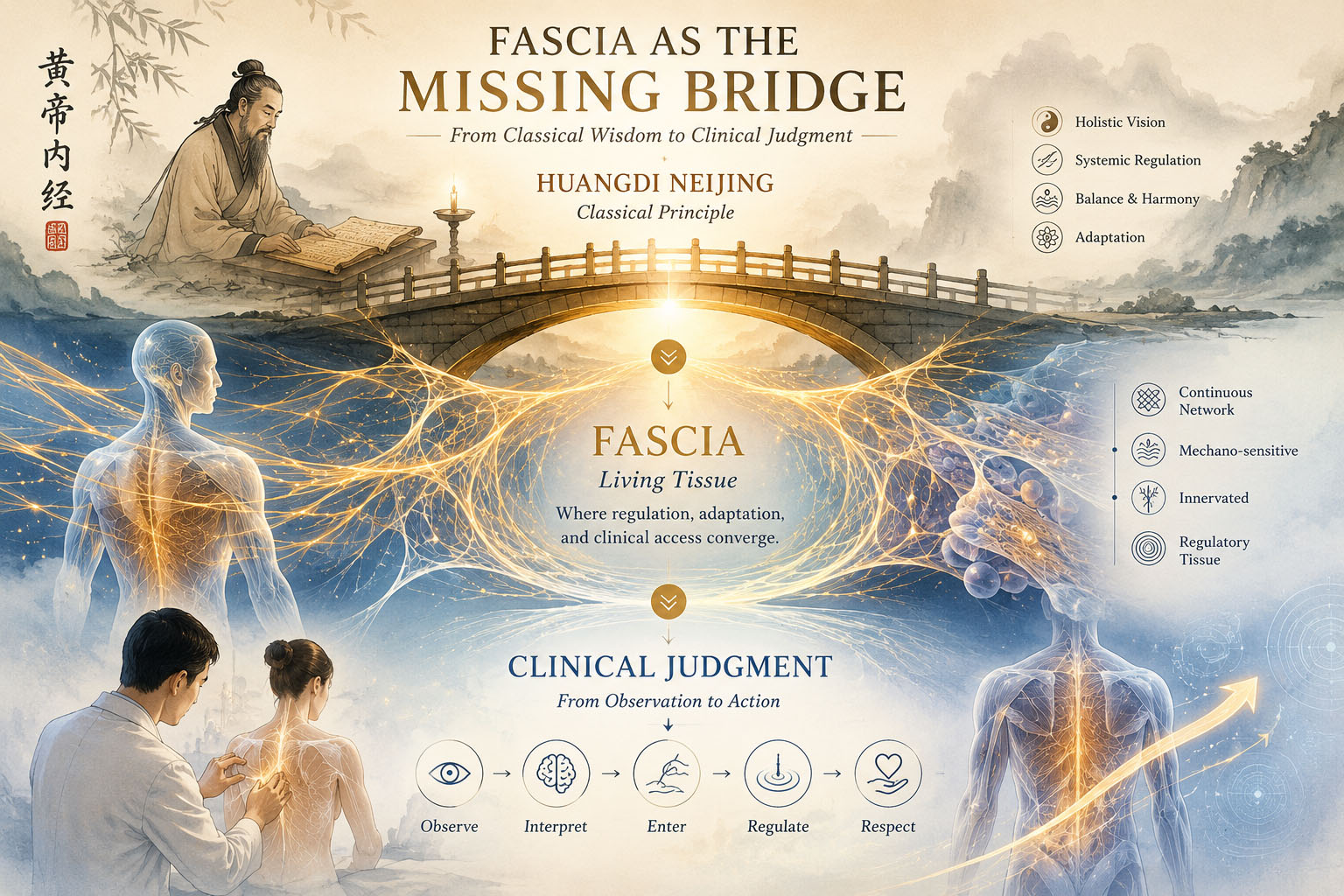
Fascia as the missing bridge between classical wisdom, living tissue, and clinical judgment.
THE CLINICAL QUESTION
Where Does Holistic Regulation Actually Happen?
The clinical vision of Huangdi Neijing is often described as holistic, systemic, and profound.
Yet one question is rarely addressed clearly:
inside the living body?
In Fasciapuncture®, the answer is fascia.
Not as metaphor. Not as a symbolic shortcut. But as living tissue where regulation, adaptation, and clinical access converge.
VISUAL SYNTHESIS
The Missing Bridge
PART 0 | ORIENTATION & SAFETY GATE
1. “治未病” — Fascia as a Regulatory Early-Warning System
The Neijing emphasizes intervening before disorder consolidates. Fascia makes this principle tangible.
As a continuous, innervated, and mechano-sensitive network, fascia often reacts earlier than joints or organs.
- It reflects autonomic imbalance.
- It reveals loss of adaptability before structural damage appears.
- It shows where the body has begun organizing around protection.
Gate assessment is therefore not abstract philosophy. It is reading fascial availability before intervention.
PART 1 | CLINICAL PERCEPTION
2. “观其外,以知其内” — Fascial Signals Before Diagnostic Labels
Classical observation focuses on breathing, movement, and spirit. Fascia is the tissue that expresses these changes physically.
Through fascial palpation and observation, we assess:
- respiratory-fascial coupling
- tone modulation
- subtle behavioral responses
- movement quality and protective patterns
Diagnosis becomes the interpretation of fascial-neural signals, not merely the collection of symptom lists.
PART 2 | ENTRY & REGULATORY LOGIC
3. “审其虚实” — Fascial Availability, Not Force
In classical terms, xu and shi describe availability and resistance.
In fascia-oriented practice, this corresponds to:
- tissue compliance
- sliding capacity
- elastic response
- response to minimal input
Entry zones are selected not by location alone, but by fascial readiness to transmit regulation.
PART 3 | PRECISION & APPLICATION
4. “少火生气” — Minimal Fascial Input, Systemic Effect
The Neijing warns against excessive stimulation. Fascia explains why.
Because fascia integrates mechanical force, neural feedback, fluid dynamics, and autonomic response, small precise input at the fascial level can reorganize global patterns.
It is accuracy.
PRECISION LOGIC
Why Less Can Create More
PART 4 | REGIONAL CLINICAL APPLICATIONS
5. “因地制宜” — One Fascial Logic, Multiple Regions
Fascia connects regions without isolating them.
Regional teaching in Fasciapuncture® does not mean local treatment. It shows how global fascial tension reorganizes differently in the neck, thorax, pelvis, or limbs.
The logic remains the same. The fascial expression changes.
PART 5 | COMPLEX & SENSITIVE CASES
6. “慎终如始” — Fragile Systems, Fragile Fascia
Anxiety, aging, chronic illness, and long-term exhaustion often share one feature:
reduced fascial adaptability.
Treatment here is not about releasing more, but about preserving what still regulates.
restraint is not weakness.
It is clinical responsibility.
PART 6 | CLINICAL INTEGRATION
7. “医者,责任也” — Fascia, Ethics, and Clinical Responsibility
Fascia remembers force, timing, and excess.
Clinical responsibility therefore includes:
- knowing when not to enter
- knowing when fascial input would destabilize
- planning treatment across time, not sessions
- maintaining coherence rather than chasing change
Healing is not only improvement. It is maintaining systemic coherence through fascial respect.
CLINICAL RESPONSIBILITY
The Sequence Matters
CONCLUSION
Fascia as the Missing Bridge
Fasciapuncture® does not modernize Chinese medicine by adding technology.
It clarifies where and how classical regulation occurs inside living tissue.
Fascia is not a new concept. It is the anatomical expression of the Neijing’s systemic vision, made visible and clinically usable.
No symbolic shortcuts.
Only living tissue, regulation,
and responsibility.
RELATED CLINICAL PATTERNS
This essay connects to the wider Clinical Map
Global Protective State
The long-term organization of the body around protection, vigilance, and adaptation.
REGULATION PATTERNAutonomic Dysregulation
When sleep, digestion, emotion, and recovery rhythm become unstable.
CENTRAL PRESSURECore Block
Where breathing, abdominal pressure, and transmission become restricted.
BREATHING PATTERNDiaphragm Restriction
When diaphragmatic freedom becomes limited and regulation cannot descend.
CONTINUE EXPLORING
Follow the bridge from classical principle to clinical pattern
This essay belongs to the wider Fasciapuncture® Clinical Map: a living structure connecting classical medical reasoning, fascia-oriented observation, clinical patterns, and real cases.