
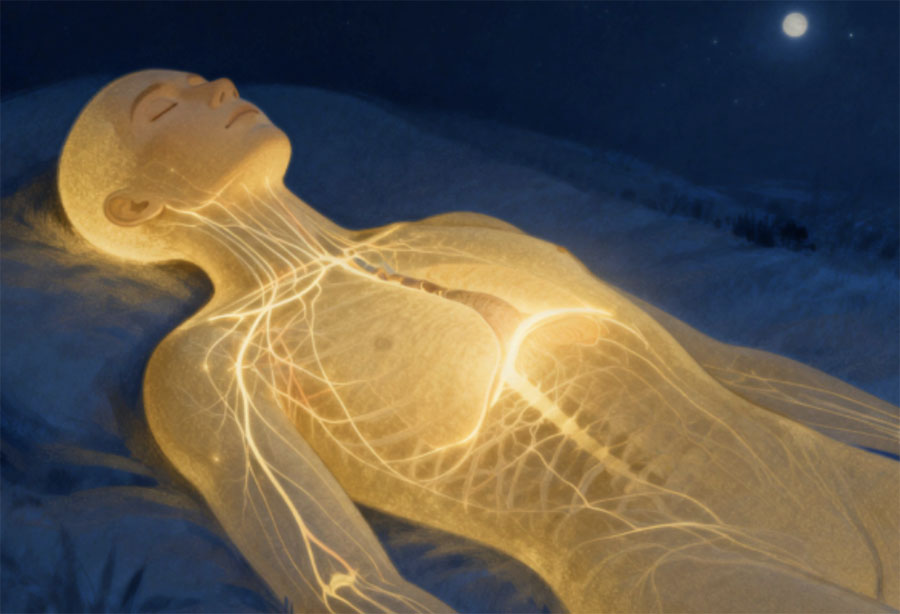
Insomnia is often described as a mental issue:
“My mind won’t stop.”
“I think too much.”
“My thoughts keep me awake.”
In clinical practice, this explanation is rarely sufficient.
What we observe instead is that thinking is usually a consequence, not the cause, of insomnia.
When the Body Fails to Enter Night Mode
Sleep is not initiated by the brain alone.
It requires the entire neuro-fascial system to shift into a state of reduced vigilance.
When this shift does not occur —
when the body remains subtly alert —
the nervous system keeps scanning for safety.
The brain stays online not to analyze problems,
but to monitor the environment.
Thoughts multiply because the system has not received the signal that it is safe to stand down.
Why Some People Can’t Fall Asleep
In difficulty falling asleep, we often find:
-
persistent upper-body tension
-
restricted diaphragmatic movement
-
poor abdominal pressure adaptation
The body cannot “descend.”
The night-time shutdown sequence never fully initiates.
Why Others Wake Between 1 and 3 a.m.
Early-morning awakening often reflects a different issue:
-
partial sleep initiation succeeded
-
but deep autonomic regulation failed to sustain itself
The system wakes during a natural regulatory window,
not because of stress alone,
but because the lower anchoring mechanisms were insufficient.
A Fascia-Oriented Clinical Perspective
In fascia-oriented therapy, we do not attempt to silence thoughts.
We address the physical conditions required for nervous system down-regulation:
-
restoring diaphragmatic mobility
-
re-establishing abdominal and pelvic support
-
reducing neuro-fascial vigilance patterns
When the body regains its capacity to feel safe at night,
the mind follows naturally.
No effort.
No mental control.
No forcing sleep.
Sleep Cannot Be Commanded — It Must Be Permitted
From this perspective, sleep is not something to achieve.
It is something the body must be allowed to do.
Restoring that permission is often the most effective intervention of all.