
FASCIAPUNCTURE® CLINICAL PERSPECTIVE
When Facial Symptoms Share the Same Origin
Dry eyes, tinnitus, ear fullness, nasal blockage, facial heaviness, jaw tension, and sinus pressure may appear to belong to different medical fields. Clinically, they may also reflect the same cervical and fascial regulatory corridor.

Many people arrive with symptoms that seem to belong to completely different medical fields:
- Dry eyes often discussed in ophthalmology
- Tinnitus and ear fullness often discussed in ENT
- Persistent nasal blockage or runny nose often discussed in allergy or immunology
- Facial heaviness or sinus pressure often discussed in neurology or ENT
Different specialists. Different explanations. Different treatments. Yet clinically, these symptoms often behave as if they were simply different exits of the same fascial and neuro-regulatory line.
The symptom may appear in the eyes, ears, nose, or face — but the control center may be lower, deeper, and more systemic.
THE OVERLOOKED CONTROL CENTER
The Fascial Crossroads Beneath the Jaw
Beneath the jawline and along the upper neck lies one of the most important — but often overlooked — functional regions of the head and neck.
This fascial region is not just soft tissue. It is a complex crossroads of structures that regulate drainage, cranial nerve sensitivity, autonomic balance, and pressure regulation in the eyes, ears, and nose.
What Lives in This Region?
- Submandibular fascial structures
- Parotid and submandibular glands
- Cervical lymph nodes
- Branches of trigeminal and facial nerves
- Carotid sheath
- Vagus nerve and sympathetic chain
- Cervical fascial planes
COMMON PRESENTATIONS
How This Pattern May Appear
Dry Eyes
Eye dryness, burning, pressure, or irritation may reflect more than local ocular surface dryness.
Tinnitus & Ear Fullness
Ear pressure or ringing may appear when cervical tension and autonomic regulation remain disturbed.
Nasal Blockage
Persistent congestion or runny nose may relate to upper cervical, facial, and autonomic tension.
Facial Heaviness
Facial pressure, sinus-like discomfort, and forehead heaviness may be expressions of the same system.
CLINICAL REASONING
Reading System Availability in Clinical Practice
In many therapeutic trainings, the focus is often placed on what to do: which technique to apply, which point to choose, and how to correct a dysfunction.
Yet in clinical reality, one essential question is frequently overlooked:
Is the body available for intervention?
In patients with chronic pain, long-term tension, or persistent compensation, the problem is often not a lack of treatment, but a system already operating under sustained pressure.
When this pressure is ignored, even gentle techniques may become intrusive. Intervention can reinforce compensation rather than resolve it.
REGULATION BEFORE INTERVENTION
Calm Is Not Passive
In Fasciapuncture®, calm is not understood as inaction. It is a physiological state in which the nervous system begins to down-regulate and reorganize.
Clinically, this state may be observed through subtle but reliable signs:
- A spontaneous deepening of respiration
- A softening of abdominal or thoracic tone
- Reduced guarding or postural effort
- Swallowing, sighing, intestinal sounds, or facial softening
- A sense of internal weight redistributing downward
These signs indicate that the system is no longer only defending itself and may safely receive input.
CLINICAL OBSERVATIONS
What We Often Observe Before the Face Changes
Facial symptoms rarely appear alone. In practice, they often come with changes in breathing, cervical mobility, jaw function, sleep quality, and overall regulation.
Breathing
Elevated chest breathing, difficulty exhaling, and reduced abdominal movement.
Jaw & Neck
Jaw tightness, submandibular tension, and restricted cervical rotation.
Expression
Reduced facial mobility, forehead pressure, and a constant feeling of effort.
Sleep & Recovery
Light sleep, difficulty settling, and persistent internal vigilance.
CLINICAL TIMING
Why Intervening Too Early Reduces Effectiveness
A common clinical error is to intervene while the body is still compensating.
In such cases:
- Posture may look “correct” but requires constant effort
- Muscles remain engaged to maintain control
- Pain relief, if obtained, is often short-lived
The body is not resisting the therapist — it is protecting itself.
When the system has not yet entered a state of relative calm, adding stimulation risks increasing noise rather than restoring regulation.
FASCIAPUNCTURE® VIEW
The Fascia as a Regulatory Interface
The fascia is not merely a supportive tissue. It functions as a regulatory interface linking:
- The nervous system
- Circulation and fluid dynamics
- Respiration
- Posture and movement
- Autonomic and emotional balance
When fascial tension accumulates, symptoms may appear far from their origin. The goal is therefore not to correct a local symptom, but to release a functional lock that prevents systemic regulation.
CLINICAL PRINCIPLE
Availability Before Precision
In Fasciapuncture®, precision does not begin with technique. It begins with timing.
A minimal, well-timed intervention applied to an available system is often more effective than multiple techniques applied too early.
This approach requires the practitioner to develop:
- Observation skills
- Patience
- Respect for the body’s internal rhythm
Calm is not the result of treatment. It is often the condition that makes treatment effective.
CLINICAL CASES
Where this pattern becomes visible
From Survival to Breathing Again
Head pressure, facial tension, anxiety, poor sleep, and cervical restriction gradually softened as breathing returned.
Read Case →
When Jaw Clicking Was Not the Jaw
Jaw tension, cervical pain, scapular restriction, and facial guarding revealed a broader cervical-fascial pattern.
Read Case →
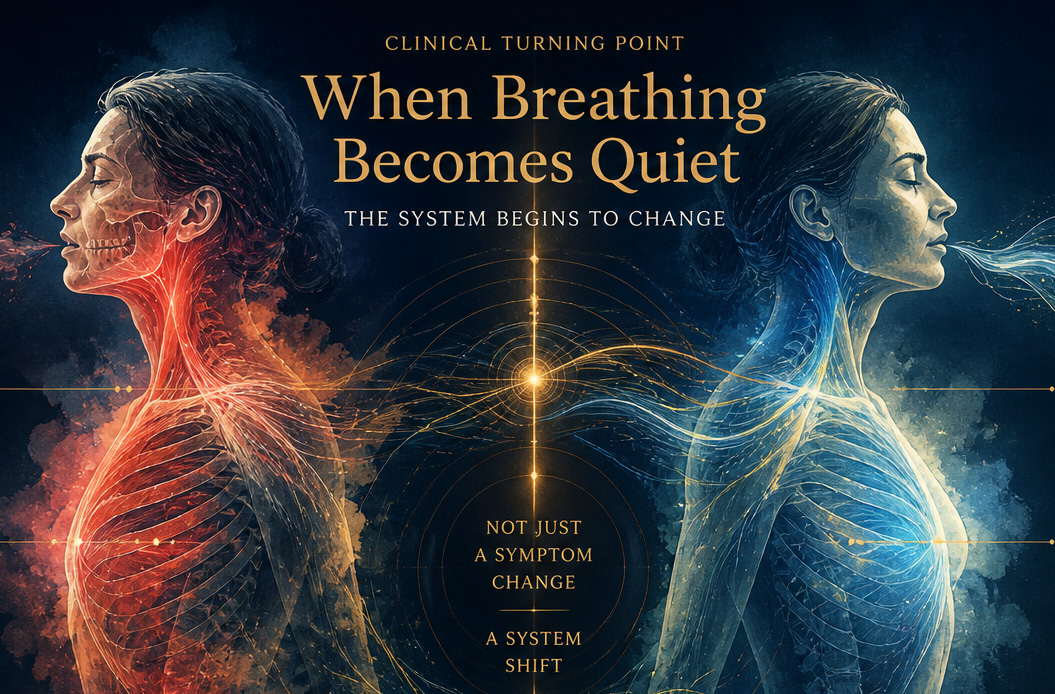
When Breathing Becomes Quiet
A clinical moment where breathing, facial expression, thoracic pressure, and nervous system regulation changed together.
Read Case →CONNECTED CLINICAL MAP
Explore Related Conditions & Patterns
RELATED TRAINING
Fasciapuncture® Training Begins with Reading the System
Learning to read system availability is a core clinical skill. It determines when to intervene, where to intervene, and when not to intervene.
Foundations
Learn the core principles of fascial regulation, symptom interpretation, and pattern-oriented thinking.
Level 2Clinical Reasoning
Develop observation, palpation, movement testing, and functional diagnosis integration.
It begins with learning when the body is ready.