
Fasciapuncture® Clinical Evidence
When Shoulder Pain Was Not the Shoulder
A clinical case showing how night shoulder pain changed when the treatment followed breathing restriction, lumbosacral tension, pelvic support, and systemic regulation.
Clinical Image
The pain appeared in the shoulder. The pattern belonged to the system.
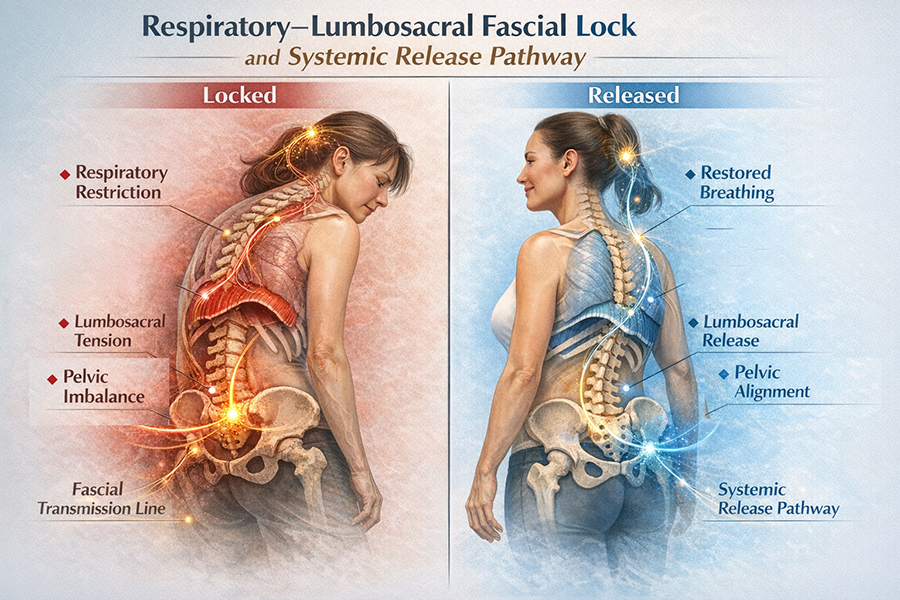
A clinical illustration of respiratory restriction, lumbosacral fascial tension, pelvic imbalance, and systemic release.
Initial Presentation
A shoulder symptom with a non-shoulder logic
A female patient, born in 1964, presented with night pain in the anterior shoulder. The discomfort was more present at night, yet during examination, the shoulder range of motion was almost normal.
This was the first important clinical sign: the pain was clear, but the shoulder did not behave like a purely local shoulder lesion.
The shoulder was speaking,
but it was not the origin.
System State
What the body was showing
Main symptoms
Night pain in the anterior shoulder, abdominal bloating, difficulty breathing, and recent worsening of lumbosacral pain.
Clinical findings
Shoulder mobility was almost normal, with only mild pain on elevation. The lumbar spine could not fully extend, breathing was difficult when standing upright, and the pelvis showed right-sided support difficulty.
Clinical Question
Is this really a shoulder problem?
In Fasciapuncture®, the location of pain does not automatically determine the location of treatment. When local movement remains almost normal, the practitioner must ask whether the symptom is expressing a deeper adaptive pattern.
In this case, the main restriction appeared in breathing, posture, lumbar extension, and pelvic support — not in the shoulder itself.
Fascia-Based Reasoning
The pattern: respiratory–lumbosacral fascial lock
Recent right lumbosacral aggravation suggested a lower-axis fascial lock.
Breathing difficulty while standing upright revealed a respiratory–postural interface problem.
Pelvic imbalance and right-sided support difficulty showed hidden compensatory tension.
The shoulder pain was interpreted as a systemic expression, not the first treatment target.
Treatment Strategy
Regulation before local treatment
The goal was not to chase the shoulder pain.
The goal was to restore the system that produced it.
Immediate Clinical Shift
When the system changed, the shoulder followed
Breathing
Breathing became smoother and easier. The upper body felt lighter, and the patient showed more confidence during treatment.
Movement
Lumbar extension and overall movement improved. The body became less guarded and more available for movement testing.
Shoulder pain
The shoulder pain disappeared during movement testing after systemic regulation, rather than after direct shoulder-focused treatment.
Clinical meaning
The change confirmed that the shoulder symptom belonged to a larger pattern involving breathing, lumbar extension, and pelvic support.
Clinical Reflection
Normal movement does not always mean a normal system
This case demonstrates one of the central principles of Fasciapuncture®: local pain may be a systemic expression. The shoulder was painful, but the body’s deeper limitation was in its ability to breathe, extend, support, and regulate.
When the system recovered availability, the shoulder no longer needed to express the same signal.
We do not treat where the pain is.
We treat where the system is blocked.
Pattern × Pillar Map
Where this case belongs in the Fasciapuncture® clinical map
Training Insight
This is not about technique. It is about seeing differently.
This case illustrates how Fasciapuncture® training develops clinical perception: how to read pain beyond location, how to identify system patterns, and how to decide when not to treat locally first.