
SIGNATURE CLINICAL CASE
When the System Becomes Quiet
A 40-year-old woman with severe night head pressure, eye tension, insomnia, neck rigidity, and emotional collapse — where the first meaningful change was not in the head, but in the whole system becoming quiet.
CLINICAL OPENING
The pain was in the head, but the system was locked above.
For more than a year, the patient had suffered from severe night head pressure and intense head pain. The symptoms became especially unbearable when lying down, making sleep almost impossible.
She had visited emergency services several times and had received frequent physiotherapy sessions, but her condition continued to worsen. At one point, the suffering became so intense that she expressed a desire not to continue living this way.
Hospital examinations showed no clear structural cause. The key was not found in the head — but in the way the whole system was locked above.
INITIAL SYSTEM STATE
The System Was Operating Under Pressure
Main Symptoms
- Severe head pressure at night
- Pain around the whole head
- Eye pressure and blurred vision
- Nasal congestion
- Left neck pain radiating into the arm
- Right chest pain with occasional hand numbness
Aggravating Factors
- Lying down
- Night-time rest
- Menstrual period
- Inability to sleep
- Emotional overload
Clinical Observation
- Breathing locked in the upper chest
- Thoracic inlet hard and tense on palpation
- Abdominal central axis tight
- Extremely restricted neck movement
- Robotic and protective head movement
Systemic Reading
- Upper chest could not release
- Thoracic outlet acted as a pressure gate
- Head expressed distress from a deeper pattern
- The body remained locked in protective tension
PATTERN ATLAS
Patterns Revealed in This Case
Upper Exit Block
The upper exit was closed, limiting the system’s ability to release pressure and regulate cranial sensations.
02Thoracic Restriction
Breathing remained trapped in the upper chest, with little rib descent or diaphragmatic participation.
03Abdominal Pressure
The abdominal center was tight, leaving the body with no internal space to absorb and reorganize tension.
04Autonomic Dysregulation
Chronic vigilance, insomnia, and emotional overload suggested a system unable to return to safety.
BEFORE & AFTER OBSERVATION
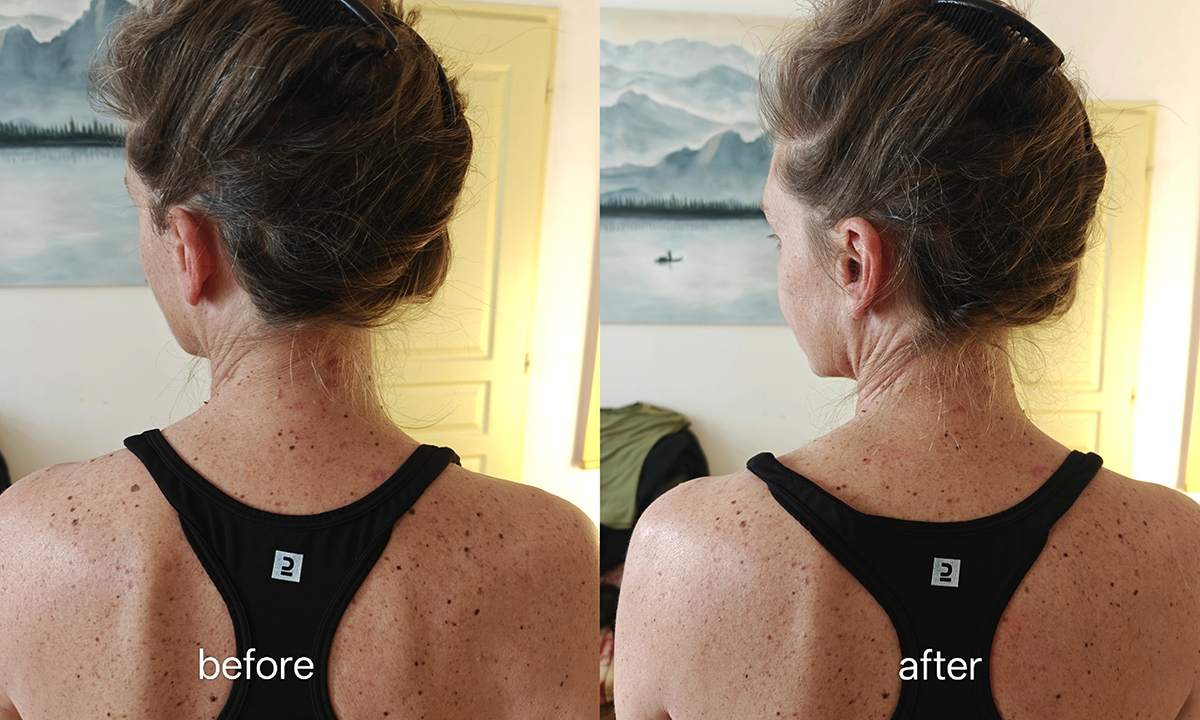
The Neck and Upper System Began to Move Again
Before-and-after observation showing visible improvement in cervical mobility, posture, and upper-body tension.
CLINICAL READING
Why the head was not treated first
This case was interpreted as a systemic fascial tension pattern involving the thoracic outlet, respiratory restriction, central axis tension, and autonomic overload.
The head was the place where the suffering appeared, but not necessarily where the problem began. The clinical signs pointed to a locked upper system: upper chest breathing, blocked thoracic inlet, rigid neck movement, and a tight abdominal axis.
The symptom may be in the head. But the system may be asking for an exit.
ENTRY STRATEGY
Treatment Did Not Begin at the Head
THE CLINICAL TURNING POINT
The First Change Was the Breathing
During treatment, the patient’s breathing gradually became deeper and slower. The abdomen began to make intestinal sounds. The shoulders dropped. She swallowed saliva several times, and her facial expression became peaceful.
These signs suggested that the body was no longer only defending itself. It was beginning to enter a state of regulation.
WHAT BECAME VISIBLE
The System Shifted Before the Symptoms Did
IMMEDIATE RESULT
The Head and Neck Were No Longer Locked
After re-testing, the head and neck were no longer locked. Range of motion improved, and the movement became more natural. Her face regained a smile.
Her eyes became soft, and she said:
“Ah… it is so quiet here, so comfortable.”
Outside, construction work was very noisy. Yet she no longer reacted to it in the same way. The external environment had not changed — but the internal system had.
THE HUMAN MOMENT
For the First Time in Over a Year, She Smiled
When the session ended, she held my hand. Her eyes were full of gratitude. For the first time in over a year, she smiled.
This was not only a change in pain. It was a return of safety, quietness, and emotional presence.
CLINICAL REFLECTION
Severe Head Pressure May Be a Systemic Exit Problem
This case demonstrates one of the central principles of Fasciapuncture®: pain does not always identify the source.
For severe head pressure with normal examinations, fascia-based clinical reasoning offers another way to read the body: through breathing, thoracic outlet tension, central axis restriction, movement testing, and autonomic regulation.
When the upper system regained space, the head no longer needed to carry the entire pressure of the body’s protection.
We did not chase the pain. We opened the exit, created space, and allowed the system to become quiet.
CONNECTED CLINICAL MAP
Explore Related Conditions & Patterns
RELATED CASES
Other Cases in the Same Clinical Map
CONTINUE LEARNING
From Head Pressure to System Regulation
Foundations of Fasciapuncture®
Understanding regulation before intervention.
Module 2Clinical Assessment
Reading pressure, posture, breathing, and functional availability.
Module 4Head & Neck Myofascial Syndromes
Exploring cervical-origin syndromes, cranial pressure, and upper exit patterns.
TrainingClinical Reasoning Pathway
Learn how cases become maps for clinical decision-making.