
SIGNATURE CLINICAL CASE
When the Scar Was Still Holding the Story
A post-breast cancer case where persistent discomfort, scar-related fascial tension, shoulder restriction, anxiety, and sleep disturbance gradually softened as the body began to release a long-held protective memory.
CLINICAL OPENING
The medical tests were normal, but the body was still protecting.
A 65-year-old woman presented with persistent discomfort following breast cancer treatment. Her medical follow-ups were reassuring, yet the affected region continued to feel painful, tense, and difficult to forget.
The visible scar left by breast surgery was deeply striking. Around the chest, shoulder, cervico-scapular region, and upper thoracic area, the fascial tension remained high, as if the body had not fully exited the protective state created by surgery, radiotherapy, and fear.
The cancer had been treated. But the body was still remembering the experience.
INITIAL SYSTEM STATE
The Scar Was Not Only a Mark on the Skin
History
- Breast cancer treatment history
- Breast surgery with visible scarring
- Radiotherapy completed in the past
- Medical examinations reassuring
Main Symptoms
- Persistent discomfort around the affected breast region
- Pain and tension around the scar area
- Shoulder and thoracic restriction
- Deep diffuse discomfort difficult to localize
Movement Findings
- Restricted shoulder mobility
- Increased tension around the cervico-scapular region
- Anterior thoracic holding pattern
- Protective posture around the operated side
Systemic State
- Sleep disturbance
- Anxiety and internal vigilance
- Difficulty feeling fully relaxed
- Emotional weight associated with the past illness
PATTERN ATLAS
Patterns Revealed in This Case
Scapular Lock
Shoulder and scapular mobility were restricted by protective tension around the upper thoracic and operated region.
02Thoracic Restriction
The chest wall and upper thoracic fascia remained guarded, limiting breath, movement, and comfort.
03Autonomic Dysregulation
Anxiety, poor sleep, and internal vigilance suggested that the body had not fully returned to safety.
04Neuro-Fascial Irritation
Scar-related sensitivity and regional pain reflected irritation within the local neuro-fascial field.
POST-ONCOLOGICAL FASCIAL ATLAS
The Scar Was Still Organizing the Region
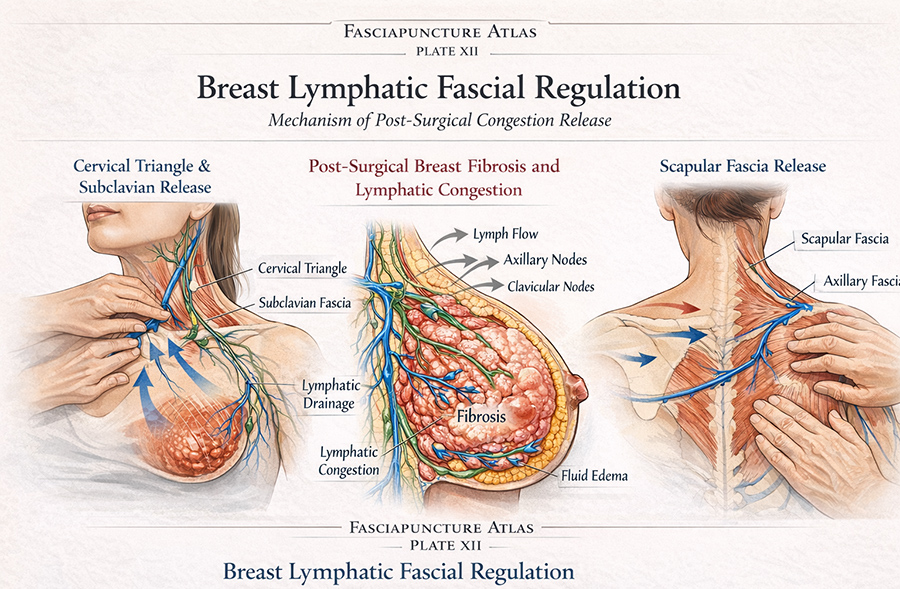
The scar was interpreted not only as a local tissue mark, but as part of a broader protective pattern involving the shoulder, chest wall, thoracic fascia, breathing, and autonomic regulation.
CLINICAL READING
This was not simply a breast pain problem.
Although the discomfort was felt around the breast and scar region, the clinical picture suggested a wider post-treatment protective pattern.
After surgery and radiotherapy, the body often reorganizes around the affected side. Fascial tension increases, mobility decreases, the shoulder becomes guarded, and the nervous system may remain watchful even years after treatment has ended.
Pain was not where the story began. It was where the system continued to express protection.
ENTRY STRATEGY
Treatment Did Not Chase the Pain
THE CLINICAL TURNING POINT
The First Change Was Not the Scar
As the shoulder and thoracic fascial tension softened, the patient experienced a clear reduction in discomfort around the breast region.
The affected side became less protective. Shoulder mobility improved, thoracic tension decreased, and breathing became easier.
WHAT BECAME VISIBLE
The Body No Longer Needed to Hold the Same Protection
LONG-TERM EVOLUTION
She Began to Forget the Painful Chapter
With ongoing care, the discomfort around the breast region disappeared. The surrounding fascial tension decreased, the shoulder felt freer, and sleep became more restorative.
As anxiety reduced, the patient gradually stopped organizing her daily life around the painful memory of the illness and treatment.
The most important change was not only that the pain disappeared, but that the body no longer needed to constantly remember that painful chapter.
The scar remained visible, but the body no longer lived inside the scar.
CLINICAL REFLECTION
Post-Treatment Pain May Be a Protective Memory
Many patients continue to experience discomfort long after breast cancer treatment, even when medical examinations are reassuring. In these cases, the body may still carry tension around the operated region, scar tissue, thoracic fascia, shoulder mechanics, and autonomic regulation.
This case illustrates how post-oncological discomfort may sometimes be better understood as a persistent protective pattern rather than a simple local pain problem.
Fasciapuncture® does not treat cancer and does not replace medical follow-up. In this case, it was used to support comfort, movement, regulation, and the body’s ability to return to a safer internal state.
We do not chase the scar. We help the system stop living around it.
CONNECTED CLINICAL MAP
Explore Related Conditions & Patterns
RELATED CASES
Other Cases in the Same Clinical Map
CONTINUE LEARNING
From Scar Protection to System Regulation
Foundations of Fasciapuncture®
Understanding regulation before intervention.
Module 2Clinical Assessment
Reading protective patterns instead of isolated symptoms.
Module 5Shoulder Myofascial Dysfunctions
Understanding shoulder restriction through fascial and thoracic relationships.
Module 7Thoracic & Upper Back Syndromes
Exploring thoracic restriction, breathing, and postural protection.