
SIGNATURE CLINICAL CASE · CERVICAL FASCIAL REGULATION
When a Lifelong Neck Tension Finally Softened
A clinical case of congenital neck asymmetry, anterior cervical fascial tension, laryngeal displacement, and long-term thyroid regulation — where local neck release opened a deeper question about space, movement, and systemic balance.
THE FIRST IMAGE
The neck had been telling the story for years
Visible Holding
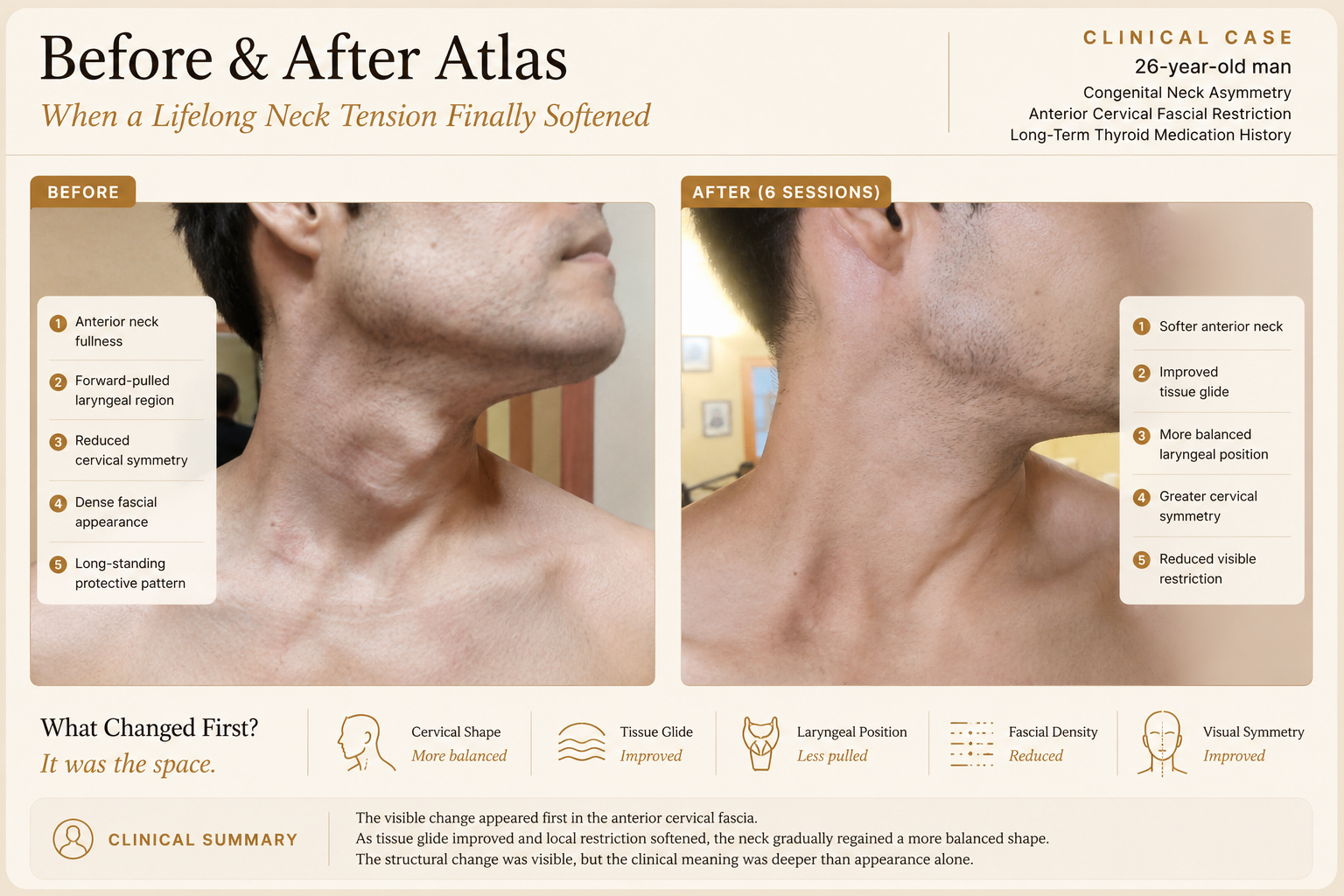
When he arrived, the change was already visible in the shape of his neck. The left side appeared thicker and more contracted, while the laryngeal area seemed pulled forward.
Long-Term Adaptation
The anterior cervical fascia had the feeling of tissue that had been holding a protective pattern for a very long time. The body had adapted around an old restriction rather than resolving it.
INITIAL SYSTEM STATE
The system was holding a long-term cervical protection pattern
Neck Shape
Visible asymmetry, left-sided cervical thickening, and a forward-pulled laryngeal region suggested a long-standing anterior neck lock.
Fascial Texture
Dense anterior cervical fascia, limited tissue glide, and deep fixation were observed around the throat and neck region.
Regulatory Context
The neck was not read as a local structure only. It was considered part of a deeper regulatory environment involving breathing, circulation, lymphatic flow, and autonomic balance.
Medical Follow-Up
Thyroid monitoring remained under medical supervision. Fasciapuncture® was used to support the tissue environment, not to replace medical care.
PATTERN ATLAS
The neck was read as a passage, not an isolated part
Upper Exit Block
The upper neck and throat region appeared unable to release pressure, movement, and internal tension freely.
PRIMARY PATTERNAnterior Chain Lock
The anterior cervical fascia formed part of a larger front-line holding pattern.
ASSOCIATED PATTERNCervical Axis Tension
Neck asymmetry and laryngeal displacement reflected altered cervical alignment and tissue pull.
ASSOCIATED PATTERNAutonomic Regulation
The throat region was understood as part of a broader regulatory field, not only a mechanical structure.
ENTRY STRATEGY
The first goal was not to “treat the thyroid”
BEFORE & AFTER CLINICAL ATLAS
The front of the neck became quiet again
Before Regulation
- Visible anterior neck asymmetry
- Thickened left cervical region
- Laryngeal area pulled forward
- Dense anterior cervical fascia
- Long-standing protective fixation
After Six Sessions
- The anterior cervical fascia softened
- Neck symmetry improved visibly
- The laryngeal area settled into a more natural position
- The front of the neck looked smoother and less pulled
- The tissue pattern appeared less protective
CLINICAL TURNING POINT
What happened later surprised everyone
Over the following months, he continued regular medical follow-up.
Gradually, his thyroid values began to normalize. Under medical supervision, medication was progressively reduced and eventually discontinued.
Two years later, his thyroid values remained stable, and he had not needed to resume medication.
This result is not presented as a guarantee. It is not a replacement for medical care. It is a clinical observation — one that invites a deeper question.
“What happens when a body releases a restriction it has carried since birth?”
WHAT BECAME VISIBLE
A local release revealed a systemic response
CLINICAL REFLECTION
Fascia is not separate from regulation
The thyroid sits within a deep cervical fascial environment. It is surrounded by tissues involved in movement, circulation, lymphatic drainage, breathing, and autonomic regulation.
When the fascia around this region is chronically tense, the question is not whether fascia “controls” the thyroid. The better question is whether the organ environment has enough space, mobility, and softness to function without unnecessary protective pressure.
Fasciapuncture® does not claim to treat hormones directly. It works with the tissue environment — restoring glide, reducing restriction, and allowing the system to reorganize.
KEY LEARNING POINTS
What this case teaches
The neck is a passage
The anterior cervical region contains fascia, vessels, lymphatic pathways, airway structures, and regulatory tissues. It should not be read as a simple local area.
Visible change can reflect deeper release
A change in neck shape may reflect a change in tissue pressure, glide, and long-term fascial holding.
Medical care remains essential
Thyroid follow-up, medication adjustment, and biological monitoring must remain under medical supervision.
Fascia and regulation communicate
This case suggests that tissue restriction and systemic regulation may interact more deeply than a purely local model would suggest.
CONNECTED CLINICAL MAP
Related Patterns
RELATED CONDITIONS
Clinical entry points connected to this case
RELATED CASES
Other stories of fascial release and regulation
When the Heart Finally Remembered How to Rest
A clinical story of thoracic tension, sleep disturbance, autonomic overload, and the return of deep rest.
Long-Term RegulationAfter a Lifetime of Holding Everything Together
A retired lawyer’s long-term journey through poor sleep, slow digestion, abdominal heaviness, and recovery.
Autonomic RegulationWhen Breathing Becomes Quiet
A clinical moment where breath, pressure, tension, and nervous system regulation changed together.
Clinical LibraryExplore More Clinical Cases
Continue through the Fasciapuncture® Clinical Evidence Library.
CONTINUE LEARNING
A local restriction may carry a systemic story.
Fasciapuncture® reads the body through patterns of tension, pressure, movement, circulation, and regulation. In this case, the anterior neck became the doorway through which a long-held system pattern became visible.