
What Is Fasciapuncture®?
A Fascia-Based Acupuncture Method
Focused on Regulation, Precision, and Responsibility,Fasciapuncture® is a clinical method that works through the fascia to restore regulation, adaptability, and coherent movement within the body. It does not aim to force change, but to engage the body at a level where change becomes possible.
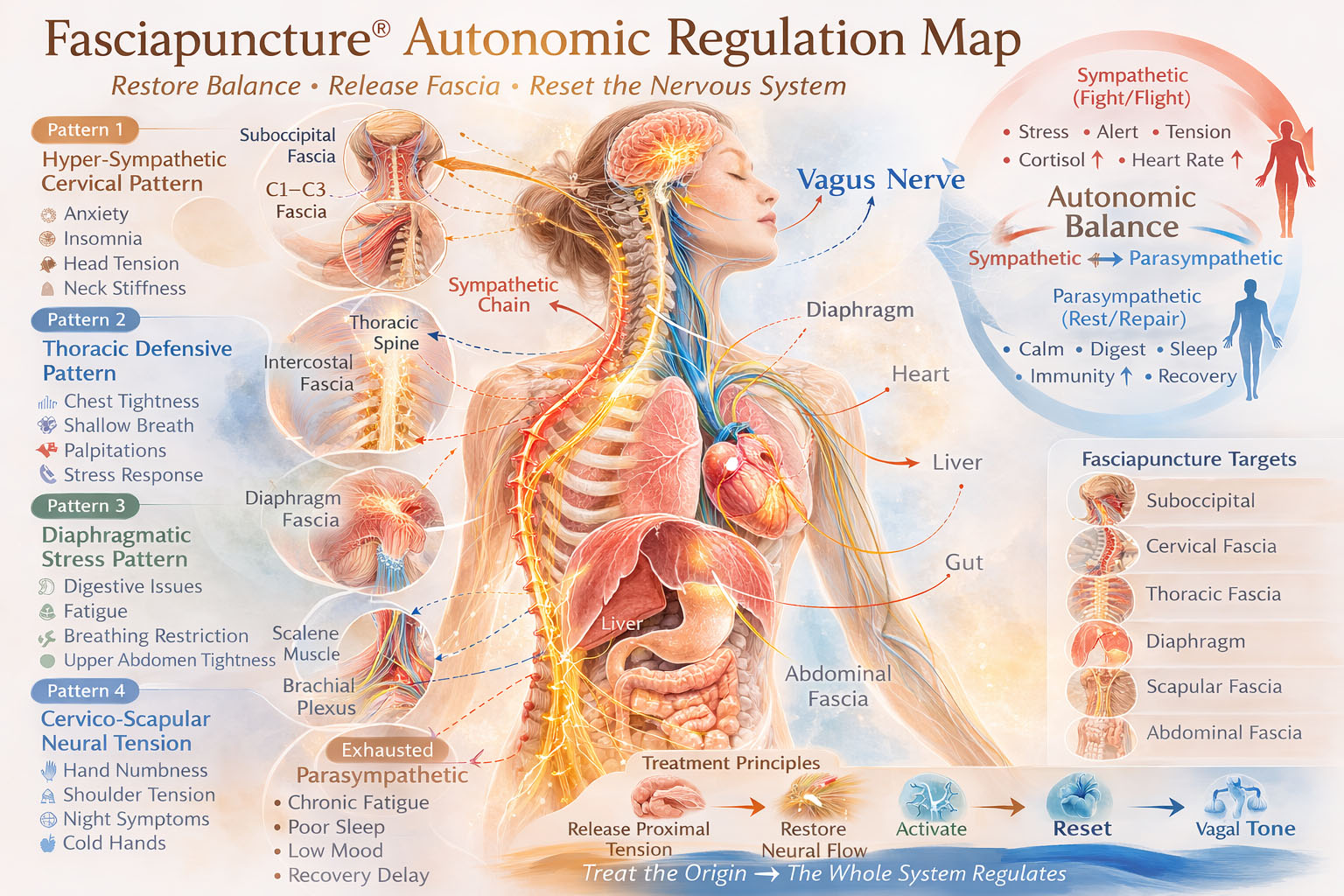
How Fasciapuncture Influences the Autonomic Nervous System
Fasciapuncture® works through the fascial network to influence the autonomic nervous system, helping restore balance between sympathetic activation and parasympathetic recovery.
Jaw Clicking and Cervical Fascia
A clinical case demonstrating how mandibular symptoms may originate from cervical fascial tension.
Read the CaseNeck-Origin Hand Numbness
Distal numbness improved after addressing proximal fascial tension in the cervical-scapular region.
Read the CaseShoulder Tension and Fascial Regulation
A case showing how functional shoulder pain responded through fascial decompression and rebalancing.
Read the CaseA Method Rooted in Fascia
Fasciapuncture® approaches fascia not as a passive structure, but as a living regulatory network.
Through fascia, the body organizes:
-
tension and release
-
protection and compensation
-
communication between regions
By accessing this system, clinical work can address the origin of dysfunction, not just its visible expression.
Bridging East and West
Fasciapuncture® bridges two clinical traditions:
-
the relational, systemic logic of classical Chinese medicine
-
contemporary understanding of fascial continuity and regulation
Rather than opposing these views, the method uses fascia as a shared clinical language through which both traditions become tangible and observable.
Not a Technique Collection
Fasciapuncture® is not defined by a list of points or protocols.
It is defined by:
-
a way of reading the body
-
a way of deciding when and where to intervene
-
a way of respecting biological limits
Technique serves reasoning — never the other way around.
Precision Over Force
Intervention in Fasciapuncture® is characterized by:
-
minimal mechanical input
-
precise access to key fascial zones
-
continuous attention to tissue response
The objective is not to dominate tissue, but to restore its capacity to adapt.
A Sequential Clinical Logic
In clinical practice, Fasciapuncture® follows a clear internal sequence:
– regulation must be established before intervention
– tension must be precisely located, not broadly addressed
– release must be compatible with the body’s capacity to integrate
– reorganization is allowed to occur without forcing or correctionThis sequence guides clinical decision-making at every stage of treatment.
A Safety-Centered Clinical Approach
Because fascia reflects the body’s regulatory state, intervention is never automatic.
Fasciapuncture® emphasizes:
-
timing
-
permission
-
restraint when regulation is compromised
Safety is not an afterthought — it is a core clinical skill.
A Method Designed to Be Taught and Transmitted
Fasciapuncture® is structured as a coherent clinical system.
Its principles can be:
-
learned progressively
-
applied safely
-
transmitted without mystification
This allows the method to support long-term clinical practice and professional maturity.
What Fasciapuncture® Is — and Is Not
Fasciapuncture® is:
-
a fascia-based acupuncture method
-
regulation-oriented rather than symptom-driven
-
designed for clarity, durability, and responsibility
Fasciapuncture® is not:
-
a quick-fix technique
-
a protocol system
-
a force-based corrective approach
From Definition to Method
Understanding what Fasciapuncture® is clarifies how it must be practiced and taught.