
When the Abdomen Finally Let Go
A 70-year-old woman with groin and sacroiliac pain, shallow breathing, and a limping gait — where old abdominal scars revealed a deeper system-wide protection pattern.
The Body No Longer Needed to Protect Itself the Same Way
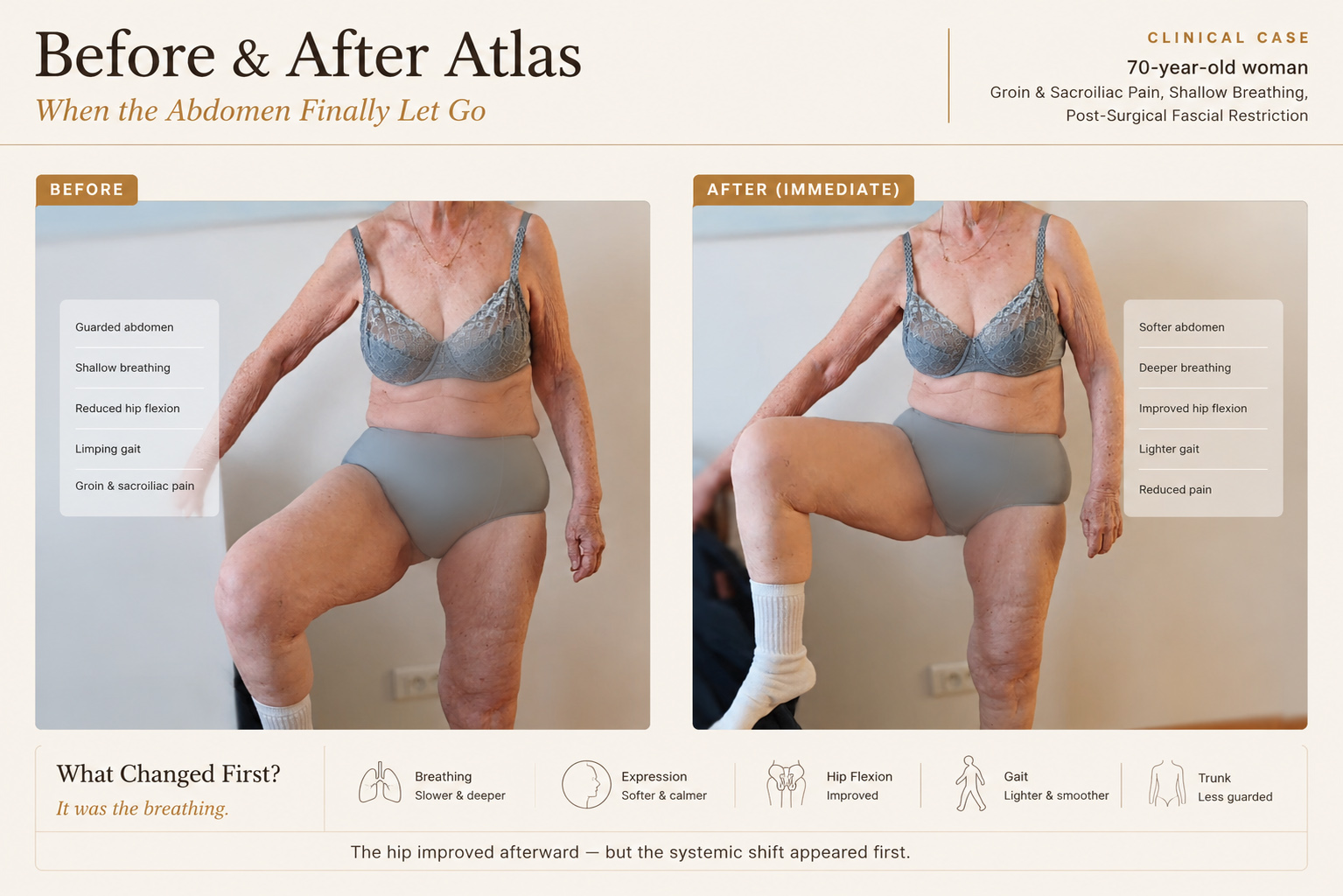
Walking comparison before and after treatment.
Immediate change after treatment — improved hip flexion, lighter gait, reduced guarding, and smoother trunk movement.
The First Change Was Not the Hip
It was the breathing.
During treatment, the patient’s breathing gradually became deeper and slower.
Her facial expression softened, the trunk appeared less guarded, and the body began to move with less internal resistance.
The hip improved afterward — but the systemic shift appeared first.
The System Was Holding a Long-Term Protective Pattern
Movement
Limping gait, reduced hip flexion, guarded trunk movement, difficulty lifting the right leg.
Breathing
Elevated shallow breathing, limited abdominal expansion, thoracic dominance.
Abdominal Findings
Deep gallbladder surgery scar, appendectomy scar, visible central tension patterns.
Clinical Observation
The body appeared organized around protection, not around efficient movement.
The Scar Was Still Holding the System
Before-and-after atlas illustrating the relationship between abdominal scar restriction, breathing adaptation, pelvic compensation, and movement recovery.
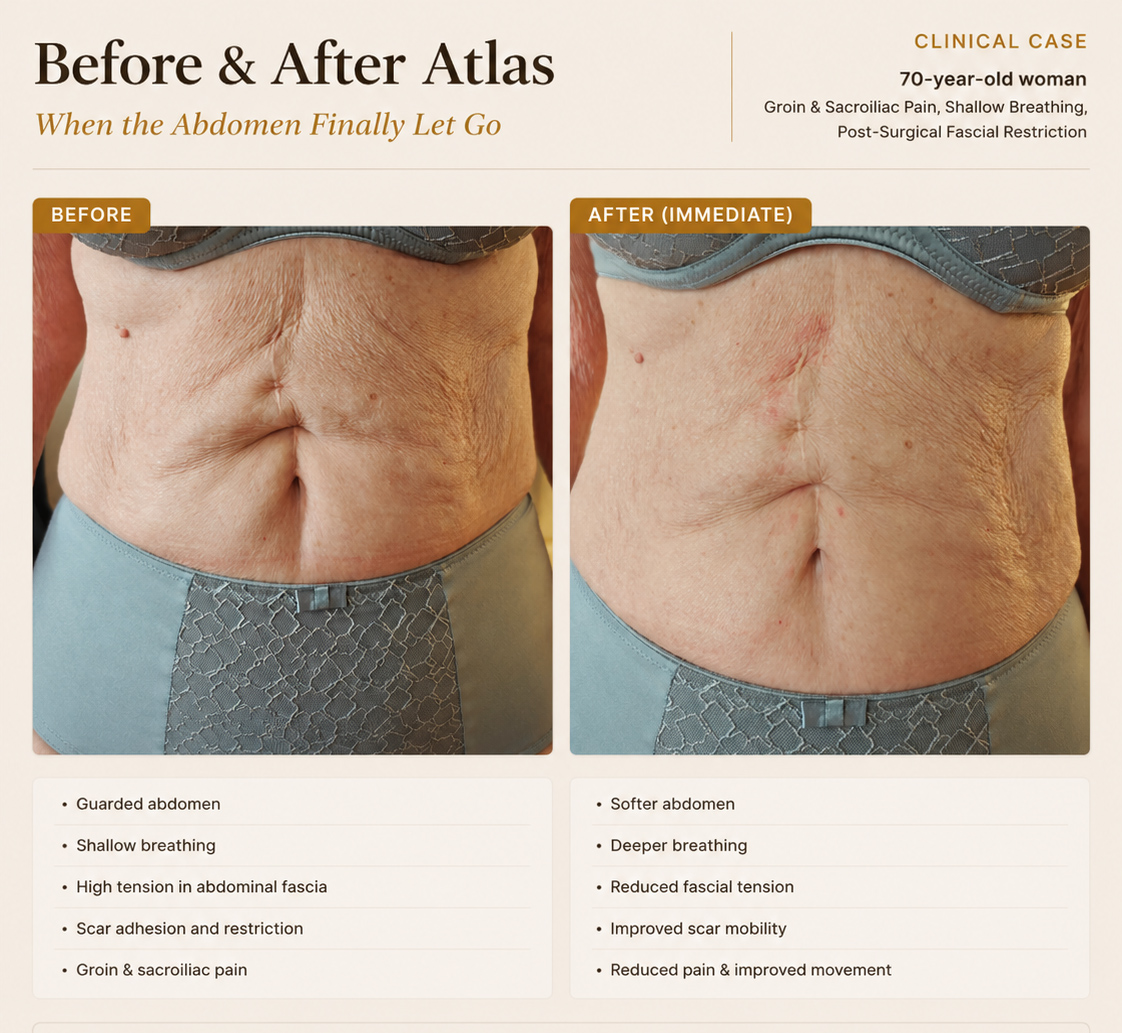
The abdominal scars were not interpreted as isolated tissue marks.
They appeared to participate in a broader protective pattern involving:
- Breathing restriction
- Anterior fascial tension
- Pelvic compensation
- Walking adaptation
- Autonomic guarding
The patient later explained that the gallbladder surgery had nearly cost her life.
In some cases, scars may continue to carry not only mechanical tension — but also a long-standing protective response.
Treatment Did Not Begin at the Hip
Abdominal scar fascial release
Anterior cervical regulation
Midline abdominal release
Breathing observation and re-test
Walking reassessment
The System Shifted Before the Symptoms Did
Pain Is Sometimes the End of the Story — Not the Beginning
This case illustrates how chronic pain and movement limitation may reflect a deeper protective strategy involving breathing, fascial tension, and post-surgical adaptation.
The painful area was not treated first.
Instead, treatment focused on restoring systemic availability.
“We do not only treat pain. We observe what the body is still protecting.”