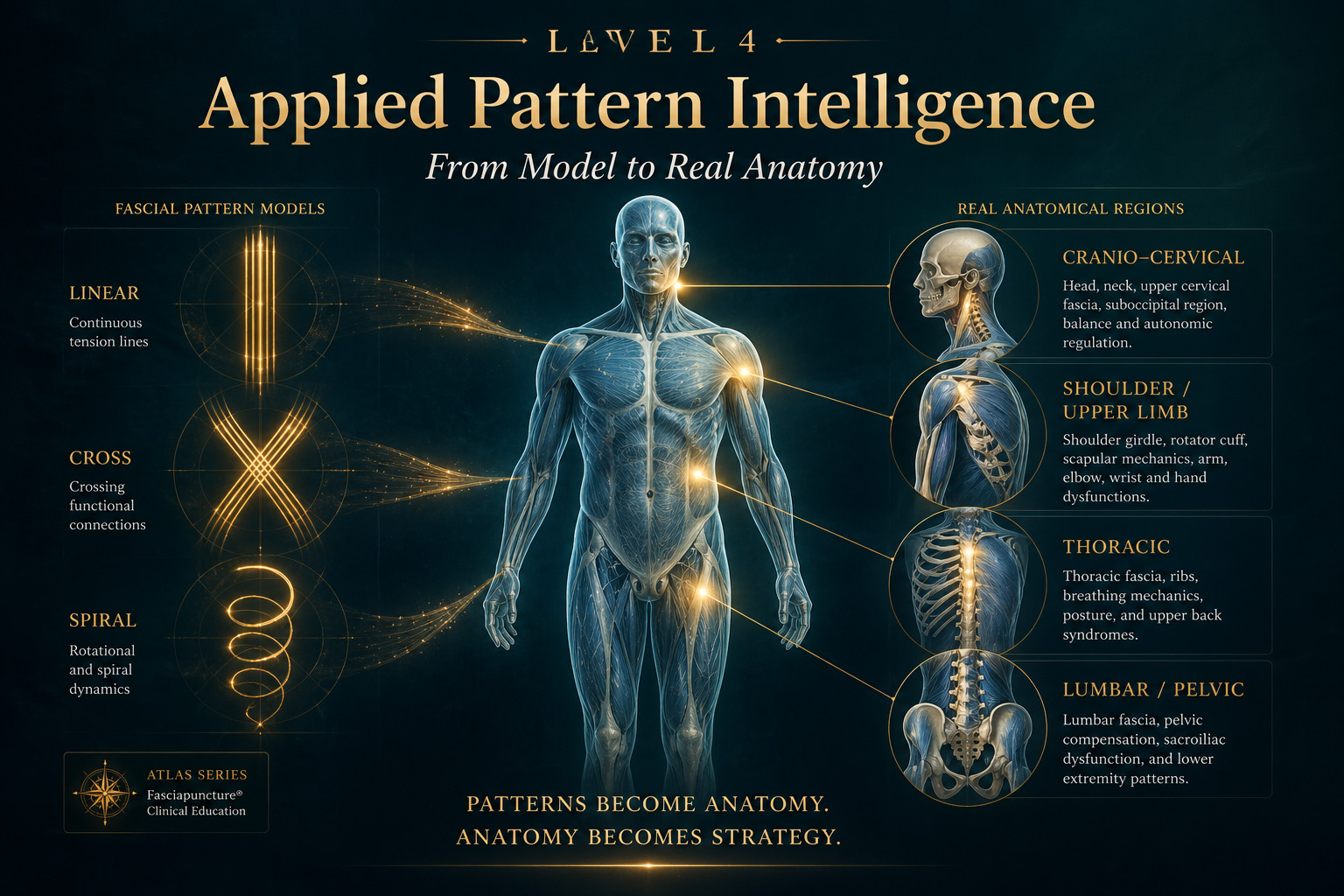
Applied Pattern Intelligence
From Model to Real Anatomy
This level is where fascial pattern models begin to meet real anatomical regions, clinical symptoms, movement restrictions, and treatment logic.
This level does not simply teach anatomy. It teaches you how anatomy behaves inside a pattern.
Access to Level 4 is part of the full clinical training program
This level is included in the complete Fasciapuncture® training curriculum. To continue into regional clinical applications, real anatomical interpretation, and applied treatment strategy, active enrollment is required.
Why applied pattern intelligence changes clinical work
In the earlier levels, the practitioner learns to observe restriction, read compensation, and recognize fascial organization.
But clinical treatment requires another step: the ability to translate a pattern into real anatomy.
This level introduces the clinical bridge:
From pattern model
to anatomical region
From movement restriction
to tissue logic
From symptom location
to entry strategy
Anatomy tells you where to enter.
How this level is structured
Regional Translation
Learning how global fascial patterns appear inside specific anatomical regions.
Neck & Cranial System
Understanding cervical-origin symptoms, headaches, dizziness, facial tension, and upper cervical regulation.
Shoulder & Upper Limb
Reading rotator cuff dysfunction, frozen shoulder, nerve entrapment, elbow and wrist patterns.
Thoracic, Lumbar & Pelvic Integration
Connecting thoracic restriction, lumbar fascia, pelvic compensation, and disc-related syndromes.
Lessons included in this level
4.1 Pattern to Region
How a global fascial pattern becomes visible in a specific anatomical area.
4.2 Neck & Cranial Regulation
Cervical tension, suboccipital fascia, dizziness, headache, facial symptoms, and autonomic reactions.
4.3 C1–C2 Clinical Intelligence
Understanding upper cervical fascial restriction and its influence on head, face, ear, and balance symptoms.
4.4 Shoulder Pattern Application
Rotator cuff, scapular mechanics, frozen shoulder, and regional fascial compensation.
4.5 Arm, Elbow & Wrist Disorders
Tennis elbow, pronator syndrome, carpal tunnel, radial tunnel, and distal symptom patterns.
4.6 Thoracic & Upper Back Syndromes
Rib restriction, rhomboid tension, breathing limitation, chest tightness, and thoracic fascial dysfunction.
4.7 Lumbar Fascia & Disc-Related Pain
Rethinking lumbar disc symptoms through soft tissue imbalance, inflammation, and fascial compensation.
4.8 Pelvic & Sacroiliac Compensation
Understanding pelvic tilt, sacroiliac dysfunction, piriformis, gluteal fascia, and chain transmission.
4.9 Regional Strategy Integration
Bringing regional anatomy, pattern intelligence, and entry point logic into one clinical reasoning map.
You are no longer asking:
Where is the pain?
You are beginning to ask:
Which anatomical region carries the pattern?
Level 4 becomes the bridge between pattern recognition and clinical treatment. The body is no longer read as isolated symptoms, but as regional expressions of a structured fascial system.
After this level, you will be able to
What comes next
Once regional anatomy becomes clear, the next question is no longer:
Which muscle hurts?
It becomes:
Where is the most intelligent entry point?
In the next level, we move from regional clinical application to advanced treatment strategy — the moment where clinical intelligence becomes precise intervention.
Unlock Level 4 — Applied Pattern Intelligence
This is one of the most important clinical thresholds in the full Fasciapuncture® training.
Because once pattern meets anatomy, treatment strategy becomes possible.