
SIGNATURE CLINICAL CASE
When the Burning Face Finally Became Quiet
A trigeminal neuralgia case where two years of electric burning facial pain, facial redness, sweating, cervical guarding, and nervous system overload gradually resolved after the hidden fascial entry point was found.
CLINICAL OPENING
Two years of burning pain had pushed the system to its limit.
A man in his seventies came to the clinic after living with severe facial pain for almost two years. One side of his head and face felt as if it were burning and being struck by electric shocks.
The pain fluctuated in intensity, but never truly disappeared. At times it became unbearable. Pain medication had helped slightly in the beginning, but over time it had become almost ineffective.
When he sat in the waiting room, his head was covered in sweat. It was autumn, and the room was not hot. When asked if he felt warm, he replied:
“It is not heat. It is the pain.”
CLINICAL ATLAS
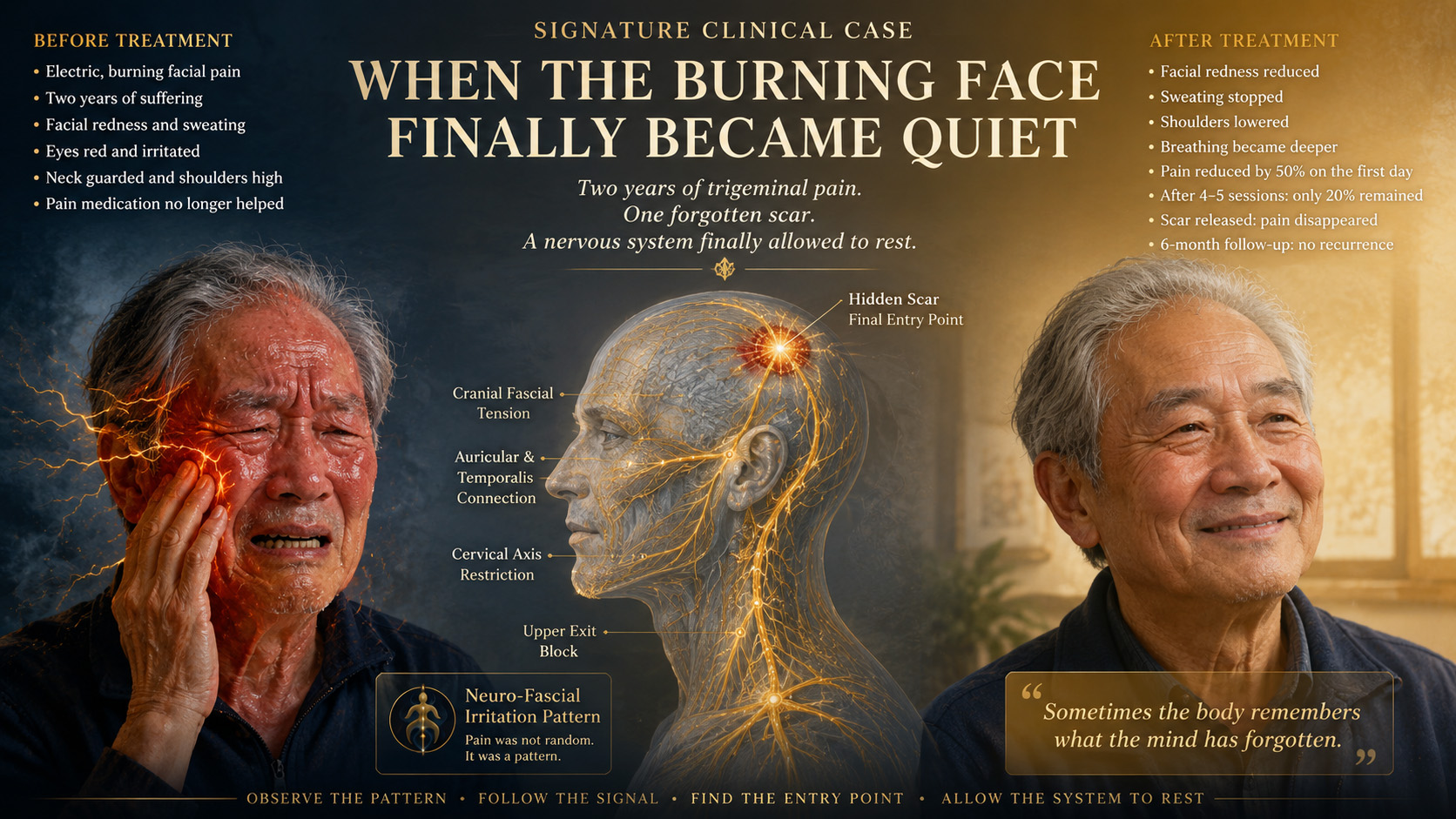
A visual summary of the case: two years of burning trigeminal pain, neuro-fascial irritation, upper exit restriction, a hidden scalp scar, and the return of a quiet nervous system.
INITIAL SYSTEM STATE
The Face Was Red, the Neck Was Guarded, and the System Was Overloaded
Main Symptoms
- Two years of severe one-sided facial pain
- Electric and burning sensations
- Intermittent flare-ups with strong intensity
- Pain medication no longer providing meaningful relief
Visible Presentation
- Face red and inflamed in appearance
- Eyes red and irritated
- Profuse sweating due to pain
- Speech trembling and effortful
Protective Posture
- Neck drawn in and guarded
- Shoulders elevated
- Breathing held high
- Whole upper system under visible tension
Clinical Reading
- Neuro-fascial irritation
- Cranial and facial hypersensitivity
- Upper exit restriction
- Autonomic overload from prolonged pain
PATTERN ATLAS
Patterns Revealed in This Case
Neuro-Fascial Irritation
The facial pain appeared as an amplified nerve-like signal within a reactive fascial field.
02Upper Exit Block
The neck and cranial outlet remained guarded, limiting the system’s ability to release pressure.
03Cranial Fascial Tension
The remaining pain followed a sensitive cranial line that eventually led to a hidden scar.
04Autonomic Dysregulation
Sweating, facial redness, trembling speech, and guarded breathing reflected systemic overload.
CLINICAL READING
The pain was not treated as a nerve problem alone.
The facial pain was understood as part of a broader neuro-fascial and autonomic state. The visible redness, sweating, neck guarding, and trembling speech suggested that the entire upper system was in a state of protection.
In Fasciapuncture®, this type of presentation is not approached only by asking where the pain is. The deeper clinical question is:
What system is amplifying the pain signal?
ENTRY STRATEGY
Treatment Did Not Begin by Chasing the Pain
THE CLINICAL TURNING POINT
The First Change Was Visible on His Face
During the first session, the facial redness visibly reduced. His shoulders descended, his breathing became deeper, and the tremor in his speech softened.
By the end of the treatment, he reported that the pain had decreased by approximately 50%. The relief was not only physical. It was visible in the whole person.
He held my hand. He was not a man of many words, but the gratitude was very clear.
WHAT BECAME VISIBLE
The Nervous System Began to Quiet
PROGRESSIVE CHANGE
After Four to Five Sessions, Only a Small Pain Remained
After four to five sessions, the pain had greatly decreased. Only about 20% of the original pain remained.
The patient described one small area on the top of the head where the pain still flashed intermittently, like a remaining spark of burning sensation.
This remaining pain became clinically important. It was no longer a large, diffuse, overwhelming facial pain. It had become a precise signal.
THE HIDDEN ENTRY POINT
The Final Entry Point Was a Small Forgotten Scar
Following the remaining pain signal carefully, a very small scar was found near the painful area on the scalp.
When asked about it, the patient said he did not know where it came from. Yet the tissue around the scar was highly sensitive on palpation.
The surrounding fascia was gently released. At that moment, the remaining pain disappeared completely.
Sometimes the body remembers what the mind has forgotten.
LONG-TERM EVOLUTION
Two Years of Suffering Came to an End
The disappearance of the remaining pain marked the end of a two-year cycle of burning facial pain and constant fear of recurrence.
Six months later, during follow-up, the patient reported that the pain had not returned.
CLINICAL REFLECTION
Trigeminal Pain May Be More Than a Nerve Problem
Trigeminal neuralgia is often described through nerve irritation and facial pain pathways. In this case, however, the clinical picture also revealed a broader system: facial redness, sweating, cervical guarding, emotional exhaustion, and a hidden scar-related fascial sensitivity.
The final resolution did not come from treating a large region more aggressively. It came from following the remaining signal precisely until the forgotten entry point appeared.
We did not only ask where the pain was. We followed what the pain was still pointing to.
CONNECTED CLINICAL MAP
Explore Related Conditions & Patterns
RELATED CASES
Other Cases in the Same Clinical Map
CONTINUE LEARNING
From Facial Pain to Neuro-Fascial Reasoning
Foundations of Fasciapuncture®
Understanding pain as system information rather than isolated tissue damage.
Module 2Clinical Assessment
Learning to follow clinical signals and identify meaningful entry points.
Module 4Head & Neck Myofascial Syndromes
Exploring cranial, cervical, facial, and neuro-fascial pain patterns.
TrainingClinical Reasoning Pathway
Learn how cases become maps for clinical decision-making.