
SIGNATURE CLINICAL CASE
When the Bladder Was Not the Beginning
A chronic cystitis case where pelvic protection, autonomic tension, and fascial regulation became more visible than the urinary symptoms themselves.
CLINICAL OPENING
The symptom was local. The pattern was not.
A 76-year-old female patient presented with a five-year history of chronic cystitis. Her condition was characterized by frequent urination, pelvic irritation, discomfort, and recurrent symptoms after stopping antibiotic treatment.
From a Fasciapuncture® perspective, this presentation was not interpreted only as a bladder issue. It suggested a broader protective state involving the pelvis, lower abdomen, lumbosacral fascia, and autonomic regulation.
The bladder was not acting alone.
INITIAL SYSTEM STATE
The System Was Holding a Long-Term Protective Pattern
Symptoms
- Frequent urination
- Pelvic irritation and discomfort
- Recurrence after stopping antibiotics
Postural Findings
- Pelvic asymmetry
- Anterior pelvic tension
- Protective posture
Tissue Findings
- Significant lumbosacral fascial density
- Restricted abdominal–pelvic mobility
- Persistent high tone in the pelvic region
General State
- Low body weight
- Hypertension
- Fragile regulatory capacity
PATTERN ATLAS
Patterns Revealed in This Case
Pelvic Protection
Persistent guarding around the pelvis and lower abdominal region.
02Abdominal Pressure
Altered pressure management influencing bladder and pelvic function.
03Autonomic Dysregulation
A body remaining in vigilance rather than recovery.
04Chronic Inflammatory Overload
Long-standing irritation maintained by regulatory dysfunction.
PELVIC PROTECTIVE ATLAS
The Pelvis Was Protecting More Than the Bladder
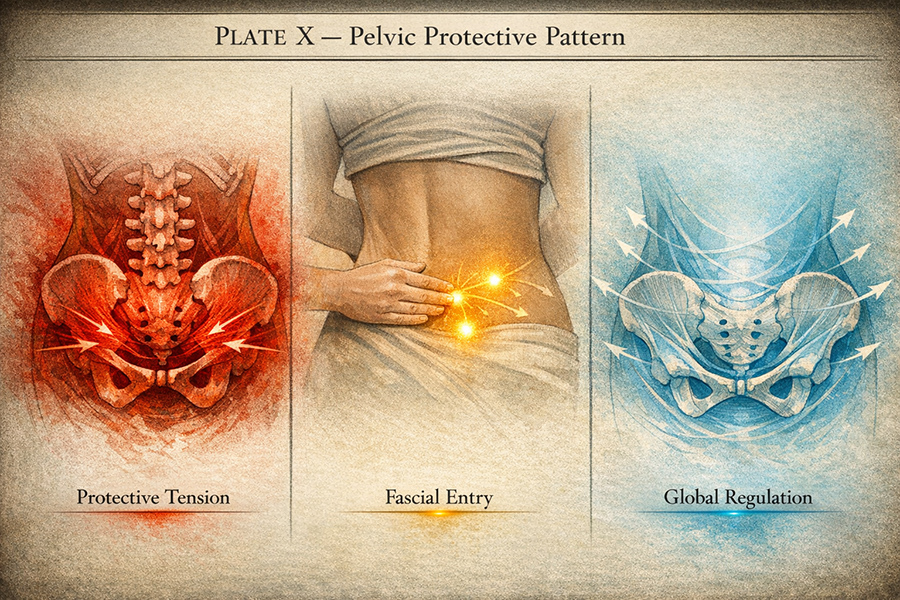
The urinary symptoms appeared within a broader protective pattern involving the pelvis, lower abdomen, breathing mechanics, and autonomic regulation.
ENTRY STRATEGY
Treatment Did Not Begin at the Bladder
THE CLINICAL TURNING POINT
The First Change Was Not the Frequency
Immediately after treatment, the patient described a sensation of release throughout the pelvic region.
The urgency diminished. The body appeared calmer. The emotional tone softened. The urinary symptoms changed afterward.
WHAT BECAME VISIBLE
The System Responded Before Resolution Was Complete
FOLLOW-UP OBSERVATION
Several Weeks Later, The Change Remained
The patient returned for a follow-up consultation several weeks after the initial session.
Most notably, the chronic cystitis had not recurred.
During a short video interview she explained:
Follow-up video: the patient describes feeling well, less stressed, and reports no recurrence of chronic cystitis symptoms.
“Je me sens bien.”
“Je suis moins stressée.”
(“I feel well.”
“I feel less stressed.”)
Beyond the absence of urinary symptoms, she described an increased sense of wellbeing, emotional ease, and internal calm.
The absence of recurrence was not interpreted only as a local bladder change.
It suggested a broader shift involving pelvic protection, autonomic regulation, and systemic recovery.
The symptom improved, but more importantly, the body appeared less protective and more available for regulation.
CLINICAL REFLECTION
The Bladder Was Not Acting Alone
This case suggests that chronic cystitis may sometimes persist within a larger protective system involving the pelvis, fascia, breathing mechanics, abdominal pressure, and autonomic regulation.
At this stage, the goal was not immediate resolution, but progressive regulation. The most important early sign was that the system remained responsive.
The follow-up response reinforced the original interpretation. The urinary symptoms were not viewed as an isolated bladder problem, but as part of a wider pelvic and autonomic protective pattern.
When that protective state began to soften, the body did not only urinate differently. It felt different.
We do not only treat the bladder. We observe what the body is still protecting.
CONNECTED CLINICAL MAP
Explore Related Conditions & Patterns
RELATED CASES
Other Cases in the Same Clinical Map
CONTINUE LEARNING
From Case Observation to Clinical Reasoning
Foundations of Fasciapuncture®
Understanding regulation before intervention.
Module 2Clinical Assessment
Reading global patterns instead of isolated symptoms.
Module 9Pelvic & Visceral Integration
Exploring pelvic protection, visceral tension, and regulatory patterns.
TrainingClinical Reasoning Pathway
Learn how cases become maps for clinical decision-making.