
The Fascial System as a Regulatory Interface
Understanding fascia beyond structure — as a sensory and regulatory system
Pain is not only a structural problem.
It is often a reflection of disrupted coordination between multiple regulatory systems.
In this lesson, we explore fascia as a key interface between structure, sensation, and autonomic regulation.
Watch the Lesson
A quiet, slow-paced explanation designed to be felt, not just understood.
Lesson Summary
Fascia is not just a structure.
It is a living interface — where movement, sensation, and regulation meet.
Within this network, mechanical changes become sensory signals,
and local events influence the entire system.
To understand fascia is to see pain differently:
not as damage, but as a disruption of coordination.
Key Ideas
These are the core principles you should retain from this lesson.
Fascia is a continuous network
Fascia connects all structures of the body into a single functional system.
Fascia is sensory
It contains mechanoreceptors that continuously inform the nervous system.
Fascia is regulatory
It influences movement, autonomic function, and perception.
Small changes, large effects
Minimal intervention in fascia can affect multiple systems simultaneously.
Fasciapuncture Atlas
This atlas plate illustrates pain as a signal of system imbalance rather than a purely local structural event. This visual model represents the core mechanism behind the lesson.
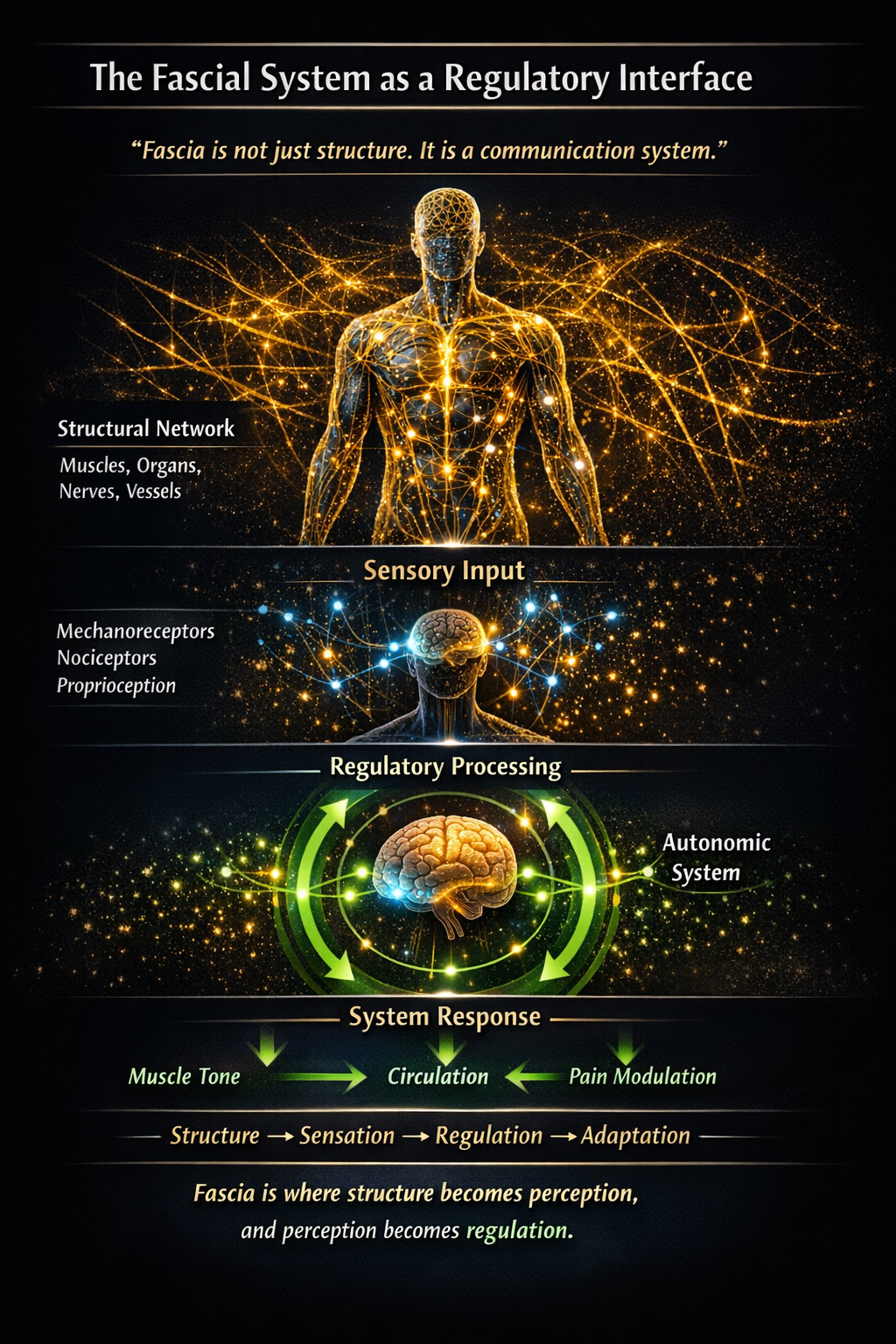
It is richly innervated and acts as a sensory interface between the body and the nervous system.
Through this interface, mechanical changes are translated into neural signals.
Clinical Insight
Pain does not always originate where it is felt.
Fascial tension alters sensory input and autonomic balance.
Symptoms may appear far from the origin.
This is why local treatment often fails.
Continue Learning
In the next lesson,
we will explore how fascial tension patterns develop and how to begin identifying them clinically.