
Module 1.4
Reading Fascial Tension in the Body
From visible posture to invisible patterns
Pain is not where the problem is.
It is where the system can no longer compensate.
Fascial dysfunction rarely appears as a single isolated problem.
What we observe clinically is not simply a painful area,
but a pattern of tension distributed across the body.
A patient may complain of low back pain,
yet the underlying dysfunction may originate from the thoracic region,
the pelvis, or even the cervical fascia.
In Fasciapuncture®, we do not begin with the pain.
We begin with the pattern.
This section introduces a practical way to read fascial tension in the body —
through posture, movement, and subtle asymmetries.
Watch the Lesson
Clinical Observation: Seeing Beyond the Pain
Lesson Summary
Reading fascial tension is a clinical skill.
It requires:
- observing without forcing interpretation
- recognizing patterns instead of isolated findings
- integrating posture, movement, and sensation
We explored:
- how tension becomes visible
- how compensation reorganizes the body
- how to begin identifying meaningful patterns
👉 The goal is not diagnosis.
👉 The goal is orientation.
Key Ideas
The body expresses tension globally
Fascial imbalance rarely stays local. It spreads through interconnected chains.
The body compensates before it fails
Before pain emerges,
the body redistributes tension to maintain function.
Fascial tension follows patterns
Tension does not stay local.
It spreads through continuous fascial chains.
Observation precedes intervention
Clinical effectiveness depends on recognizing patterns before selecting any treatment point.
Fasciapuncture Atlas –
Fascial Entry Point and System Response
This atlas illustrates how localized pain may reflect a broader distribution of fascial tension.
Red zones indicate areas of perceived pain,
while lines represent tension transmission across the fascial network.
Clinical observation focuses on identifying these patterns
rather than treating the painful area alone.
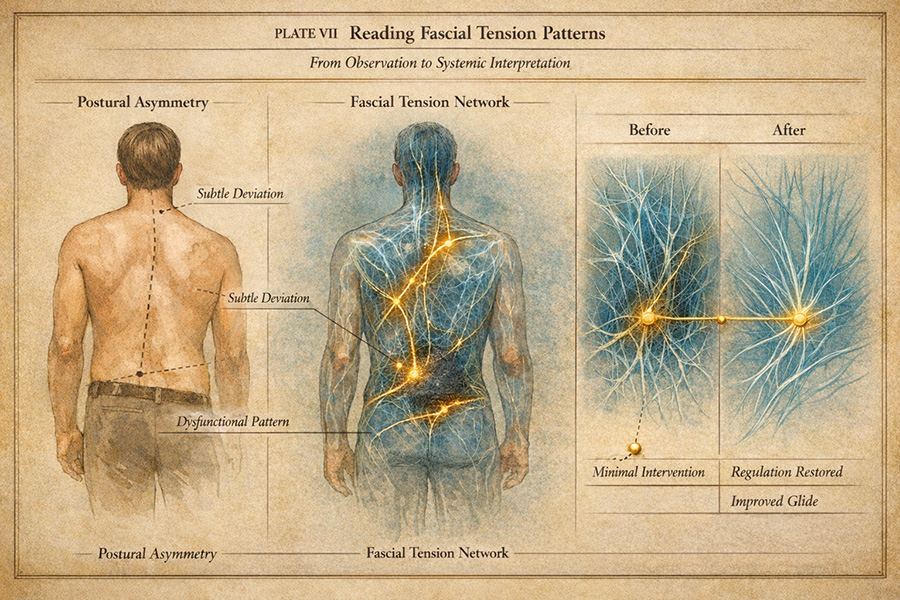
This atlas illustrates how fascial tension becomes visible through the body.
You can observe:
- asymmetrical scapular positioning
- tension lines extending across regions
- zones of densification and restriction
- compensatory adaptations in posture
👉 These patterns are not random. They reflect underlying fascial organization.
Clinical Reflection
In clinical practice, patients rarely present with a single complaint.
A patient may report:
- shoulder pain
- but display pelvic imbalance
- and restricted thoracic movement
This is not coincidence. It is pattern expression.
The clinician must ask:
👉 Where is the system adapting?
👉 Where is the system restricted?
👉 Where is the system compensating?
This shift—from symptom to pattern— marks the beginning of clinical reasoning in Fasciapuncture®.
Continue Learning
Up to this point,
we have learned how to see.
From here—
we begin to decide.
And this is where
real clinical work begins.
The next part of the course
moves into pattern recognition
and clinical decision-making.
This is where
everything changes.