
When the Body Stops Leaking
A 52-year-old woman with menopause-related sweating, poor sleep, chest tightness, abdominal surgical history, and low back discomfort — where the first clinical question was not “how to stop sweating,” but how to restore regulation.
The Body Was Not Failing. It Was Finding an Exit.
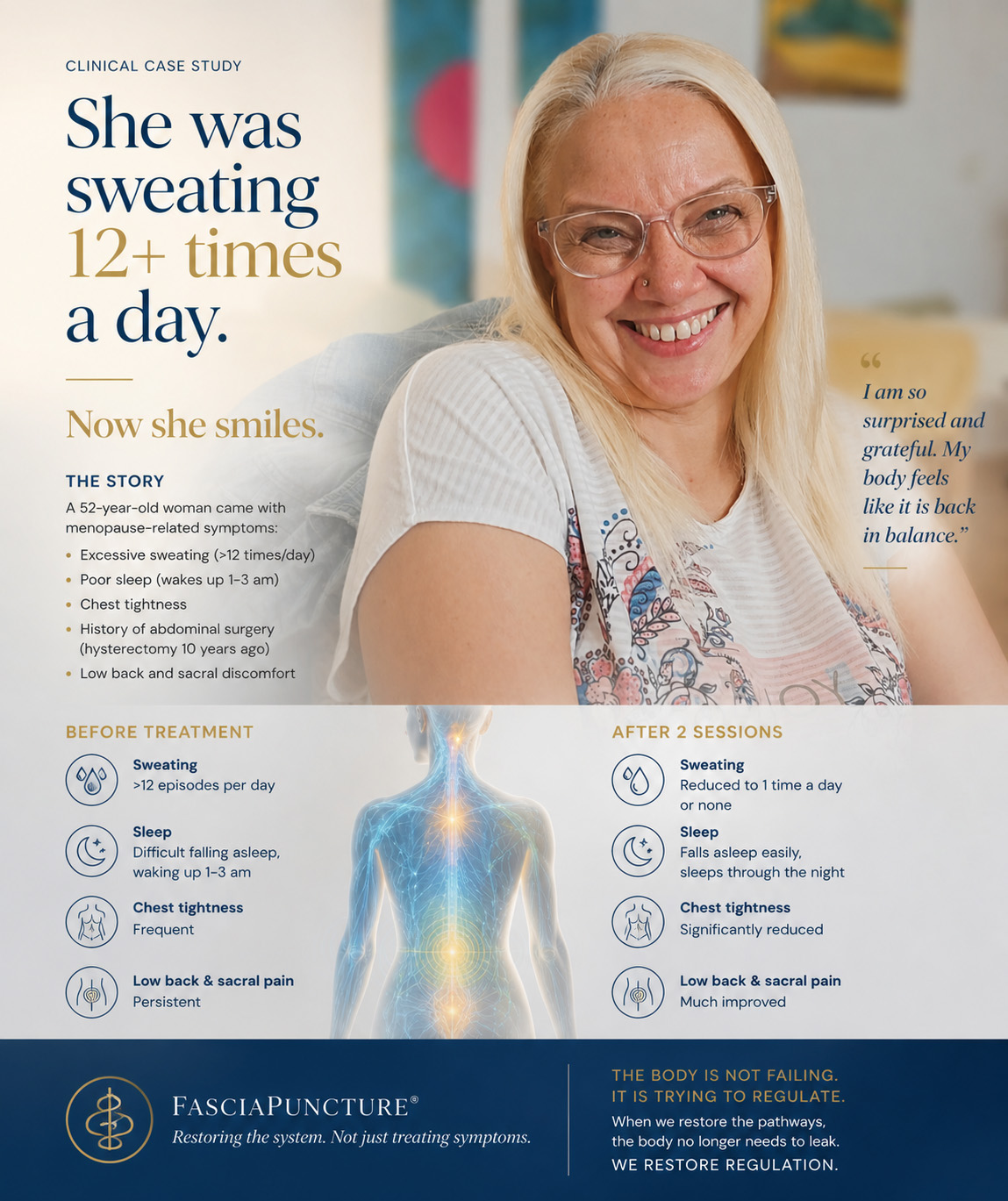
Sweating was interpreted as a possible regulatory outlet — not merely a surface symptom to suppress.
The clinical reading suggested a broader pattern involving:
- Upper thoracic outlet restriction
- Central axis tension
- Abdominal and diaphragmatic limitation
- Scar-related fascial guarding
- Autonomic dysregulation
When the deeper pathways of breathing, pressure, and fascial mobility began to recover, the body no longer needed to use sweat as its primary release mechanism.
Her Smile Said What the Body Had Already Understood
After the second session, she reported that sweating had dropped from more than twelve episodes per day to once a day, or sometimes none. The change was not only described through symptoms — it became visible in her face, her tone, and her relief.
Patient testimony shared with consent for educational and clinical training purposes.
The Problem Was Not the Sweat
It was the body trying to regulate.
The sweating appeared as a menopause-related symptom. But clinically, the body showed a broader pattern: chest tightness, sleep disturbance, abdominal tension, surgical history, and low back-sacral discomfort.
In Fasciapuncture®, the question is not only where the symptom appears. The deeper question is: what is the body still trying to release, protect, or regulate?
The System Was Caught Between Pressure and Release
Sweating
More than twelve episodes per day, experienced as repeated internal release.
Sleep
Difficulty falling asleep, with waking between 1–3 am.
Chest
Chest tightness suggesting upper outlet and breathing restriction.
Abdomen
History of abdominal surgery, with possible scar-related fascial tension.
Treatment Did Not Begin by Chasing the Symptom
Read the upper outlet restriction
Observe the breathing and chest response
Assess the abdominal and central axis tension
Respect scar-related protective memory
Re-test systemic regulation after treatment
The System Shifted Before the Story Was Fully Explained
Sweating Is Sometimes the End of the Story — Not the Beginning
This case shows how a symptom may be the final visible expression of a deeper system trying to manage pressure, tension, and internal overload.
The symptom was not treated as an isolated problem.
Instead, treatment focused on restoring systemic availability.
“We do not only treat symptoms. We observe what the body is trying to regulate.”