
Interpreting Pain: Beyond Structural Damage
How fascial tissues communicate mechanical information to the nervous system, and why this changes the way we interpret pain.
In many clinical models, pain is interpreted primarily as the direct consequence of tissue damage.
However, clinical experience repeatedly shows that symptoms frequently persist even when structural findings are minimal — or absent.
Fasciapuncture® begins from a different perspective.
Pain is not always the sign of a damaged structure.
Very often, it is the signal of a regulatory imbalance within the body’s fascial and autonomic systems.
This lesson introduces the first shift in perception that underlies the entire method.
Watch the Lesson
Lesson Summary
Pain is commonly interpreted as a problem located within a specific anatomical structure:
a muscle strain, a disc lesion, a joint degeneration.
While structural pathology certainly exists, many clinical cases reveal a different reality.
Patients may experience intense pain even when imaging shows little structural change.
Conversely, severe structural alterations may sometimes produce minimal symptoms.
This discrepancy suggests that pain cannot always be explained solely by tissue damage.
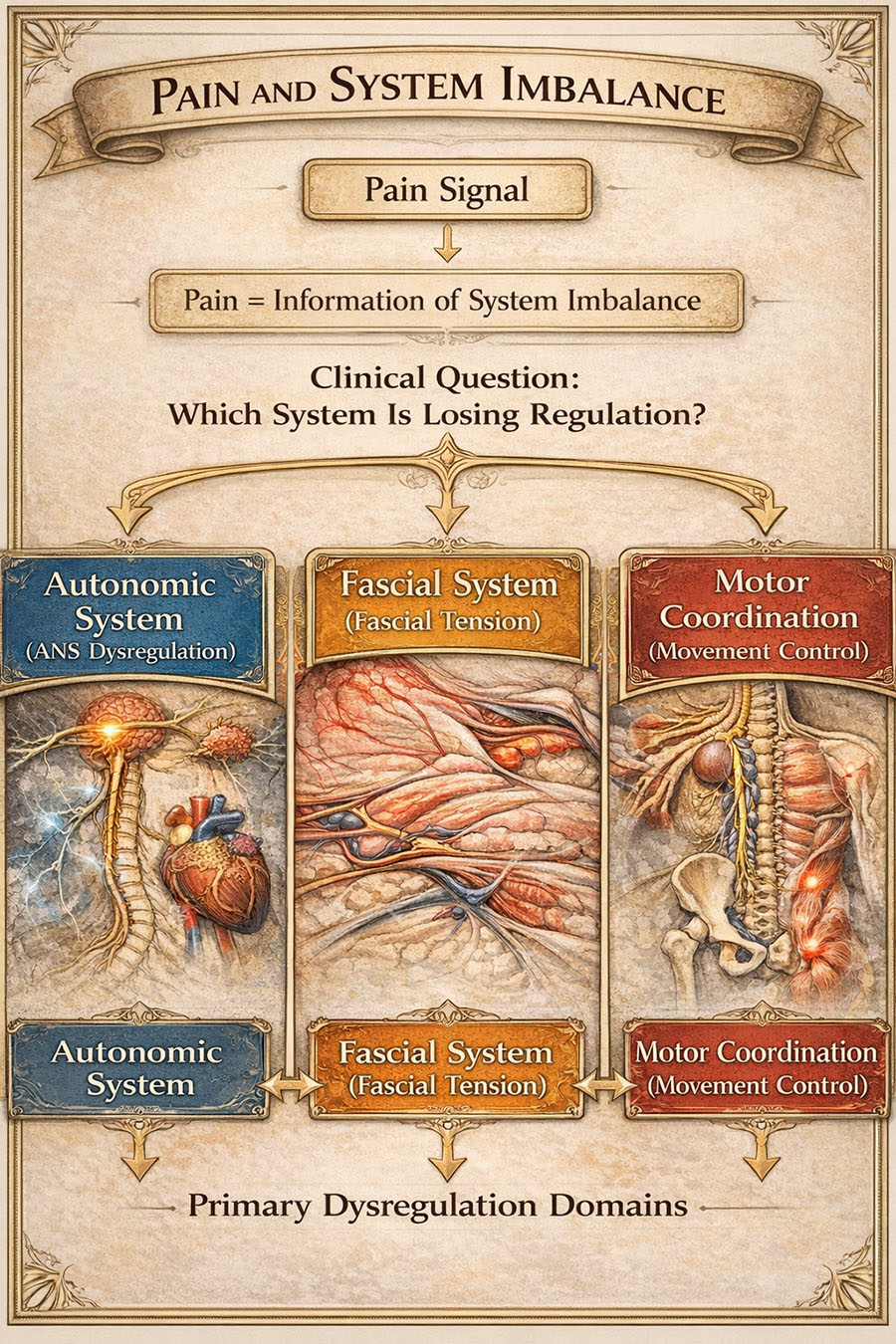
Fasciapuncture® approaches pain as a dynamic signal emerging from the interaction between fascia, mechanical tension, and autonomic regulation.
Because fascia forms a continuous sensory network throughout the body, changes in tension, pressure, or mobility can influence the nervous system and alter the perception of pain.
Understanding this broader regulatory context allows the practitioner to look beyond the immediate site of pain and begin reading the body’s global patterns of tension and imbalance.
This interpretive shift marks the true beginning of clinical reasoning in Fasciapuncture®.
Key Ideas
Pain does not always equal structural damage.
Symptoms may arise even when structural injury is minimal or absent.
Pain often reflects altered regulation rather than purely local pathology.
Fascia acts as a sensory interface.
Fascial tissues contain numerous mechanoreceptors that continuously communicate mechanical information to the nervous system.
Tension patterns matter.
Local pain may originate from distant zones of fascial tension or mechanical imbalance within the body.
Interpretation precedes intervention
Before applying any treatment technique, the practitioner must first
interpret the meaning of pain within the body’s regulatory system.
Fasciapuncture Atlas
This atlas plate illustrates pain as a signal of system imbalance rather than a purely local structural event.
Clinical Reflection
In clinical practice, the most important question is not only:
“Where does it hurt?”
but rather:
“What regulatory process is being expressed through this pain?”
When practitioners learn to interpret pain as information rather than simply as damage,
their attention naturally shifts from local intervention toward systemic observation.
This change in perspective forms the foundation of the Fasciapuncture® clinical approach.
Continue Learning
← Back to Module 1