
When the Body Stops Leaking
A real clinical case showing how excessive sweating, poor sleep, chest tightness and abdominal tension may reflect a deeper regulation pattern.
Explore the Clinical Reasoning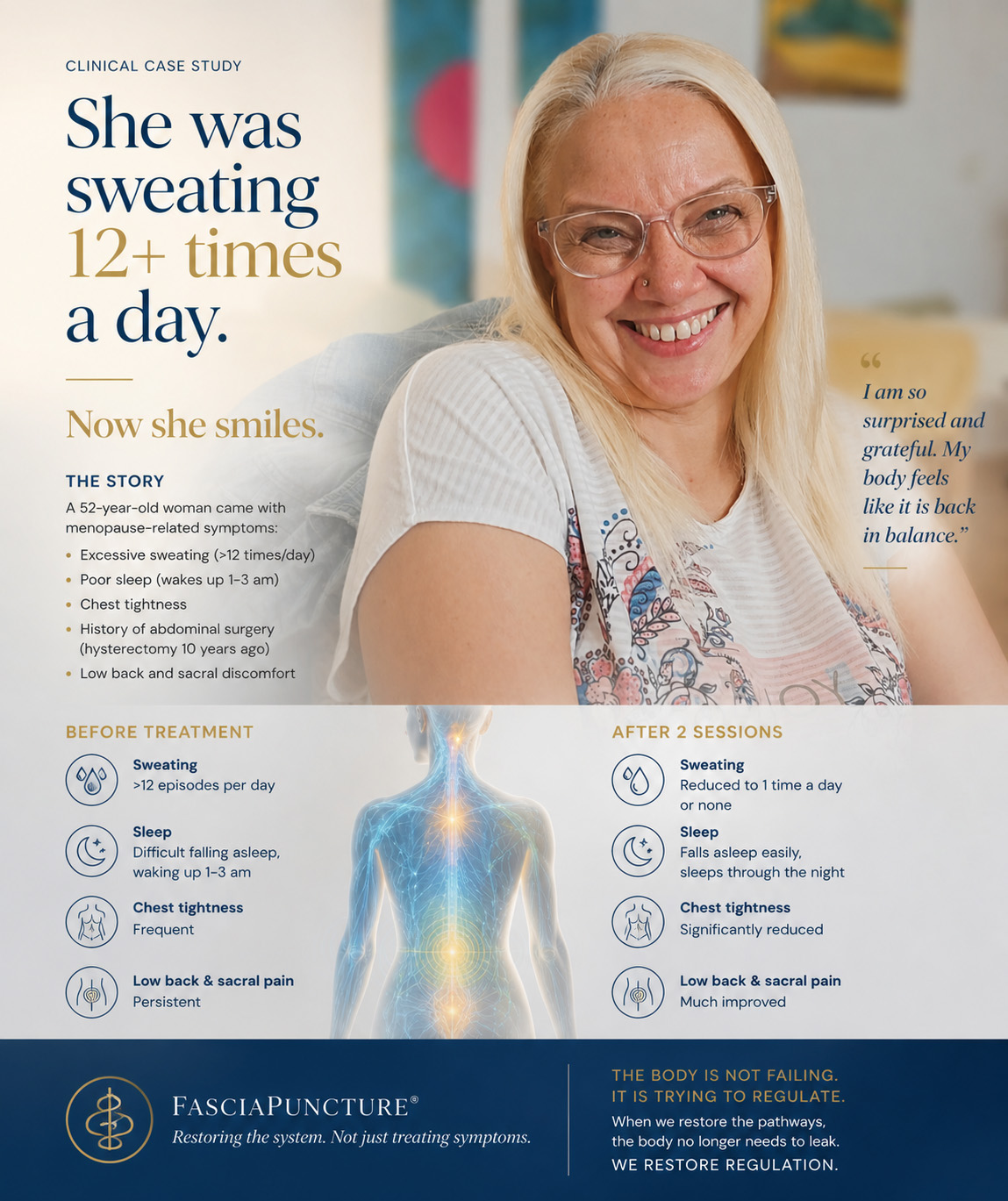
Sweating was not the problem.
What appeared as a menopause-related symptom was read as a system that had lost its capacity to regulate pressure, tension and internal rhythm.
A 52-year-old woman with daily sweating episodes
She came with frequent sweating episodes, difficulty falling asleep, waking between 1–3 am, chest tightness, low back and sacral discomfort, and a history of abdominal surgery.
After the second session, she reported that sweating had reduced from more than twelve episodes per day to once a day, or sometimes none.
Initial Presentation
- Excessive sweating, more than 12 episodes per day
- Poor sleep and waking between 1–3 am
- Chest tightness
- History of abdominal surgery
- Low back and sacral discomfort
In Fasciapuncture®, we do not begin by chasing the symptom. We observe how the whole system organizes tension, pressure and compensation.
What We Read
- Upper thoracic outlet restriction
- Central axis tension
- Abdominal and diaphragmatic limitation
- Possible scar-related fascial restriction
- Autonomic dysregulation pattern
From symptom to system
The clinical focus was not to suppress sweating, but to restore the pathways through which the body could regulate itself.
When the system regained space and fluidity, the body no longer needed to use sweating as a repeated release mechanism.
The change after two sessions
12+ episodes/day
Frequent sweating, poor sleep, chest tightness and low back discomfort.
1 or none
Sweating reduced dramatically, symptoms eased, and the patient felt surprised and relieved.
Clinical change is visible in the face.
Beyond symptom reduction, her expression changed. Her smile, her eyes, and the softness of her face reflected something deeper: a return to regulation.
In training, this becomes an essential lesson: we do not only measure pain. We observe how the person returns into their body.
We do not treat symptoms. We restore regulation.
This case is part of the Fasciapuncture® clinical reasoning framework: reading patterns, identifying entry points, observing systemic response, and verifying change through function, expression and regulation.
Learn to read the system behind the symptom.
This clinical case belongs to the Fasciapuncture® training pathway, where practitioners learn to move from local symptoms to global pattern recognition.
Explore the Training Program