
Curriculum
A structured and progressive clinical path
The Fasciapuncture® curriculum is designed as a progressive clinical pathway.
It begins with the interpretation of pain and fascial regulation, then moves through assessment, mechanism, regional application, and clinical integration.
Each stage develops not only technical knowledge, but also clinical perception, therapeutic restraint, and decision-making.
Complete Clinical Training Framework
This training framework shows how the curriculum progresses
from foundational understanding to regional application and clinical reasoning.
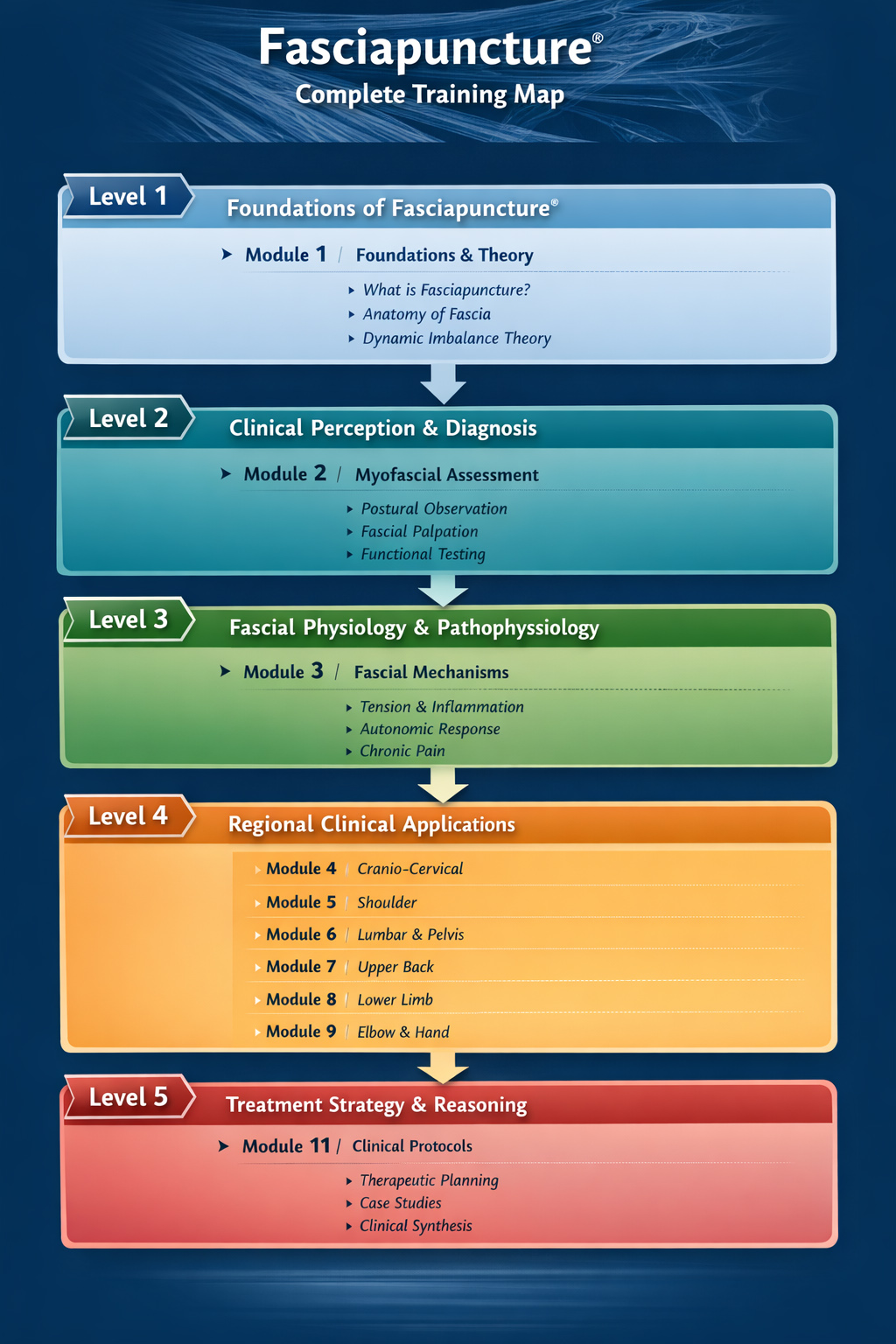
Level 1
Clinical Foundations
Understanding pain, fascia, and regulation
Focus: pain interpretation, fascia theory, regulatory thinking
Level 1 establishes the conceptual foundations of Fasciapuncture®.
Students learn to interpret pain beyond structural damage, understand fascia as a sensory and regulatory system, and recognize the principles of dynamic imbalance, minimal intervention, and therapeutic safety.
This level builds the clinical operating system of the method.
Level 2
Clinical Perception & Diagnosis
Learning to read the body before intervention
Focus: observation, palpation, functional reading, decision before treatment
Level 2 develops clinical perception.
Students learn how to observe posture, read fascial tension, palpate key zones, and interpret movement restrictions before considering intervention.
Assessment is treated as an active clinical phase rather than a preliminary formality.
Level 3
Fascial Physiology & Mechanisms
Understanding how dysfunction becomes pain
Focus: biomechanics, autonomic response, chronic pain mechanisms
Level 3 deepens the mechanistic understanding of pain and fascial dysfunction.
Students explore glide restriction, inflammation, autonomic involvement, sensory amplification, fibrosis, and chronic pain patterns.
This level explains why fascial intervention can produce both local and systemic clinical effects.
Level 4
Regional Clinical Applications
Applying the model to real anatomical regions
Focus: regional anatomy, fascial syndromes, applied reasoning
Level 4 brings the method into regional clinical practice.
Students learn to apply fascial reasoning to the cranio-cervical region, shoulder, upper limb, thorax, lumbar-sacral region, pelvis, and lower limb.
Each module links symptoms, movement patterns, palpation findings, and treatment logic within a specific anatomical territory.
Level 5
Clinical Integration
From technique to clinical judgment
Focus: planning, sequencing, case reasoning, restraint
Level 5 is the stage of integration.
Students learn how to plan treatment, prioritize findings, sequence interventions, follow clinical evolution, and decide when not to treat.
This level transforms technical knowledge into therapeutic judgment.
What You Develop Through the Curriculum
You begin by learning how to understand pain differently.
You then learn how to observe the body and read fascial patterns.
You develop a deeper understanding of the physiological and sensory mechanisms behind dysfunction.
You apply this knowledge region by region through structured clinical modules.
Finally, you learn to think, choose, and intervene with greater precision and responsibility.
Why this curriculum is different
This is not a technique-first curriculum.
It is a clinical reasoning pathway built around fascia, regulation, and perception.
Rather than accumulating isolated methods, students progressively develop a way of seeing pain, reading the body, and choosing intervention with greater precision.
The emphasis is not only on where to treat, but on how to think before treatment begins.