
Reading Fascial Tension in the Body
Learning to see what the body is already expressing
how to observe fascial tension
In previous lessons, we explored how fascial tension forms and how dysfunction emerges.
Now we take the next step:
👉 Learning how to observe it.
Fascial tension is not abstract.
It manifests through:
- asymmetry
- restriction
- altered rhythm
- and subtle compensations
These signs are always present— but they require a different way of looking.
This lesson introduces the foundations of fascial pattern reading in clinical practice.
Watch the Lesson
A quiet, slow-paced explanation designed to be felt, not just understood.
Lesson Summary
Key Ideas
These are the core principles you should retain from this lesson.
The body expresses tension globally
Fascial imbalance rarely stays local. It spreads through interconnected chains.
Posture is a reflection, not a cause
What we see is often the result of deeper fascial adaptation.
Compensation creates new patterns
The body reorganizes itself to maintain function, even when inefficient.
Observation precedes intervention
Without proper reading, treatment becomes guesswork.
Fasciapuncture Atlas
Fascial Tension Distribution and Transmission
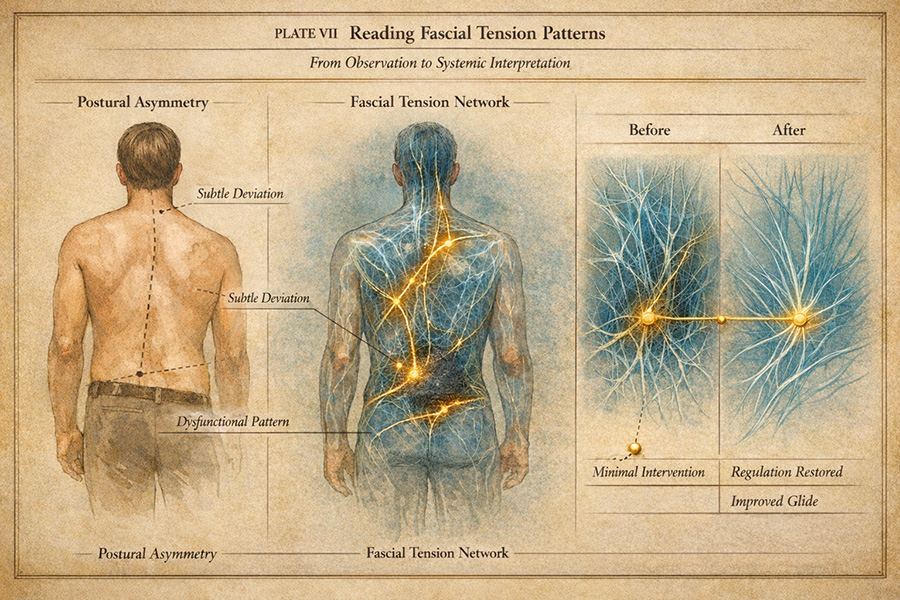
This atlas illustrates how fascial tension becomes visible through the body.
You can observe:
- asymmetrical scapular positioning
- tension lines extending across regions
- zones of densification and restriction
- compensatory adaptations in posture
👉 These patterns are not random. They reflect underlying fascial organization.
Clinical Insight
In clinical practice, patients rarely present with a single complaint.
A patient may report:
- shoulder pain
- but display pelvic imbalance
- and restricted thoracic movement
This is not coincidence. It is pattern expression.
The clinician must ask:
👉 Where is the system adapting?
👉 Where is the system restricted?
👉 Where is the system compensating?
This shift—from symptom to pattern— marks the beginning of clinical reasoning in Fasciapuncture®.
This is where everything changes.
← Back to Module 1The first lessons are open. Beyond this point, the training moves into pattern recognition, clinical reasoning, and precise intervention logic.